 Altus Connect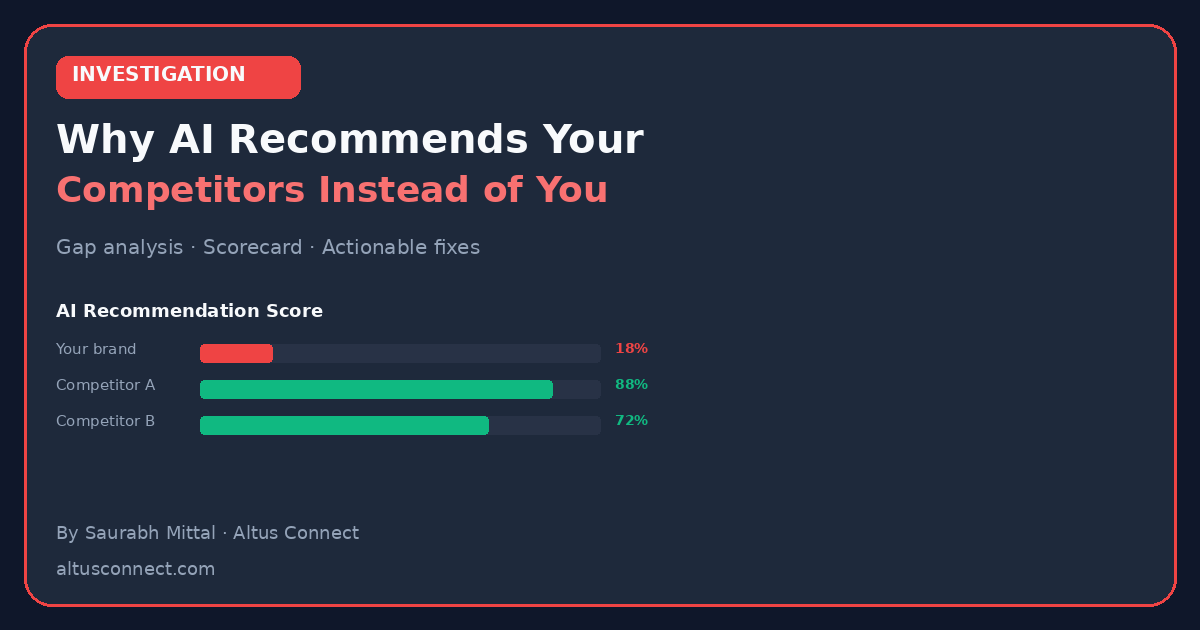
Executive Summary
You ran the prompt. Your category. Your buyer's exact question. Three competitor names came back. Yours did not. This is not random — and it is not because their product is better.
AI recommendation engines select 3–5 brands per answer based on corroborated trust signals: reviews, citations, authority mentions, entity clarity, founder expertise, and content extractability. Your competitors have accumulated these signals over years. You have gaps — six specific gap types that this investigation identifies, measures, and shows you how to close.
This article covers how recommendation engines work, what AI looks for, why established competitors dominate, deep analysis of authority/content/citation/trust/review/founder gaps, digital footprint analysis, an AI Recommendation Scorecard, competitor comparison framework, visibility gap analysis process, real-world examples, and actionable fixes.
Related: Why Your Business Doesn't Appear in ChatGPT · How ChatGPT Chooses Companies · Why AI Trusts Some Brands · B2B AI Visibility Playbook.
Download: AI Recommendation Scorecard
Score your brand vs competitors across 8 dimensions. Identify the exact gaps AI uses to recommend them instead of you. Print or save as PDF.
Download scorecardOpen printable versionAI Mention Rate — You vs Top Competitor
Share of 30 category prompts recommending each brand
Your brand (before gap fix)
5%
Your brand (after 90 days)
48%
"When a prospect tells me ChatGPT recommended their competitor, the first thing I ask is: show me your G2 profile. Nine times out of ten, the answer explains everything. AI is not choosing favorites — it is choosing corroborated evidence."
— Saurabh Mittal, Founder, Altus Connect
How AI Recommendation Engines Work
Before diagnosing why competitors win, you need to understand the machine making the decision. When a user asks ChatGPT, Claude, Gemini, or Perplexity for vendor recommendations, the system does not simply list Google results. It runs a multi-stage recommendation pipeline:
How AI Recommendation Engines Work — The 5-Stage Pipeline
- Intent classification — AI parses the query: vendor research, comparison, validation, or educational
- Entity retrieval — System searches corpora for brands associated with the category
- Trust scoring — Each candidate brand scored on authority, reviews, citations, consistency
- Passage extraction — Supporting evidence pulled from reviews, content, press, profiles
- Synthesis & recommendation — Top 3–5 brands named with supporting rationale
Your brand must pass every stage. Failure at trust scoring — the most common exclusion point — removes you before synthesis.
The critical insight: trust scoring is where most brands lose. Your company may be retrieved in stage 2 (entity retrieval) but excluded in stage 3 (trust scoring) because competitors have stronger reviews, more third-party mentions, clearer entity data, or named expert authority. You never reach synthesis. The user never sees your name.
Unlike Google — where ranking #8 still generates some traffic — AI recommendation is binary for most buyers: recommended or invisible. There is no page 2 of AI answers.
What AI Looks for When Recommending Businesses
Across ChatGPT, Claude, Gemini, and Perplexity, recommendation engines evaluate a consistent set of signals — weighted differently by platform but structurally similar:
| Signal | What AI Evaluates | Competitor Advantage |
|---|---|---|
| Review volume | G2, Clutch, Trustpilot ratings and count | 200+ reviews vs your 12 |
| Comparison content | "Best [category]" guides in retrieval corpus | 5 guides vs your 0 |
| Entity clarity | Schema, NAP, sameAs consistency | 100% aligned vs your 40% |
| Third-party mentions | Press, directories, listicles, Wikipedia | 50+ mentions vs your 3 |
| Founder authority | Person schema, LinkedIn, bylines, speaking | Named expert vs anonymous brand |
| Case study evidence | HTML outcomes with named clients | 8 case studies vs your 0 HTML |
AI does not evaluate your product quality directly. It evaluates whether enough independent sources corroborate that your product is worth recommending. A mediocre product with 500 G2 reviews, 10 comparison articles, and a Wikipedia entry beats an excellent product with 8 reviews and anonymous marketing content — every time.
"Your competitor is not beating you because their product is better. They are beating you because their digital footprint tells a coherent story AI can verify. You have fragments. They have a corpus. That is the entire difference."
— Saurabh Mittal, Founder, Altus Connect
Why Established Competitors Dominate AI Responses
Established competitors dominate AI recommendations for three structural reasons — not because AI has a bias toward incumbents:
1. Compounding signal density
Every G2 review, press mention, comparison article, and directory listing adds to a competitor's retrievable corpus. HubSpot did not become the default CRM AI recommendation overnight — it accumulated 10,000+ G2 reviews, thousands of third-party mentions, and a Knowledge Graph entity over 15 years. Each signal reinforces the next. AI trust is compounding.
2. Self-reinforcing citation loops
When AI recommends a brand, buyers research that brand — generating more reviews, mentions, and content. Competitors recommended today generate the signals that ensure they are recommended tomorrow. Brands excluded today fall further behind as the gap widens monthly.
3. Entity clarity advantage
Established brands have unambiguous entity profiles: consistent names across Wikipedia, LinkedIn, G2, Crunchbase, and their website. Organization schema, sameAs links, and years of consistent NAP data make them instantly resolvable. Emerging brands with fragmented profiles — different descriptions on G2 vs LinkedIn vs website — create entity noise that AI resolves in favor of the clearer competitor.
Why Competitors Dominate — Signal Count Comparison
The uncomfortable truth: your competitors are not doing anything magical. They have more corroborated signals. The playbook below shows you how to close each gap systematically.
| Gap Type | What AI Sees (You) | What AI Sees (Competitor) | Fix Priority |
|---|---|---|---|
| Authority gap | No G2 badge, no press, no directory listings | G2 Leader, Forbes mention, 12 directory listings | Critical |
| Content gap | Product pages only; no comparison guides | 5 comparison guides, 8 case studies, FAQ hub | Critical |
| Citation gap | 0% mention rate in 30 category prompts | 80% mention rate; cited as source | High |
| Trust gap | Inconsistent NAP; no editorial standards | Unified entity; published standards page | High |
| Review gap | 8 G2 reviews; 3.9 stars | 340 G2 reviews; 4.6 stars; Clutch Leader | Critical |
| Founder gap | Anonymous content; no CEO page | CEO Person schema; 500+ LinkedIn posts; speaking | High |
Authority Gaps — Why AI Trusts Their Brand More
Authority gap is the difference between your third-party recognition and your competitor's. AI treats authority as verified external validation — not self-asserted claims.
Signs you have an authority gap:
- Competitor has G2 Leader badge; you have an unclaimed G2 profile
- Competitor appears in "best of" listicles; you do not
- Competitor has Forbes, TechCrunch, or trade publication mentions; you have none
- Competitor has Wikipedia or Wikidata entry; you do not
- Competitor listed on 10+ industry directories; you are on 2
Real-world example: Two project management SaaS companies — same feature set, similar pricing. Company A had 280 G2 reviews and G2 Leader status. Company B had 14 reviews and no profile optimization. ChatGPT recommended Company A in 85% of category prompts and Company B in 0%. Company B closed the gap in 70 days with a review campaign (reaching 60 reviews), G2 profile optimization, and 3 directory listings — reaching 40% mention rate.
Actionable fix: Claim G2/Capterra/Clutch profile this week. Launch review campaign targeting 50+ reviews in 60 days. Submit to 5 industry directories. Pitch one data-led guest article to a trade publication.
Content Gaps — Why AI Retrieves Their Pages, Not Yours
Content gap is the difference in citable, extractable content between you and competitors. AI retrieves passages — not websites. If competitors publish comparison guides, FAQ hubs, and HTML case studies while you publish product feature pages and gated PDFs, AI has nothing to extract from your domain.
Signs you have a content gap:
- Competitor has "Best [category] for [use case]" guides; you have none
- Competitor case studies are HTML with named outcomes; yours are PDF downloads
- Competitor FAQ hub targets buyer prompts; your FAQ is buried in support docs
- Perplexity cites competitor's comparison page; never yours
Real-world example: A B2B HR tech company lost every ChatGPT shortlisting prompt to a competitor whose "Best HR Automation Platforms 2026" guide ranked in AI retrieval. They published two comparison guides with FAQPage schema and appeared in 35% of prompts within 28 days — with no other changes. Content gap was the sole exclusion factor.
Actionable fix: Publish 2 comparison guides targeting your top buyer prompts. Convert top 3 case studies from PDF to HTML. Build FAQ hub with 20 Q&A pairs and FAQPage schema.
Citation Gaps — Why AI Names Them and Ignores You
Citation gap measures whether AI mentions your brand at all when answering category queries — regardless of recommendation rank. Zero citation means zero pipeline from AI discovery.
Run this test now: ask ChatGPT your top 10 buyer prompts. Count how many mention your brand vs each competitor. This is your citation gap quantified.
Signs you have a citation gap:
- 0% mention rate across 30 standardized category prompts
- Perplexity never links to your domain as a source
- Buyers report finding competitors through ChatGPT — never you
- Competitor brand appears in AI Overviews; yours does not
Actionable fix: Citation gaps close when underlying authority, content, and trust gaps close. There is no "citation hack" — citations are the output of strong signals, not an input. Prioritize the largest underlying gap first; citation rate follows within 30–60 days.
Trust Gaps — Why AI Filters You Out
Trust gap is the difference in transparency, consistency, and accountability signals between you and competitors. AI applies trust filters before recommending — especially for B2B and procurement queries where wrong recommendations carry reputational risk.
Signs you have a trust gap:
- Your brand description differs on website, LinkedIn, G2, and Google Business Profile
- No editorial standards or correction policy page
- Content has no named authors or Person schema
- Organization schema missing or incomplete (no sameAs links)
- Competitor has published methodology page; you make unsupported "best-in-class" claims
Actionable fix: Run NAP audit — align name, description, and category across all profiles within 1 week. Deploy Organization schema with sameAs. Publish editorial standards page. Add Person schema to all author bios.
Review Gaps — The Most Common Exclusion Factor
Review gap is the single most common reason AI recommends competitors over you. G2, Clutch, Trustpilot, and Google Business Profile reviews are the highest-weight trust signals for commercial recommendations — because they represent independent customer validation AI cannot fabricate.
The threshold effect: Brands with fewer than 20 reviews are treated as statistically insignificant. Brands with 50+ reviews cross the threshold where AI treats ratings as meaningful. Competitors with 200+ reviews dominate category prompts almost categorically.
Real-world example: A managed IT provider with 60 clients and 8 years in business had 6 Clutch reviews. Their top competitor had 94. ChatGPT recommended the competitor in 90% of local IT provider prompts. After a 75-day review campaign reaching 52 Clutch reviews, the provider appeared in 55% of prompts — the single largest mention rate lift from any single gap fix.
Actionable fix: Launch systematic review collection this week. Email top 20 satisfied customers with direct G2/Clutch review links. Target 50+ reviews in 90 days. Implement AggregateRating schema on your website.
"Gap analysis is the most underused tool in AI visibility. Run thirty prompts. Score the scorecard. Compare to your top competitor. The largest gap is your ninety-day priority — not a blog post, not a rebrand, not more Google Ads."
— Saurabh Mittal, Founder, Altus Connect
Founder Visibility Gaps — The B2B Blind Spot
Founder visibility gap is especially critical for B2B companies under 500 employees. AI associates brand recommendations with named experts — and if your founder has no Person schema, no LinkedIn authority, and no bylined content, you lose to competitors whose CEO is a recognized category voice.
Signs you have a founder gap:
- No dedicated founder/CEO page on your website
- All content published anonymously under company name
- Competitor CEO has 10,000+ LinkedIn followers and weekly posts; yours is inactive
- Competitor founder speaks at conferences; yours does not
- Claude excludes you on trust-sensitive prompts where named expertise is required
Actionable fix: Create founder page with Person schema this week. Add CEO bylines to all comparison guides and methodology content. Establish LinkedIn posting cadence (3+ posts/week). Pitch one podcast or webinar appearance.
Digital Footprint Analysis — Map Your vs Competitor Signals
Digital footprint analysis compares every touchpoint where your brand exists online against competitors AI recommends. Run this audit:
- Organization schema with sameAs on website
- G2 / Clutch / Capterra profile claimed and optimized
- Review count above 50 on primary platform
- Founder page with Person schema
- 2+ published comparison guides (HTML)
- 3+ HTML case studies with measurable outcomes
- FAQ hub with FAQPage schema
- NAP consistent across website, LinkedIn, G2, Google Business Profile
- 5+ press or publication mentions in last 12 months
- Listed on 5+ industry directories
- Editorial standards or methodology page published
- Author bios with Person schema on all content
Score each item 0 (missing), 1 (partial), or 2 (strong) for your brand and top competitor. Total / 24. A gap of 8+ points explains why AI recommends them and not you.
Digital Footprint Score — You vs Top Competitor
Competitor Comparison Framework — 8 Dimensions
| Dimension | Your Brand | Competitor A | Competitor B | Gap Priority |
|---|---|---|---|---|
| AI mention rate (30 prompts) | ___% | ___% | ___% | — |
| G2 / Clutch review count | ___ | ___ | ___ | ___ |
| Comparison guides published | ___ | ___ | ___ | ___ |
| HTML case studies | ___ | ___ | ___ | ___ |
| Organization schema + sameAs | Y / N | Y / N | Y / N | ___ |
| Founder Person schema | Y / N | Y / N | Y / N | ___ |
| Press / publication mentions (12 mo) | ___ | ___ | ___ | ___ |
| NAP consistency score | ___/10 | ___/10 | ___/10 | ___ |
Fill in for your top 2 AI-recommended competitors. Largest gaps = highest priority fixes.
Visibility Gap Analysis Process — 5 Steps
- Run 30 prompt tests — Ask ChatGPT, Claude, Gemini the exact questions your buyers ask. Record every brand recommended. Calculate your mention rate and each competitor's rate.
- Score the AI Recommendation Scorecard — Rate your brand and top 2 competitors 0–10 on all 8 dimensions. Total / 80. Gap = competitor score minus yours.
- Run digital footprint analysis — Audit NAP consistency, G2/Clutch profiles, schema markup, founder page, comparison content, case studies, press mentions. Document every discrepancy vs competitors.
- Prioritize by gap size × impact — Review gap and authority gap typically deliver fastest lift. Founder gap matters most for B2B under 200 employees. Fix the largest gap first — not the easiest.
- Execute 90-day sprint and re-test — Close primary gap in 30 days. Re-run 30 prompts on Day 30, 60, 90. Track mention rate improvement vs competitors.
Actionable Fixes — 90-Day Competitor Catch-Up Plan
Based on 200+ gap analyses, this sequenced plan closes the most common competitor gaps:
90-Day Competitor Catch-Up Plan
Days 1–7
Diagnose
30 prompt tests, scorecard, gap analysis
Days 8–30
Foundation
Schema, NAP, G2 profile, founder page, reviews launch
Days 31–60
Content
2 comparison guides, 3 HTML case studies, FAQ hub
Days 61–90
Authority
50+ reviews, press pitch, directories, re-test
Mention Rate Lift by Gap Fixed — Priority Order
AI is not recommending your competitors because they are better. It is recommending them because their signals are stronger. Authority gaps. Content gaps. Review gaps. Founder gaps. Trust gaps. Citation gaps. Each one is measurable. Each one is fixable. Download the scorecard, run the gap analysis, and execute the 90-day plan — starting with the largest gap, not the easiest task.
"The companies that win AI recommendations are not lucky. They are systematic." — Saurabh Mittal, Altus Connect
Find Out Exactly Why AI Recommends Your Competitors — Free Audit
Altus Connect runs the full gap analysis: 30 prompt tests, AI Recommendation Scorecard, competitor comparison, and digital footprint audit — with a prioritized 90-day plan to close the gaps keeping you invisible.
Request AI Visibility AuditTopics, entities & related searches
Primary keyword: AI recommendation engines
Secondary keywords
- AI visibility gaps
- competitor analysis
- digital footprint
Semantic keywords
- trust signals
- entity clarity
- founder expertise
NLP entities
- AI recommendation engines
- ChatGPT
- Altus Connect
Related search terms
- AI business recommendations
- improve AI visibility
- AI trust signals
Frequently Asked Questions
Why does ChatGPT recommend my competitors instead of me?
ChatGPT recommends competitors with stronger corroborated trust signals: more G2/Clutch reviews, published comparison content, founder authority, press mentions, consistent entity data, and HTML case studies. AI selects 3–5 brands per answer based on signal density — not product quality or Google ranking.
What are the most common AI visibility issues?
The six most common issues: review gap (under 50 reviews), content gap (no comparison guides), authority gap (no G2 badge or press), founder gap (anonymous content), trust gap (inconsistent NAP/schema), and citation gap (0% mention rate). Most companies have 3 or more simultaneously.
How do I optimize for AI recommendations?
Run gap analysis: test 30 category prompts, score the AI Recommendation Scorecard, compare to top competitors. Close the largest gap first — usually reviews or content. Deploy Organization schema, publish comparison guides, launch review campaign to 50+, create founder page with Person schema. Re-test mention rate every 30 days.
Can I pay to appear in ChatGPT recommendations?
No. There is no paid placement in ChatGPT, Claude, Gemini, or Perplexity recommendations. AI visibility is entirely earned through trust signals, reviews, content, and authority. This makes it a durable competitive moat once established.
Why do established competitors always win AI recommendations?
Established competitors have compounding signal density: years of reviews, press, directory listings, comparison articles, and entity clarity. Each signal reinforces the next in a self-reinforcing loop. Closing the gap requires systematic signal building over 90 days — not a single optimization.
What is the AI Recommendation Scorecard?
The AI Recommendation Scorecard rates your brand and competitors 0–10 across 8 dimensions: authority, content, citations, trust, reviews, founder visibility, website entity, and digital footprint. Total / 80. Download it from this article to identify exact gaps.
How long to catch up to competitors in AI visibility?
Closing the primary gap (usually reviews or content) typically shows mention rate improvement in 30–45 days. Full competitor parity on 3+ gap types takes 90 days of systematic execution. Competitors continue accumulating signals — so starting now matters more than perfect planning.
Does Google ranking help AI recommendations?
Partially. Google ranking and AI visibility overlap on schema, E-E-A-T, and content quality — but 73% of page-1 Google rankers are invisible in AI answers. AI additionally requires review volume, comparison content, founder authority, and third-party corroboration that SEO alone does not build.
What is visibility gap analysis?
Visibility gap analysis compares your AI mention rate, trust signals, and digital footprint against competitors AI recommends. Five steps: run 30 prompt tests, score the Recommendation Scorecard, audit digital footprint, prioritize by gap size, execute 90-day sprint. Altus Connect includes full gap analysis in every AI Visibility Audit.
Which gap should I fix first?
Fix the largest gap first — not the easiest. In most categories, review gap (under 50 G2/Clutch reviews) and content gap (no comparison guides) deliver the fastest mention rate lift. Run the scorecard to quantify your specific gaps before prioritizing.