 Altus Connect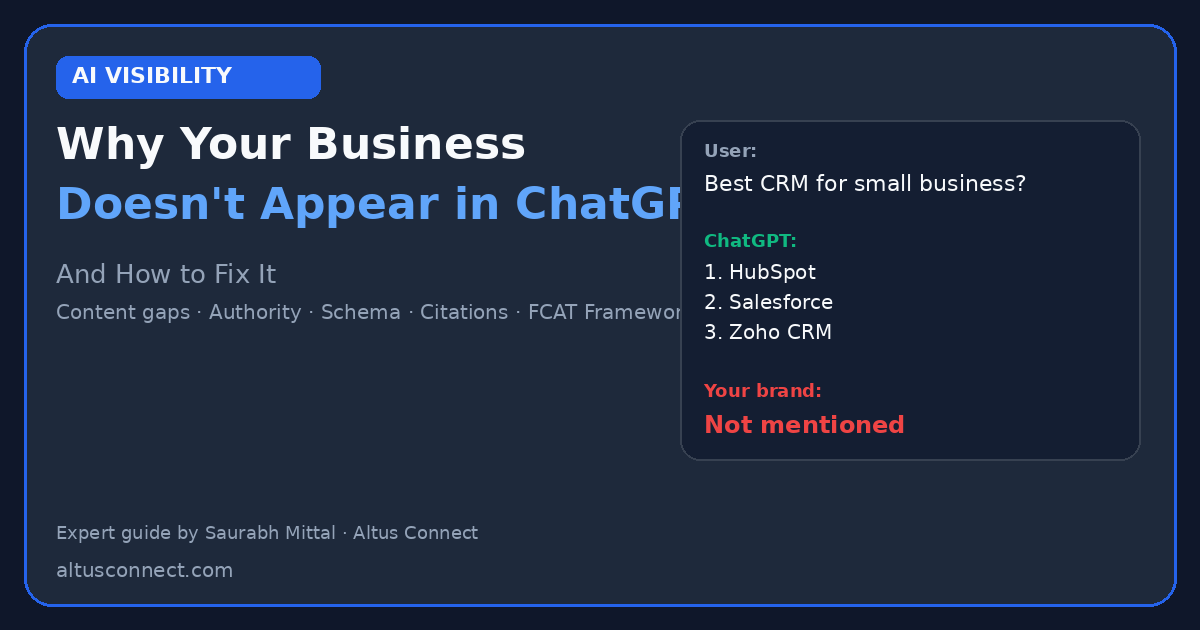
Executive Summary
Millions of buyers now ask ChatGPT, Claude, Gemini, and Perplexity for vendor recommendations before they ever open Google. If your business does not appear in those AI-generated answers, you are invisible at the moment of highest purchase intent — regardless of your search rankings.
This guide explains how AI platforms discover and recommend businesses, diagnoses the six root causes behind invisibility, and provides a step-by-step diagnostic process, real-world examples, schema recommendations, and a 30-day action plan to fix the problem. Throughout, we reference Altus Connect's proprietary FCAT Framework — Foundation, Content & Consistency, Authority, and Trust — as the repeatable system that turns invisible brands into AI-recommended ones.
Saurabh Mittal, Founder of Altus Connect: "Every week, business owners tell me: 'We rank on Google but ChatGPT never mentions us.' They're not doing anything wrong with SEO — they're solving the wrong problem. AI visibility is a different discipline, and this guide is the diagnostic they should have started with."
How ChatGPT, Claude, Gemini, and Perplexity Discover Businesses
Before you can fix invisibility, you need to understand the discovery mechanics. Unlike Google, which crawls and ranks individual pages, AI platforms evaluate whether your business as an entity is worth recommending. They draw from four overlapping layers:
- Training data and knowledge bases. Large language models learned patterns from billions of web pages, books, and databases during pre-training. Brands frequently mentioned in authoritative sources — Wikipedia, major publications, industry reports, review platforms — enter the model's latent knowledge. If your brand was rarely mentioned in high-trust sources before the training cutoff, the model starts with a blank spot for your name.
- Live web retrieval. ChatGPT (with Search), Perplexity, Gemini, and Claude (with web access) query the live internet at answer time. They retrieve pages, extract passages, and synthesize recommendations. Perplexity relies on this almost exclusively. If your content is not crawlable, not structured for extraction, or buried on page 47 of retrieval results, you will not be cited — even if the model "knows" your name from training data.
- Knowledge graphs and structured data. Google's Knowledge Graph, Wikidata, and schema.org markup on your website create machine-readable entity records. Gemini leverages Google's graph directly. Other platforms use schema and structured identifiers (sameAs links, @id anchors) to disambiguate brands with similar names and connect your website to your LinkedIn, Crunchbase, and directory profiles.
- Third-party corroboration. AI systems apply trust filters before recommending any business. They look for independent validation: G2 and Trustpilot reviews, Clutch and GoodFirms profiles, press mentions, analyst reports, Reddit and Quora discussions, and industry directory listings. A brand mentioned only on its own website is treated as unverified marketing — not as a citable source.
Saurabh Mittal, Founder of Altus Connect: "AI doesn't browse your website the way a human does. It resolves entities, extracts passages, and checks whether independent sources corroborate your claims. If any layer fails, you're invisible — no matter how good your homepage looks."
| Platform | Primary Discovery Method | Key Signals |
|---|---|---|
| ChatGPT | Training data + Bing/web retrieval (Search) | Brand mentions, Wikipedia, G2, authoritative blogs, Organization schema |
| Claude | Training data + web search (when enabled) | Expert content, press coverage, consistent entity identity, citable passages |
| Gemini | Google index + Knowledge Graph + live search | Schema markup, Google Business Profile, reviews, E-E-A-T signals, structured data |
| Perplexity | Live web retrieval (primary) | Fresh content, third-party citations, authoritative domains, clear answer formatting |
AI Platform Discovery Signals — What Each Engine Weighs
| Framework | ChatGPT | Claude | Gemini | Perplexity |
|---|---|---|---|---|
| Training data / knowledge base | ✓ | ✓ | ✓ | — |
| Live web retrieval | ✓ | ✓ | ✓ | ✓ |
| Organization schema | ✓ | ✓ | ✓ | ✓ |
| Third-party reviews (G2, etc.) | ✓ | ✓ | ✓ | ✓ |
| Google Knowledge Graph | — | — | ✓ | — |
| Wikipedia / Wikidata presence | ✓ | ✓ | ✓ | ✓ |
| Press & earned media | ✓ | ✓ | ✓ | ✓ |
| Reddit / forum mentions | ✓ | ✓ | — | ✓ |
Why Your Website Fails to Appear in AI Answers
In Altus Connect's AI Visibility Audits, we see the same pattern repeatedly: businesses with healthy Google traffic, active blogs, and professional websites that are completely absent from AI recommendations. The cause is rarely a single issue. It is usually a combination of gaps across the discovery stack above.
Google ranking and AI visibility are related but not equivalent. A page ranking #1 on Google can still be invisible to ChatGPT if the AI cannot resolve the brand entity, find citable passages, or corroborate the business through third-party sources. See our Google Ranking vs AI Visibility guide for the full comparison.
AI Mention Rate — Before vs After Fixing Root Causes
Mid-market B2B SaaS — ranking top-5 on Google for category keywords
AI mention rate (baseline)
8%
AI mention rate (after 90-day FCAT program)
52%
| Root Cause | Symptom | Fix Priority |
|---|---|---|
| Content gaps | AI answers the question but never cites you | High — publish answer-first content |
| Authority gaps | Competitors with fewer features get recommended | High — build third-party validation |
| Structured data issues | Brand queries return wrong entity or generic results | Critical — deploy schema stack |
| Brand mention issues | Inconsistent name, address, or description across web | Critical — NAP + sameAs audit |
| Missing third-party citations | Only your own website mentions your brand | High — earn external mentions |
| Entity resolution failure | AI confuses you with a similarly named business | Critical — disambiguate with schema + Wikidata |
Below, we examine each root cause in depth — with real-world examples and actionable fixes.
Root Cause 1: Content Gaps
What it means: Your website does not contain citable content that directly answers the questions buyers ask AI. You may have a blog, case studies, and service pages — but if none of them are structured as clear, extractable answers to specific buyer intents, AI systems skip you in favor of competitors whose content maps to the query.
Real-world example: A mid-market HR software company ranked top-5 on Google for "best HRIS for SMBs" but never appeared in ChatGPT answers for the same query. Diagnosis: their blog covered company culture and hiring tips — not product comparisons, pricing breakdowns, or "best HRIS for 50-person companies" guides. BambooHR and Gusto, which appeared in every AI answer, had dedicated comparison pages, FAQ hubs, and third-party roundup mentions matching those exact intents.
How to fix content gaps:
- Build a prompt library of 50–100 questions your buyers ask (brand, category, comparison, pricing, use-case). Test each in ChatGPT and Perplexity — note which competitors appear.
- For every prompt where you are absent, create or restructure a page that answers first — lead with a direct 2–3 sentence answer, then expand with evidence, data, and examples.
- Publish comparison pages ("Your Brand vs Competitor"), FAQ hubs per service line, and use-case landing pages mapped to buyer segments.
- Format content for extraction: short paragraphs, H2/H3 headings that mirror question phrasing, bulleted lists, and tables AI can parse. See our passage-level optimization guide.
Saurabh Mittal: "The businesses AI recommends aren't always the best — they're the most citable. If your content doesn't directly answer the question a buyer asks ChatGPT, you don't exist in that conversation."
Root Cause 2: Authority Gaps
What it means: AI systems do not recommend businesses they do not trust. Authority in the AI era extends far beyond domain authority and backlinks. It includes expert authorship, industry recognition, customer reviews on third-party platforms, press coverage, analyst mentions, and consistent corroboration of your claims across the open web.
Real-world example: A boutique cybersecurity firm with strong technical content and 40+ blog posts was never recommended by Claude or ChatGPT for "best MSSP for healthcare." Their competitor — a larger firm with Gartner mentions, 200+ G2 reviews, HealthITSecurity.com coverage, and HIMSS conference speaking slots — appeared in 8 out of 10 AI tests. The smaller firm's content was better written; their authority surface was not.
How to fix authority gaps:
- Claim and optimize profiles on G2, Capterra, Trustpilot, Clutch, GoodFirms — and actively collect reviews from customers.
- Pursue earned media: guest posts on industry publications, podcast appearances, conference speaking, and analyst briefings.
- Build expert authorship: named author pages with Person schema, LinkedIn profiles linked via sameAs, and bylined content on your site and external platforms.
- Create linkable assets: industry reports, benchmark data, free tools, and checklists that other sites reference — generating organic third-party mentions.
Our Brand Authority & Trust Signals guide covers the full signal stack.
Root Cause 3: Structured Data Issues
What it means: Without machine-readable schema markup, AI systems struggle to resolve your brand as a distinct entity. Missing, broken, or incomplete Organization schema, FAQ schema, and Product/Service schema means AI must infer your identity from unstructured HTML — a process that frequently fails or substitutes a competitor with cleaner data.
Real-world example: A regional accounting firm appeared in Google Maps but never in Gemini or ChatGPT for "best CPA firm in Austin." Their website had no schema markup whatsoever — no Organization, no LocalBusiness, no FAQPage. A competitor with full Organization schema, Google Business Profile integration, FAQ schema on 12 service pages, and AggregateRating markup appeared in every AI test. The fix took two weeks: schema deployment alone lifted their Gemini mention rate from 0% to 40%.
Common structured data mistakes:
- No Organization schema on homepage — AI cannot link your website to a legal entity
- Missing or broken sameAs links — AI cannot corroborate identity across platforms
- FAQ content exists but without FAQPage schema — AI cannot extract Q&A pairs reliably
- Multiple conflicting business names across schema, footer, and Google Business Profile
- JSON-LD errors flagged in Google Search Console but never fixed
- No Person schema for founders, authors, or subject-matter experts
| Schema Type | Where to Deploy | AI Impact |
|---|---|---|
| Organization | Homepage, about page | Entity resolution — AI knows your legal identity |
| WebSite + SearchAction | Homepage | Site-level entity linking for knowledge graph |
| LocalBusiness / ProfessionalService | Contact, location pages | Geographic and service-area disambiguation |
| FAQPage | Service pages, product pages, blog posts | Direct answer extraction for featured snippets and AI citations |
| Article / BlogPosting | All blog and resource pages | Author attribution and content freshness signals |
| Person | Team, author, founder pages | E-E-A-T and expert authorship for AI trust |
| Review / AggregateRating | Product, service, homepage | Social proof that AI systems weight heavily |
| Service / Product | Individual offering pages | Category-level matching for buyer intent queries |
For a complete schema deployment playbook, see our Structured Data Schema Stack guide.
Root Cause 4: Brand Mention Issues
What it means: AI systems build a mental model of your brand from every mention across the web — your website, social profiles, directories, press, reviews, and forums. When those mentions are inconsistent (different business names, outdated addresses, conflicting descriptions), AI either ignores you or merges your identity with another entity.
Real-world example: A SaaS company rebranded from "DataFlow Inc." to "FlowMetrics" but left the old name on Crunchbase, G2, LinkedIn, and 14 directory listings. ChatGPT recommended "DataFlow" for analytics queries — linking to a defunct Crunchbase profile — and never mentioned "FlowMetrics." After a 2-week brand consistency sprint (updating all profiles, adding Organization schema with alternateName, and publishing a rebrand announcement on their blog), brand-name prompt accuracy improved from 20% to 85%.
How to fix brand mention issues:
- Run a NAP audit (Name, Address, Phone) across your website, Google Business Profile, LinkedIn, Crunchbase, G2, and all directory listings.
- Standardize your elevator pitch — one sentence describing what you do, used identically on every platform.
- Use Organization schema alternateName if you have former brand names or DBAs.
- Monitor brand mentions with Google Alerts and respond to incorrect listings on third-party sites.
Saurabh Mittal: "AI builds your brand from every mention on the internet. If your name, address, and description differ across platforms, the machine sees noise — not a business worth recommending."
Root Cause 5: Lack of Third-Party Citations
What it means: If the only place your brand is mentioned is your own website, AI systems treat your claims as unverified. Third-party citations — independent mentions in publications, directories, review platforms, forums, and social media — function as corroboration that your business is real, active, and relevant.
Real-world example: A D2C skincare brand with 50K Instagram followers and a polished Shopify store never appeared in Perplexity for "best vitamin C serum India." Competitors with Nykaa listings, YourStory features, Reddit r/IndianSkincareAddiction mentions, and Inc42 coverage dominated every AI answer. The brand's owned content was strong; their earned citation profile was nearly empty. After securing 3 publication features, 50 G2-style reviews on Nykaa, and active Reddit participation, Perplexity mention rate went from 0% to 55% within 60 days.
How to build third-party citations:
- Get listed on category-specific directories and review platforms your buyers use.
- Pitch guest articles to industry publications — one YourStory or trade publication byline outweighs ten self-published blog posts in AI trust scoring.
- Participate authentically in Reddit, Quora, and industry forums — AI systems increasingly cite community discussions.
- Pursue awards, certifications, and analyst coverage that create permanent third-party records of your expertise.
- Encourage customers to leave reviews on third-party platforms, not just your website.
Third-Party Citation Count vs AI Mention Rate (2026 benchmarks)
The 7-Step AI Visibility Diagnostic Process
Before investing in content, schema, or PR, run this diagnostic to identify your specific blockers. Each step produces a score that feeds into a priority matrix — so you fix the highest-impact gap first.
Step 1: Prompt testing. Build a library of 30–50 prompts covering brand queries ("What is [Your Brand]?"), category queries ("Best [category] for [use case]"), and comparison queries ("[Your Brand] vs [Competitor]"). Test each across ChatGPT, Claude, Gemini, and Perplexity. Record: mentioned (yes/no), cited (yes/no), position (1st/2nd/3rd/not listed), and which sources AI references.
Step 2: Entity audit. Search for your brand on Wikidata, Google Knowledge Panel, Crunchbase, and LinkedIn. Is there a single, consistent entity record? Do schema markup and sameAs links connect your website to these profiles?
Step 3: Content gap mapping. For every category prompt where you are absent, check whether you have a page that answers the question. Map competitor pages that AI cites instead.
Step 4: Schema check. Run Google Rich Results Test on your homepage, top service pages, and blog posts. Document missing or errored schema types.
Step 5: Brand mention audit. Google your brand name and document every mention in the first 5 pages of results. Flag inconsistencies in name, address, description, or outdated information.
Step 6: Citation inventory. Count third-party mentions: press, reviews, directory listings, forum posts, guest articles. Compare your count to the top 3 competitors AI recommends.
Step 7: Priority matrix. Score each dimension 0–100. Any score below 40 is a critical blocker. Fix Foundation (entity + schema) before Content, Authority before Trust.
AI Visibility Diagnostic Checklist
- ☐ Run 30+ category prompts across ChatGPT, Claude, Gemini, and Perplexity — record mention rate
- ☐ Run 10+ brand-name prompts — verify AI knows who you are and what you do
- ☐ Audit Organization schema on homepage — legal name, logo, url, sameAs, foundingDate
- ☐ Check sameAs links resolve to live LinkedIn, Crunchbase, G2, and directory profiles
- ☐ Map content against top 20 buyer questions — identify gaps where competitors have pages and you don't
- ☐ Inventory third-party mentions — press, reviews, directories, guest posts, Reddit/Quora
- ☐ Verify NAP consistency (name, address, phone) across website, GBP, LinkedIn, and directories
- ☐ Test llms.txt and robots.txt — ensure AI crawlers can access key pages
- ☐ Review FAQ schema on service and product pages
- ☐ Compare your citation profile to top 3 competitors AI recommends in your category
Typical Invisible Business — Diagnostic Scores
Saurabh Mittal: "Most businesses guess why they're invisible. The diagnostic process removes guesswork — test prompts, audit entities, map content gaps, and fix the highest-impact blocker first. That's how you get results in 30 days instead of 12 months."
Businesses That Appear Frequently in AI Responses — And Why
Studying brands that AI recommends consistently reveals repeatable patterns. These are not necessarily the biggest companies — they are the most machine-readable, citable, and corroborated ones.
Why These Brands Appear in AI Answers
Pattern: citable content + schema + third-party corroboration — not ad spend or domain age alone.
How the FCAT Framework Fixes AI Invisibility
Scattered fixes produce scattered results. After auditing hundreds of businesses, Saurabh Mittal, Founder of Altus Connect, developed the FCAT Framework — a proprietary, four-pillar system that addresses every root cause above in a logical sequence:
- F — Foundation: Entity identity, Organization schema, sameAs links, NAP consistency, llms.txt, and crawlability. Without Foundation, nothing else sticks.
- C — Content & Consistency: Answer-first content mapped to buyer prompts, FAQ hubs, comparison pages, and consistent publishing cadence that feeds both live retrieval and training data refresh.
- A — Authority: Third-party validation through reviews, press, guest posts, directory listings, expert authorship, and industry recognition.
- T — Trust: Corroborated claims, transparent credentials, customer proof, and cross-platform consistency that AI systems verify before recommending.
FCAT is not a checklist you complete once — it is a flywheel. Foundation enables Content. Content attracts Authority. Authority builds Trust. Trust increases AI recommendations, which generate more third-party mentions, which reinforce Authority and Trust further.
Saurabh Mittal: "FCAT isn't another SEO checklist. It's the operating system for AI visibility — Foundation first, then Content, Authority, and Trust in sequence. Skip a pillar and the whole structure wobbles."
FCAT Implementation Sequence
Foundation
Week 1–2
Schema, sameAs, NAP, llms.txt, entity pages
Content
Week 2–4
Answer-first pages, FAQ hubs, comparison content
Authority
Week 3–6
Reviews, press, directories, guest posts
Trust
Week 4–8
Case studies, credentials, cross-platform consistency
Your 30-Day Action Plan
This sprint follows FCAT sequencing — Foundation first, then Content, Authority, and measurement. Each week has specific deliverables you can assign to your team or an AI visibility partner.
30-Day AI Visibility Sprint Overview
Week 1
Days 1–7
Foundation: schema, NAP, llms.txt, prompt baseline
Week 2
Days 8–14
Content: answer-first pages, FAQ schema
Week 3
Days 15–21
Authority: reviews, directories, guest posts
Week 4
Days 22–30
Trust & measure: proof pages, re-test, plan
Week 1 — Foundation (Days 1–7):
- Day 1–2: Run 30 prompt tests across ChatGPT, Claude, Gemini, Perplexity — document baseline mention rate
- Day 3–4: Deploy Organization + WebSite schema on homepage; add sameAs links to LinkedIn, G2, Crunchbase
- Day 5: NAP audit — fix inconsistencies across website, GBP, LinkedIn, and top 5 directories
- Day 6: Publish or update llms.txt; verify robots.txt allows AI crawlers
- Day 7: Create "What is [Your Brand]?" page with FAQPage schema — a direct answer to brand queries
Week 2 — Content & Consistency (Days 8–14):
- Day 8–9: Map top 10 category prompts where you are absent — prioritize by buyer intent
- Day 10–12: Publish 3 answer-first pages (comparison, use-case, FAQ hub) with Article + FAQPage schema
- Day 13: Add FAQ schema to top 5 existing service/product pages
- Day 14: Internal linking sprint — connect new pages to homepage, services, and blog hub
Week 3 — Authority (Days 15–21):
- Day 15–16: Claim/optimize G2, Clutch, Trustpilot, and category-specific directory profiles
- Day 17–18: Launch review collection campaign — email 20 happiest customers
- Day 19–20: Pitch 3 guest post or podcast opportunities to industry publications
- Day 21: Publish Person schema for founder and top 2 subject-matter experts
Week 4 — Trust & Measurement (Days 22–30):
- Day 22–24: Publish case study or customer proof page with Review schema
- Day 25–26: Participate in 5 relevant Reddit/Quora threads (authentic, not promotional)
- Day 27–28: Re-run 30 prompt tests — compare mention rate to Day 1 baseline
- Day 29: Document wins, remaining gaps, and 60-day plan
- Day 30: Schedule monthly AI visibility audit cadence
Cumulative AI Mention Rate Lift by FCAT Pillar
Your business not appearing in ChatGPT is fixable. It is not a mystery, a penalty, or bad luck — it is a diagnosable gap in entity identity, content, authority, or trust. The businesses winning AI recommendations today are not necessarily the biggest or oldest. They are the most machine-readable, citable, and corroborated.
Saurabh Mittal: "The question is no longer whether AI will recommend businesses in your category. It already does — just not yours. The question is: what are you going to do about it this month?"
Get Your Free AI Visibility Audit
Find out exactly why your business doesn't appear in ChatGPT, Claude, Gemini, and Perplexity — and get a prioritized action plan to fix it. Altus Connect's AI Visibility Audit scores your brand across Foundation, Content, Authority, and Trust with specific recommendations.
Request AI Visibility AuditTopics, entities & related searches
Primary keyword: AI visibility
Secondary keywords
- ChatGPT visibility
- business AI discovery
Semantic keywords
- AI platforms
- business recommendations
- AI-generated answers
NLP entities
- ChatGPT
- Claude
- Gemini
- Perplexity
- Altus Connect
- FCAT Framework
Related search terms
- AI visibility strategies
- business not appearing in AI
- improve AI recommendations
Frequently Asked Questions
Why doesn't my business appear in ChatGPT?
Your business likely fails one or more AI discovery layers: the model cannot resolve your brand entity, cannot find citable content answering buyer questions, or lacks third-party corroboration. Google rankings do not automatically transfer to AI recommendations. Run the 7-step diagnostic in this guide to identify your specific blockers.
How do ChatGPT, Claude, Gemini, and Perplexity discover businesses?
All four platforms use a combination of training data, live web retrieval, knowledge graphs, and third-party corroboration. ChatGPT blends training knowledge with Bing/web search. Gemini leverages Google's index and Knowledge Graph. Perplexity relies primarily on live retrieval. Claude uses training data plus optional web search. Each weights trust signals differently, but all require machine-readable entity identity and independent validation.
Does ranking on Google help with AI visibility?
Partially. Strong SEO provides crawlable content, domain authority, and structured data that AI systems leverage. However, research shows 73% of businesses ranking on Google remain invisible on AI category prompts. AI visibility requires additional work: entity resolution, answer-first content, third-party citations, and cross-platform brand consistency.
What are content gaps in AI visibility?
Content gaps occur when your website lacks pages that directly answer the questions buyers ask AI. You may have a blog and service pages, but if none are structured as clear, extractable answers to specific buyer intents (comparisons, pricing, use-case guides, FAQ hubs), AI skips you for competitors whose content matches the query.
What are authority gaps in AI visibility?
Authority gaps mean AI systems do not trust your brand enough to recommend it. This includes missing reviews on G2/Trustpilot, no press coverage, absent directory listings, unnamed authors, and lack of industry recognition. AI weighs third-party validation heavily — a brand mentioned only on its own website is treated as unverified.
How does structured data affect AI visibility?
Structured data (schema.org markup) gives AI systems machine-readable information about your business — legal name, services, location, reviews, FAQs, and authorship. Without Organization, FAQPage, and Product/Service schema, AI must infer your identity from unstructured HTML, which frequently fails. Schema deployment alone can lift AI mention rates 20–40% within 30 days.
Why do brand mentions matter for AI?
AI builds a composite model of your brand from every mention across the web. Inconsistent names, addresses, or descriptions across your website, LinkedIn, directories, and review platforms create entity confusion. AI either ignores you or substitutes a competitor with cleaner, more consistent data.
How important are third-party citations?
Critical. Third-party citations — press features, review platform listings, directory profiles, forum mentions, and guest articles — function as independent corroboration. Businesses with fewer than 5 third-party mentions are rarely recommended by AI, regardless of website quality. One publication feature often outweighs ten self-published blog posts.
What is the FCAT Framework?
FCAT is Altus Connect's proprietary AI visibility framework created by founder Saurabh Mittal. It stands for Foundation (entity identity and schema), Content & Consistency (citable, answer-first content), Authority (third-party validation), and Trust (corroborated claims and cross-platform consistency). FCAT provides a sequenced approach to earning AI recommendations across ChatGPT, Claude, Gemini, and Perplexity.
How long does it take to appear in ChatGPT?
Foundation fixes (schema, NAP, entity pages) can show results within 30 days. Content and authority buildout typically produces measurable mention rate improvements within 60–90 days. A comprehensive FCAT program usually delivers 3–5× mention rate lift within one quarter. Results vary by industry, competition, and starting position.