 Altus Connect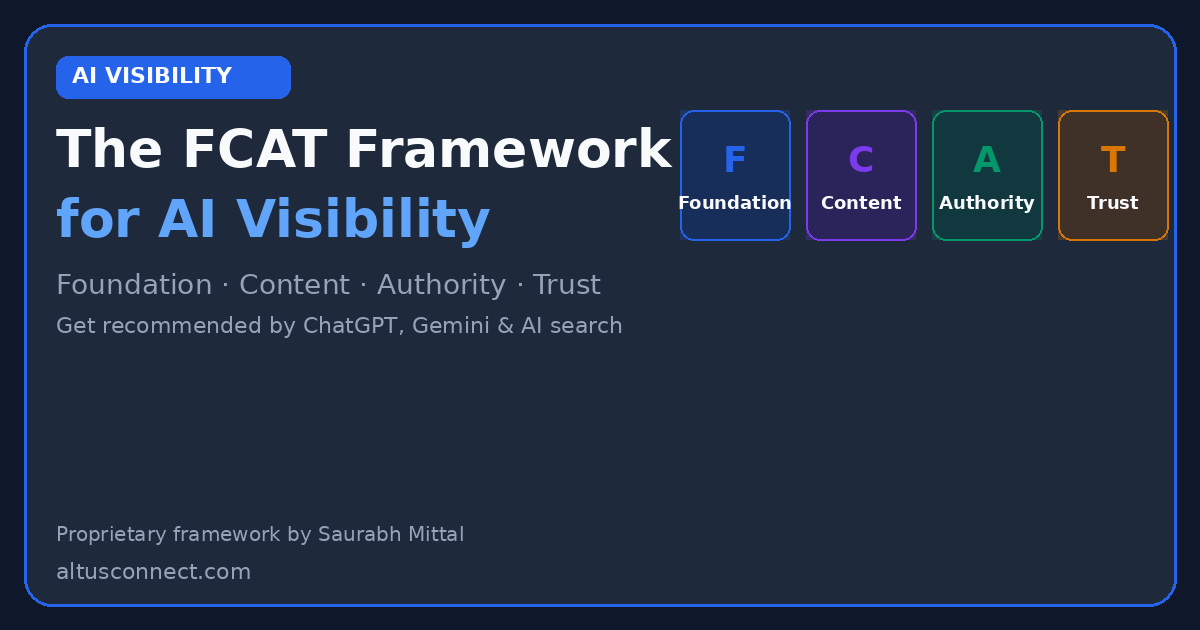
Executive Summary
Search behavior has fundamentally changed. Instead of typing keywords into Google and clicking through ten blue links, millions of people now ask ChatGPT, Gemini, Claude, and Perplexity direct questions like "What's the best accounting firm for startups in Austin?" or "Recommend a reliable logistics partner for e-commerce in the UK." These AI systems do not return a list of links — they synthesize an answer and recommend specific businesses by name. If your business is not in that answer, you do not exist in the new discovery layer.
This is the problem the FCAT Framework solves. Developed by Saurabh Mittal, Founder of Altus Connect, FCAT is a proprietary four-pillar system — Foundation, Content & Consistency, Authority, and Trust — designed specifically for the AI search era. Unlike generic SEO checklists, FCAT addresses how large language models actually evaluate, understand, and recommend businesses.
Traditional SEO remains important, but it is no longer sufficient. A business can rank #1 on Google and still never appear when a buyer asks ChatGPT for a recommendation. FCAT closes that gap by ensuring AI systems can clearly understand who you are (Foundation), see ongoing proof of expertise (Content), recognize you as an industry voice (Authority), and trust you enough to recommend you to their users (Trust).
Saurabh Mittal, Founder of Altus Connect: "I created the FCAT Framework after seeing the same pattern across hundreds of AI visibility audits — businesses investing in SEO while remaining invisible to ChatGPT and Gemini. The problem was never effort. It was structure. FCAT gives every business a clear, sequenced path from invisible to recommended. Foundation first. Always Foundation first."
FCAT Readiness Score — Before vs. After 6-Month Implementation
Mid-market B2B brand (0–100 scale across all four pillars)
Before FCAT implementation
24%
After 6-month FCAT execution
78%
The Rise of AI Search
The shift from traditional search to AI-powered discovery is not a future prediction — it is happening now. Consider how discovery behavior has evolved across just the last two years:
- ChatGPT processes over a billion queries per week, with a growing share involving product and service recommendations rather than general knowledge questions.
- Google Gemini integrates AI-generated answers directly into search results, reducing click-through to traditional websites for informational and commercial queries.
- Perplexity has become the default research tool for professionals who want sourced, synthesized answers instead of scrolling through ten search results.
- Claude and other enterprise AI assistants are increasingly used for vendor evaluation and business research in B2B buying cycles.
For business owners, this creates a new category of visibility problem. Your Google rankings measure whether you appear on a results page. Your AI visibility measures whether ChatGPT, Gemini, or Perplexity will mention your business by name when a potential customer asks for a recommendation. These are different systems with different evaluation criteria.
Why traditional SEO alone falls short:
- AI systems synthesize, not list. They choose one to five businesses to recommend — not ten blue links. Being on page two of Google means nothing if AI never mentions you.
- AI applies trust filters. Before recommending any business, AI systems evaluate whether they can trust the source. Anonymous websites with no reviews, no press mentions, and no structured data are rarely recommended — regardless of SEO score.
- AI pulls from the entire web. Your website is one input among millions. Reviews on G2, mentions in industry publications, Reddit discussions, and LinkedIn posts all feed into how AI perceives your brand.
- AI needs entity clarity. If your website does not clearly state who you are, what you do, whom you serve, and where you operate, AI systems cannot confidently recommend you — even if your content is excellent.
The new challenge is ensuring AI systems understand your business, trust your claims, and recommend you when users ask. That is exactly what FCAT is built to achieve.
How Buyers Discover Businesses in 2026 (by channel)
Introducing the FCAT Framework
After auditing hundreds of businesses across B2B SaaS, professional services, e-commerce, healthcare, and manufacturing, Saurabh Mittal identified a consistent pattern: companies that appeared in AI-generated recommendations shared four characteristics. Companies that were invisible to AI consistently failed on the same four dimensions. FCAT codifies those dimensions into an actionable framework.
The Four FCAT Pillars — Overview
The FCAT Framework is proprietary to Altus Connect and Saurabh Mittal. Expand each pillar for details.
Why all four pillars must work together: FCAT is not a pick-and-choose menu. Each pillar depends on the others. Content without Foundation creates confusion — AI sees activity but cannot connect it to a clear business identity. Authority without Content is nearly impossible to build — you cannot become a recognized voice if you publish nothing. Trust without Authority is limited — reviews and testimonials carry more weight when your brand is already mentioned across the web. Sustainable AI visibility requires all four pillars operating in concert.
The FCAT Flywheel
F
Foundation
AI understands you
C
Content
AI sees activity
A
Authority
AI recognizes you
T
Trust
AI recommends you
Foundation → Content & Consistency → Authority → Trust → Increased AI Recommendations → (cycle repeats)
F: Foundation — Build a Business AI Can Understand
Foundation is the starting point of FCAT — and the pillar most businesses underestimate. Before AI can recommend your business, it must be able to answer four fundamental questions: Who are you? What do you do? Whom do you serve? Where do you operate? If your digital presence cannot answer these clearly, every subsequent FCAT investment produces diminished returns.
What Is Foundation?
Foundation covers the basics of your digital presence — the structural layer that tells AI systems what your business is. This includes your website content, technical infrastructure, and machine-readable data that helps AI parse and categorize your business correctly.
Your Website Should Tell Your Story Clearly
AI systems read your website the way a new customer would — but with less patience for ambiguity. Every key page should communicate:
- Clear value proposition. Within the first screen, a visitor (human or AI) should understand what problem you solve and why you are different. Avoid vague taglines like "Innovative solutions for modern businesses." Instead: "Custom modular kitchen design and installation for homeowners in Lucknow and Uttar Pradesh — 15 years, 2,000+ projects completed."
- Clearly defined products and services. Each service or product should have its own dedicated page with specific descriptions, pricing indicators (where appropriate), and use cases. Generic "Our Services" pages with bullet points are insufficient for AI parsing.
- Industry expertise and use cases. Demonstrate depth by showing which industries you serve, which problems you solve, and which outcomes you deliver. Case-specific language helps AI match your business to relevant queries.
- About Us and team information. Name your founders, executives, and key team members. Include credentials, years of experience, and professional backgrounds. AI systems use team information to assess expertise (the first "E" in E-E-A-T).
- Contact details and business credentials. Physical address, phone number, email, business registration details, certifications, and awards. These are trust anchors that AI systems weigh when deciding whether to recommend a business.
Technical Foundation Matters
AI crawlers are impatient. Technical performance directly affects whether your content gets indexed and parsed by AI systems:
- Website speed and performance. Pages loading in under 3 seconds. Core Web Vitals passing on mobile and desktop. AI crawlers may skip or deprioritize slow sites.
- Mobile responsiveness. Over 60% of AI-assisted searches happen on mobile devices. Your site must render correctly on all screen sizes.
- Secure website (HTTPS). Non-HTTPS sites are flagged as insecure by AI systems and modern browsers. This is non-negotiable.
- Clean website architecture. Logical URL structure, breadcrumb navigation, and internal linking that helps crawlers understand page hierarchy and relationships.
- Search engine accessibility. Proper robots.txt, no accidental noindex tags on important pages, and XML sitemap kept current.
AI Readiness Requirements
Beyond traditional SEO, AI visibility requires specific technical signals:
- Schema markup. Organization, LocalBusiness, Service, Product, FAQ, and Person schema help AI systems parse your business identity without guessing. JSON-LD is the preferred format. See our Structured Data Schema Stack guide for implementation details.
- Structured data. Beyond schema, ensure consistent NAP (Name, Address, Phone) data across your website, Google Business Profile, and all directory listings.
- XML sitemap. Submit and maintain an XML sitemap that includes all key pages, blog posts, and service pages. Update it whenever you publish new content.
- llms.txt implementation. A machine-readable file at your site root that tells AI systems what your most important pages are, what your business does, and how to interpret your content. This emerging standard is becoming increasingly important for AI crawler guidance.
- Proper metadata and entity signals. Unique title tags, meta descriptions, Open Graph tags, and canonical URLs on every page. Consistent business name spelling across all platforms.
Common Foundation Mistakes
In AI visibility audits, these Foundation failures appear repeatedly:
- Outdated websites with copyright dates from three or more years ago and stale content
- Missing service information — businesses that mention services in passing but never dedicate pages to explaining them
- Poor navigation that buries important pages three or more clicks from the homepage
- Slow-loading pages that cause AI crawlers to timeout or deprioritize the site
- Lack of structured data — no schema markup, forcing AI to guess your business category and service offerings from unstructured text alone
Foundation Checklist
- Clear value proposition on homepage (who, what, whom, where)
- Dedicated service/product pages with specific descriptions
- About Us page with team names, roles, and credentials
- Contact page with address, phone, email, and business hours
- HTTPS enabled across entire site
- Mobile-responsive design tested on real devices
- Page load speed under 3 seconds on key pages
- Organization and LocalBusiness schema markup deployed
- XML sitemap submitted and indexed
- llms.txt file published at site root
- Clean URL structure and logical navigation
- Robots.txt allows AI crawlers where appropriate
C: Content & Consistency — Keep Feeding the AI Ecosystem
If Foundation tells AI who you are, Content & Consistency tells AI that you are active, expert, and relevant right now. AI systems strongly prefer businesses that continuously publish useful information over businesses with a static website and no recent activity.
Why Content Matters for AI Visibility
Large language models are trained on and retrieve from content across the web. Businesses that publish regularly create more touchpoints for AI systems to encounter, learn from, and cite. Fresh content signals three things AI systems value:
- Business activity. A company publishing monthly is clearly operational and engaged — not a dormant website from a business that may no longer exist.
- Domain expertise. Educational content, industry analysis, and how-to guides demonstrate that you understand your field deeply — not just that you sell a product.
- Query coverage. Every blog post, FAQ, and case study is a new opportunity to match a user query. A business with 50 content pieces covering different aspects of their industry has 50 chances to appear in AI answers; a business with 5 pages has 5.
Content Across Owned Channels
FCAT Content strategy spans every channel you control:
Website Content:
- Blogs — educational articles, industry insights, how-to guides, trend analysis
- Case studies — detailed customer success stories with measurable outcomes
- Service pages — comprehensive descriptions of each offering with use cases and FAQs
- Industry insights — original research, data, and analysis that positions you as a source
- FAQs — structured question-and-answer content that AI systems can directly extract and cite (FAQ schema markup amplifies this)
Social Media Content:
- LinkedIn — thought leadership posts, company updates, industry commentary (highest impact for B2B AI visibility)
- X (Twitter) — real-time industry engagement, thread-based educational content
- YouTube — video tutorials, product demos, customer testimonials (video transcripts feed AI training data)
- Facebook — community engagement, local business visibility, customer stories
- Industry-specific platforms — wherever your customers congregate (Houzz for home services, GitHub for developer tools, Behance for creative agencies)
Consistency Is More Important Than Virality
A common mistake is chasing viral content while ignoring consistent publishing. AI systems do not reward one viral post followed by six months of silence. They reward businesses that publish useful content on a predictable cadence — even if individual posts get modest engagement.
Saurabh Mittal puts it directly: "AI does not measure your best day. It measures your average month. A business publishing two solid articles per month for a year builds more AI visibility than a business that publishes twenty articles in one month and then goes quiet. Consistency is the signal."
Content Topics That Build AI Visibility
- Educational content — teach your audience something useful related to your industry
- Industry trends — analyze where your field is heading and what it means for customers
- Customer success stories — show real outcomes with specific metrics and named clients
- Thought leadership — share your perspective on industry challenges and opportunities
- Frequently asked questions — answer the exact questions your customers ask before buying
Building a Sustainable Content System
Content consistency requires systems, not willpower. Build a sustainable engine:
- Editorial calendar. Plan topics 90 days ahead. Assign owners. Set publish dates.
- Content templates. Standardize formats for case studies, FAQs, and blog posts so production is repeatable.
- Repurposing workflow. Turn one blog post into a LinkedIn article, three social posts, and a FAQ entry. Maximize output from each piece.
- Quality bar, not perfectionism. A good article published this week beats a perfect article that never ships. AI rewards published content, not drafts.
Content & Consistency Checklist
- Editorial calendar with minimum 2–4 publishes per month
- At least one blog post, case study, or insight per month
- FAQ pages answering top 10 customer questions
- Active LinkedIn presence (minimum 2 posts per week)
- YouTube or video content for complex topics (optional but high-impact)
- Industry trend commentary published quarterly
- Customer success stories with measurable outcomes
- Consistent brand voice and messaging across all channels
- Content updated within last 12 months on all key pages
- Internal linking between related content pieces
A: Authority — Become a Recognized Industry Voice
Authority is the FCAT pillar that separates businesses AI knows about from businesses AI recommends. It is earned over time through consistent execution of Foundation and Content strategies — plus deliberate efforts to build recognition beyond your own website.
What Is Authority in AI Visibility?
Authority is not something you claim — it is something the web confirms. When AI systems evaluate whether to recommend your business, they look for evidence that others recognize your expertise: mentions in publications, backlinks from respected sites, listings in industry directories, and visible thought leadership from your team.
How AI Systems Measure Authority
- Mentions across the web. How often your brand name appears in context on other websites, forums, and publications
- Citations from trusted sources. Links and references from domains AI systems already trust
- Industry recognition. Awards, certifications, association memberships, analyst reports
- Expert contributions. Guest posts, podcast appearances, conference talks, quoted opinions
Key Authority Signals
Thought Leadership:
- Founder visibility. Your founder or CEO should be a visible expert — publishing articles, speaking at events, and appearing in industry conversations. AI systems connect founder expertise to brand authority.
- Executive content. Byline articles, LinkedIn newsletters, and opinion pieces from senior team members
- Industry opinions. Take positions on industry trends. Neutral, generic content does not build authority. Perspective does.
- Expert commentary. Respond to industry news, contribute quotes to publications, participate in expert roundups
Backlinks:
- Quality over quantity. One link from an industry publication outweighs fifty links from irrelevant directories
- Industry-relevant websites. Links from sites in your category signal topical authority to AI systems
Citations & Directories:
- Business directories. Google Business Profile, Bing Places, Apple Maps, Yelp
- Industry listings. Category-specific directories where buyers search for vendors
- Professional associations. Membership in recognized industry bodies
Brand Mentions:
- News articles featuring your company or leadership
- Guest posts on respected industry publications
- Podcast appearances where you share expertise (transcripts become AI training data)
- Conference speaking engagements that establish you as a category expert
Building Authority as a Long-Term Asset
Authority cannot be manufactured overnight. It compounds over months and years as your Foundation strengthens, your Content library grows, and your external presence expands. Businesses that invest in authority building consistently see AI recommendation rates increase even when their direct SEO rankings remain unchanged — because AI measures a different signal set. For deeper authority tactics, see our Brand Authority & Trust Signals guide.
Authority Checklist
- Founder or executive publishing thought leadership monthly
- Listed in relevant business directories (Google Business Profile, industry-specific)
- Professional association memberships displayed
- At least 5 quality backlinks from industry-relevant websites
- Guest post or contributed article published in last 6 months
- Podcast appearance or conference speaking engagement
- Press mention or news article featuring your brand
- Person schema with sameAs links for key executives
- Wikipedia or Wikidata entry (where applicable)
- Competitor citation gap analysis completed
Authority Signal Impact on AI Recommendation Rate
T: Trust — The Ultimate Decision Factor
Trust is the final gate in the FCAT Framework — and the pillar that most directly determines whether AI recommends your business or chooses a competitor. AI systems are designed to protect users from bad recommendations. When a user asks "Who should I hire for X?", the AI's reputation depends on recommending businesses that will deliver. Trust signals are how AI reduces that uncertainty.
Why Trust Matters Most
Consider the AI recommendation from the user's perspective. If ChatGPT recommends a business that turns out to be unreliable, the user loses trust in ChatGPT — not just the business. This is why AI systems apply the strictest filters at the Trust layer. A business with perfect Foundation, excellent Content, and strong Authority can still be excluded if Trust signals are weak or negative.
Sources of Trust Signals
Customer Reviews:
- Google Reviews — the most universally weighted review signal for local and service businesses
- G2 — critical for B2B SaaS and technology companies
- Clutch — important for agencies, consultancies, and professional services
- Trustpilot — widely used for e-commerce and consumer brands
- Industry-specific review platforms — whatever your customers use to evaluate vendors
Testimonials and Case Studies:
- Real customer success stories with named clients, specific challenges, and measurable outcomes
- Video testimonials (transcripts feed AI systems)
- Before-and-after results with data, not just praise
Third-Party Discussions:
- Reddit conversations where real users recommend (or warn against) your business
- Quora discussions where your brand is mentioned in answers to industry questions
- Industry forums and community platforms where professionals share vendor experiences
- Community recommendations in Facebook groups, Slack communities, and professional networks
Reputation Management
Trust is not just about collecting positive signals — it is about actively managing your reputation:
- Monitor brand mentions. Set up alerts for your brand name across Google, Reddit, Quora, and social platforms. Know what is being said.
- Respond to reviews. Thank positive reviewers. Address negative reviews professionally and constructively. AI systems notice whether businesses engage with feedback.
- Address negative feedback professionally. Never ignore or argue with negative reviews. A thoughtful response to a negative review often builds more trust than the negative review removed.
Building Trust at Scale
Systematize trust building the way you systematize content:
- Ask every satisfied customer for a review within 48 hours of project completion
- Publish one new case study per quarter with specific, measurable outcomes
- Respond to every review (positive and negative) within 48 hours
- Monitor Reddit and Quora weekly for brand mentions and participate helpfully
- Deploy AggregateRating schema on your website referencing verified review platform data
Trust Checklist
- Google Reviews with 4.0+ average rating and 20+ reviews
- Industry review platform presence (G2, Clutch, Trustpilot, or equivalent)
- At least 3 published case studies with named clients and outcomes
- Testimonials with full names, companies, and photos where possible
- AggregateRating schema referencing verified review data
- Active monitoring of Reddit, Quora, and industry forum mentions
- Professional responses to all negative reviews within 48 hours
- Privacy policy, terms of service, and refund/guarantee policies published
- SSL certificate valid and security badges displayed
- Third-party validation (certifications, awards, partnerships) visible on site
E-E-A-T and FCAT: How Google's Quality Framework Maps to AI Visibility
Google's E-E-A-T framework — Experience, Expertise, Authoritativeness, and Trustworthiness — was originally designed for human search quality raters. In the AI search era, every major answer engine applies analogous trust evaluation. FCAT maps directly to E-E-A-T, giving you a practical implementation path for each dimension:
| E-E-A-T Dimension | FCAT Pillar | What AI Systems Evaluate |
|---|---|---|
| Experience | Content & Trust | Case studies, customer outcomes, first-hand insights, dated evidence of real work |
| Expertise | Foundation & Content | Clear service definitions, team credentials, educational depth, industry-specific knowledge |
| Authoritativeness | Authority | Backlinks, press mentions, directory listings, thought leadership, founder visibility |
| Trustworthiness | Trust | Reviews, testimonials, community sentiment, transparent contact info, professional responses |
Businesses that score well on FCAT inherently score well on E-E-A-T — because both frameworks evaluate the same underlying question: Should AI recommend this business to its users?
How FCAT Works Together — Why You Cannot Skip Steps
FCAT is designed as a sequential and interdependent system. Here is what happens when pillars are skipped:
What Happens When You Skip FCAT Pillars
The pattern is clear: each pillar amplifies the others. Foundation makes Content meaningful. Content makes Authority achievable. Authority makes Trust credible. Trust makes AI recommendations confident.
Sample FCAT Readiness Scorecard — Target After 6 Months
6–12 Month FCAT Implementation Roadmap
Month 1–2
Foundation audit & fix
Website clarity, schema, llms.txt, technical SEO
Month 3–4
Content engine launch
Editorial calendar, 2–4 posts/month, FAQ pages
Month 5–7
Authority building
Thought leadership, PR, directories, backlinks
Month 8–12
Trust & optimization
Review campaigns, case studies, retest AI visibility
Conclusion: AI Visibility Is Not a One-Time Activity
The businesses that will dominate AI search recommendations in 2026 and beyond are not those that implemented a quick SEO fix or published a few blog posts. They are the businesses that treated AI visibility as a long-term strategic investment — systematically building Foundation, publishing consistent Content, earning Authority, and proving Trust month after month.
The FCAT Framework gives you the structure. But structure alone does not produce results — execution does. As Saurabh Mittal notes: "FCAT is not a checklist you complete once. It is a operating system you run continuously. The businesses that treat it that way are the ones AI recommends — consistently, confidently, and by name."
Next Steps
- Audit your business against the FCAT framework. Score each pillar 0–100 using the checklists in this guide.
- Identify gaps in each pillar. Which pillar is weakest? That is where you start.
- Create a roadmap for improving your AI visibility over the next 6–12 months. Foundation first, then Content, then Authority, then Trust — with milestones at 30, 90, and 180 days.
Want to know how visible your business is to AI?
Get a free AI Visibility Audit and discover where you stand on the FCAT Framework. Our team will score your business across all four pillars and deliver a prioritized roadmap for the next 6–12 months.
Get Your Free AI Visibility AuditTopics, entities & related searches
Primary keyword: FCAT Framework
Secondary keywords
- AI Visibility
- ChatGPT Recommendations
- Gemini AI
Semantic keywords
- AI search engines
- business discovery
- AI recommendations
NLP entities
- FCAT Framework
- Saurabh Mittal
- Altus Connect
- ChatGPT
- Gemini
- Claude
- Perplexity
Related search terms
- AI visibility strategies
- business recommendations by AI
- FCAT system
Frequently Asked Questions
What is the FCAT Framework?
FCAT is a proprietary AI visibility framework created by Saurabh Mittal, Founder of Altus Connect. It stands for Foundation, Content & Consistency, Authority, and Trust — four pillars that work together to help businesses get discovered and recommended by ChatGPT, Gemini, Claude, Perplexity, and other AI search engines. Unlike generic SEO advice, FCAT is designed specifically for how AI systems evaluate and recommend businesses.
Who created the FCAT Framework?
The FCAT Framework was developed by Saurabh Mittal, Founder of Altus Connect, based on AI visibility audits across hundreds of businesses in B2B SaaS, professional services, e-commerce, healthcare, and manufacturing. It codifies the patterns that consistently separate businesses AI recommends from businesses AI ignores.
Why is traditional SEO not enough for AI search?
Traditional SEO optimizes for search result pages and click-through rates. AI search engines synthesize direct answers and recommend specific businesses by name. They apply trust filters, evaluate entity clarity, and pull signals from across the entire web — not just your website. A #1 Google ranking does not guarantee an AI recommendation without FCAT-level Foundation, Content, Authority, and Trust signals.
Which FCAT pillar should I prioritize first?
Always start with Foundation. AI systems cannot recommend a business they cannot clearly understand. Fix website clarity, structured data, technical performance, and entity signals before investing heavily in content, authority, or trust initiatives. Foundation is the prerequisite for everything else.
How does FCAT relate to E-E-A-T?
FCAT and E-E-A-T evaluate the same underlying question: should AI recommend this business? Experience maps to Content and Trust. Expertise maps to Foundation and Content. Authoritativeness maps to Authority. Trustworthiness maps to Trust. Businesses that execute FCAT well inherently satisfy E-E-A-T requirements across all AI platforms.
How long does it take to see results from FCAT?
Foundation fixes can show early AI visibility movement in 4–8 weeks as crawlers re-index your site. Content and authority work typically requires 3–6 months for measurable citation gains. Trust signals compound over time. Most businesses see significant FCAT score improvements within 6–12 months of consistent execution across all four pillars.
Can I skip one FCAT pillar and focus on the others?
No. FCAT pillars are interdependent. Content without Foundation creates orphan articles AI cannot connect to your business. Authority without Content has nothing to amplify. Trust without Authority cannot overcome invisibility. Sustainable AI visibility requires all four pillars operating together — that is why FCAT is a framework, not a menu.
What is llms.txt and why does FCAT include it?
llms.txt is a machine-readable file at your website root that tells AI systems what your most important pages are and what your business does. It is an emerging standard for AI crawler guidance, similar to how robots.txt guides search engine crawlers. FCAT includes llms.txt as part of Foundation because it directly improves how AI systems interpret your site.
How do I measure my FCAT score?
Score each pillar 0–100 using the checklists in this guide, then test AI visibility by running 50–100 category-relevant prompts monthly across ChatGPT, Gemini, Perplexity, and Google AI Overviews. Track whether your business is mentioned, recommended, or absent. Altus Connect offers a free AI Visibility Audit that scores all four FCAT pillars with specific evidence and a prioritized roadmap.
Is the FCAT Framework only for B2B businesses?
No. FCAT applies to any business that wants to be discovered and recommended by AI search engines — B2B SaaS, professional services, local businesses, e-commerce, healthcare, manufacturing, and more. The pillar priorities may shift (local businesses weight Trust and Foundation more heavily; B2B SaaS weights Authority and Content more), but the framework structure remains the same.