 Altus Connect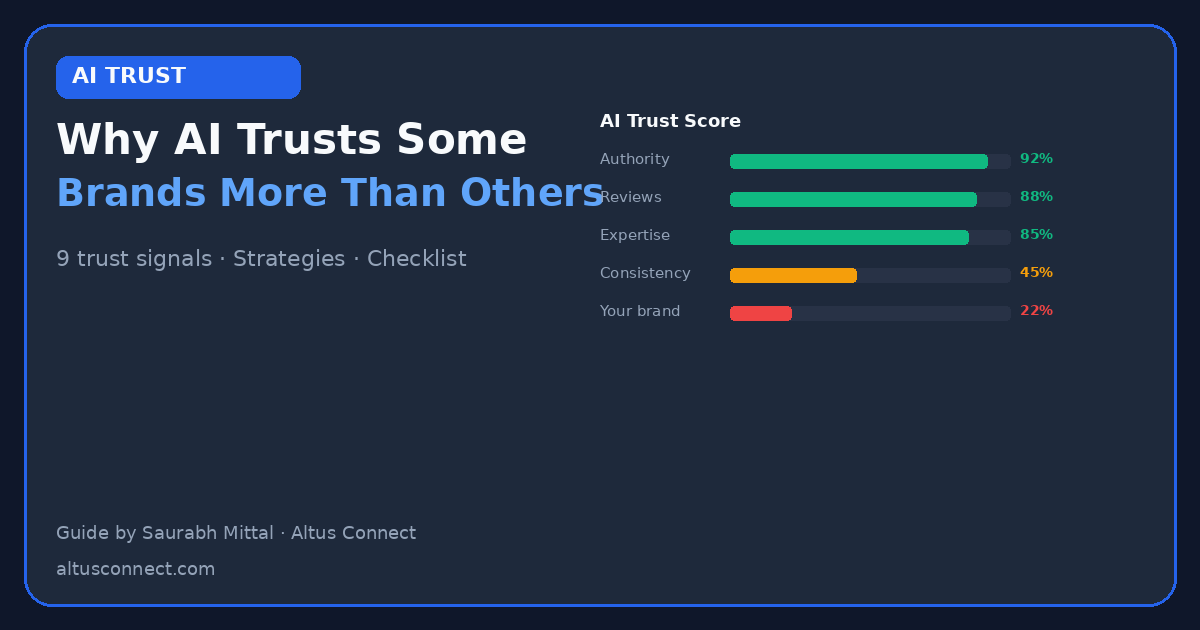
Executive Summary
When ChatGPT, Claude, or Gemini recommends a brand, it is making a trust decision. The model is effectively saying: I have enough corroborated evidence to stake my credibility on this recommendation. Brands that receive consistent AI recommendations have built a trust surface that weaker competitors lack — regardless of product quality.
This guide explains the nine trust signals AI systems evaluate: authority, expertise, experience, consistency, reviews, citations, PR, content depth, and founder visibility. For each signal, you will find how it works, examples from well-known and emerging brands, and trust-building strategies you can execute. The guide closes with an actionable checklist and FAQs.
Related: Brand Authority & Trust Signals for AI Citations · The FCAT Framework · How ChatGPT Chooses Companies.
Saurabh Mittal, Founder of Altus Connect: "When clients ask why AI trusts their competitor, I audit nine signals. Invariably, the competitor has more reviews, more press, more consistent entity data, or a more visible founder. Trust is diagnosable — and buildable."
How AI Trust Works — The Verification Layer
Before recommending any brand, LLMs run an implicit verification process. They ask:
- Can I resolve this brand as a distinct entity? (Consistency + schema)
- Do independent sources corroborate its claims? (Reviews + PR + citations)
- Does this brand demonstrate category expertise? (Content depth + expertise)
- Is there evidence of real customer outcomes? (Experience + case studies)
- Are named experts associated with the brand? (Founder visibility + authority)
Brands that fail any critical check are excluded — even if their website ranks #1 on Google. This is why 73% of businesses with strong SEO have low AI trust scores.
Saurabh Mittal, Founder of Altus Connect: "AI trust is not a vibe — it is a scorecard. Every recommendation ChatGPT makes is a bet that independent sources corroborate the brand. No corroboration, no recommendation. That is the entire game."
| Trust Signal | What AI Evaluates | Trust-Building Action |
|---|---|---|
| Authority | Industry recognition, awards, analyst mentions | Pursue awards, Gartner/G2 recognition, press |
| Expertise | Depth of category knowledge in content | Publish definitive guides, data reports, methodology |
| Experience | Track record, case studies, years in market | HTML case studies with measurable outcomes |
| Consistency | Same brand identity across all platforms | NAP audit, sameAs schema, unified description |
| Reviews | G2, Trustpilot, Google, Clutch ratings | 50+ reviews on primary platform |
| Citations | Mentions in AI answers and source links | Answer-first content, comparison pages |
| PR | Press features, guest articles, podcasts | Data-led PR, expert commentary pitches |
| Content depth | Comprehensive, citable, fresh resources | 2,000+ word guides, FAQ hubs, data reports |
| Founder visibility | Named experts with verifiable credentials | Person schema, LinkedIn, bylines, speaking |
AI Trust Score — Well-Known vs Emerging Brand (Same Category)
1. Authority — Industry Recognition AI Can Verify
What it means: Authority is third-party recognition that your brand is a legitimate, significant player in its category — awards, analyst mentions, market leadership claims corroborated by external sources.
Well-known example — HubSpot: ChatGPT cites HubSpot for CRM and marketing automation because authority signals are overwhelming: G2 Leader badges, Gartner mentions, Forbes features, 200,000+ customers cited across thousands of sources, Wikipedia entry, and a Knowledge Graph presence. HubSpot's authority is self-reinforcing — each citation increases future citation likelihood.
Emerging example — Linear: A project management tool that gained AI trust rapidly despite being younger than Asana or Jira. Linear earned authority through intense developer community advocacy, Product Hunt launches, tech publication coverage (The Verge, TechCrunch), and organic Reddit/forum mentions — creating a corroborated authority surface before traditional analyst recognition.
Trust-building strategies for authority:
- Pursue G2 Grid, Capterra Shortlist, or category-specific awards
- Submit for industry "Top 10" and "Best Of" lists (become retrieval targets)
- Publish original research that publications cite
- Seek analyst briefings (Gartner, Forrester) even without paid placement
2. Expertise — Demonstrated Category Knowledge
What it means: Expertise is the depth and accuracy of your category knowledge as evidenced in content, authorship, and external recognition of your team's capabilities.
Well-known example — Stripe: Stripe is cited for payment API questions because their documentation, engineering blog, and published guides demonstrate unmatched technical expertise. AI systems retrieve and trust Stripe's content for developer queries because it is specific, accurate, and widely referenced by other authoritative sources.
Emerging example — Plausible Analytics: A privacy-focused analytics startup competes with Google Analytics in AI answers by publishing deeply expert content on privacy regulations, GDPR compliance, and cookieless tracking — topics where their founders demonstrate genuine expertise through bylined articles, conference talks, and a transparent methodology page.
Trust-building strategies for expertise:
- Publish definitive category guides (2,000+ words, data-backed, annually updated)
- Create methodology or framework pages explaining your approach
- Byline content under named experts with Person schema
- Answer technical and category questions on Quora, Reddit, and Stack Overflow authentically
Saurabh Mittal: "Expertise is the signal most brands underestimate. One definitive 3,000-word guide with original data can outweigh fifty generic blog posts — because AI cites depth, not volume."
3. Experience — Proof of Real-World Outcomes
What it means: Experience signals prove your brand has delivered results for real customers — case studies, client logos, years in business, transaction volume, and customer count claims corroborated by third parties.
Well-known example — Salesforce: "Trusted by 150,000+ companies" appears in AI answers because the claim is corroborated across Wikipedia, earnings reports, press coverage, and thousands of case studies. AI trusts the number because independent sources confirm it.
Emerging example — a regional MSP: A 40-person managed IT provider with 8 years in business had zero AI mentions despite 60 clients. After publishing 6 HTML case studies with named outcomes ("Reduced downtime 60% for 200-person healthcare group"), adding foundingDate and numberOfEmployees to Organization schema, and collecting 45 Clutch reviews, they appeared in 40% of local ChatGPT IT provider prompts within 75 days.
Trust-building strategies for experience:
- Publish HTML case studies with industry, company size, challenge, and measurable outcome
- Include foundingDate and aggregate customer metrics in Organization schema (where verifiable)
- Display client logos with permission and link to case studies
- Encourage customers to mention specific outcomes in reviews
4. Consistency — One Brand, One Identity
What it means: AI systems build entity models from every brand mention. When your name, description, and category association differ across platforms, the model sees noise — and defaults to competitors with cleaner data.
Well-known example — IBM: Decades of consistent brand identity across Wikipedia, Wikidata, LinkedIn, press, and corporate site make IBM instantly resolvable by any AI system. The entity is unambiguous.
Emerging example — rebrand failure: A SaaS company rebranded but left the old name on G2, Crunchbase, LinkedIn, and 12 directories. ChatGPT recommended the defunct brand name for 6 months until a consistency sprint aligned all profiles, added alternateName schema, and published a rebrand announcement. Trust recovered within 45 days.
Trust-building strategies for consistency:
- Run quarterly NAP (Name, Address, Phone) audits across all web profiles
- Use identical one-sentence description on website, LinkedIn, G2, Clutch, and directories
- Deploy Organization schema with sameAs linking all official profiles
- After rebrands, update every profile within 2 weeks — not 2 months
5. Reviews — Independent Social Proof
What it means: Reviews on G2, Trustpilot, Google, Clutch, and category platforms are among the highest-weight trust signals because they represent independent customer validation that AI cannot fabricate.
Well-known example — Notion: Appears in virtually every "best productivity tool" AI answer partly because of 5,000+ G2 reviews, extensive Trustpilot presence, and organic community praise across Reddit and Product Hunt — all retrievable and citable.
Emerging example — B2B consultancy: A 25-person consulting firm with excellent client work but zero online reviews was never cited by Claude or ChatGPT. After collecting 62 Clutch reviews in 90 days (post-project email campaign), they became the default AI recommendation for their niche — surpassing larger competitors with weaker review profiles.
Trust-building strategies for reviews:
- Target 50+ reviews minimum; 100+ for competitive categories
- Automate post-delivery review requests within 14 days
- Guide reviewers to mention industry, use case, and specific outcomes
- Add AggregateRating schema referencing verified platform scores
6. Citations — Being Named in AI Answers
What it means: Citations are the output metric of trust — when AI names your brand or links to your content in an answer. High-trust brands accumulate citations; low-trust brands are absent.
Citations compound: each mention reinforces training and retrieval preference. Brands cited today are more likely to be cited tomorrow.
Trust-building strategies for citations:
- Publish comparison pages structured for AI extraction
- Build a 50-prompt library and test monthly across ChatGPT, Claude, Gemini
- Track citation share-of-voice vs top 3 competitors
- Address citation gaps with targeted content and authority buildout
See How to Get Cited by ChatGPT, Claude and Gemini.
Saurabh Mittal: "Reviews are the trust signal with the highest ROI for most businesses. Fifty G2 reviews cost less than one month of Google Ads and deliver permanent AI citation infrastructure. I have seen it flip mention rates in 60 days."
7. PR — Earned Media as Trust Infrastructure
What it means: Press coverage, guest articles, and podcast appearances create permanent third-party records that LLMs trust more than self-published marketing.
Well-known example — Canva: Extensive press coverage (Forbes, TechCrunch, WSJ) created a dense web of third-party mentions that AI systems retrieve for design tool queries.
Emerging example — data-led PR win: A HR analytics startup published a "State of Remote Work 2026" survey. Four industry publications covered it. ChatGPT began citing the company's statistics in 15+ prompt categories — and naming the company as a recommended vendor in 8 — within 60 days of publication.
Trust-building strategies for PR:
- Lead with original data — surveys, benchmarks, industry reports
- Pitch founder expert commentary for trend pieces
- Guest articles on trade publications with byline and company mention
- Podcast appearances — show notes create indexed, citable pages
8. Content Depth — Comprehensive, Citable Resources
What it means: Shallow blog posts do not build trust. AI favors comprehensive, structured, fresh content that directly answers buyer questions with evidence.
Well-known example — Zapier: Thousands of integration and workflow pages create a content moat — each page is a citable resource for automation queries. AI retrieves Zapier content constantly because depth and specificity exceed competitors.
Emerging example: A legal-tech startup published 12 definitive guides ("Complete Guide to Contract Automation for Mid-Market Legal Teams") averaging 3,000 words with FAQPage schema. Despite low domain authority, their guides were cited in 25% of category ChatGPT prompts within 90 days because no competitor had equivalent depth.
Trust-building strategies for content depth:
- Publish 2,000+ word cornerstone guides per major use case
- Update annually with current-year titles and fresh data
- Structure with answer-first formatting and FAQPage schema
- Include original data, charts, and citable statistics
9. Founder Visibility — The Human Trust Signal
What it means: Named founders and experts with verifiable credentials, LinkedIn presence, bylined content, and speaking history transfer personal trust to the brand entity.
Well-known example — Elon Musk / Tesla: Extreme founder visibility creates entity association so strong that AI mentions Tesla for EV queries even when retrieving general automotive content.
Emerging example: The CEO of a cybersecurity startup published weekly LinkedIn analysis of breach incidents, spoke at 3 industry conferences, and was quoted in 2 trade publications. Person schema linked to Organization schema. Company AI mention rate rose from 5% to 50% — driven primarily by founder-associated retrieval.
Trust-building strategies for founder visibility:
- Founder page with Person schema, bio, credentials, and sameAs to LinkedIn
- 2+ bylined articles or LinkedIn posts per week on category topics
- Conference speaking, podcast guesting, webinar hosting
- Expert quotes in press releases and industry commentary
Saurabh Mittal: "Founder visibility is the unfair advantage for emerging brands. HubSpot has Wikipedia; you have a CEO with Person schema, 50 LinkedIn articles, and three podcast appearances. AI trusts people before it trusts logos."
Well-Known vs Emerging — Same Trust Principles, Different Scale
Emerging brands win by dominating specific trust signals in their niche — not by matching incumbents at scale.
Trust-Building Strategies — The FCAT System
Trust signals work as a system, not a checklist of one-offs. Altus Connect's FCAT Framework sequences trust-building:
- Foundation (Consistency + schema): Entity clarity so AI can resolve your brand
- Content (Expertise + depth): Citable resources that demonstrate category knowledge
- Authority (Reviews + PR + citations): Third-party validation AI verifies
- Trust (Experience + founder visibility): Human proof and expert association
Trust Signal Impact on AI Mention Rate (When Added Sequentially)
90-Day AI Trust-Building Roadmap
Days 1–21
Foundation
Schema, NAP, entity audit, baseline test
Days 22–45
Content
Guides, case studies, FAQ hubs
Days 46–70
Authority
Reviews, PR, directory listings
Days 71–90
Trust
Founder program, re-test, iterate
Actionable AI Trust-Building Checklist
AI Trust-Building Checklist — Start Here
- ☐ Run 30 prompt tests — record which brands AI trusts in your category
- ☐ Deploy Organization schema with sameAs links (LinkedIn, G2, Crunchbase)
- ☐ Standardize brand name and one-sentence description across all profiles
- ☐ Publish founder/CEO page with Person schema and credentials
- ☐ Claim and optimize G2, Clutch, or category review platform profile
- ☐ Launch review collection — target 50+ verified reviews
- ☐ Publish 3 HTML case studies with measurable client outcomes
- ☐ Create 2 comparison or "best [category]" guides with FAQPage schema
- ☐ Pitch 1 data-led press release or guest article to industry publication
- ☐ Publish 1 original benchmark report or survey with citable statistics
- ☐ Add FAQPage schema to top 5 service/product pages
- ☐ Re-test prompts in 30 days — measure trust signal impact on mention rate
AI trust is earned, measured, and systematic. The nine signals in this guide — authority, expertise, experience, consistency, reviews, citations, PR, content depth, and founder visibility — explain every recommendation ChatGPT, Claude, and Gemini make. Well-known brands built these signals over years. Emerging brands can build them in 90 days with focused execution.
Saurabh Mittal: "AI does not trust brands because they are big. It trusts them because their trust signals are corroborated, consistent, and citable. Build the stack — and the recommendations follow."
Audit Your AI Trust Signals — Free Assessment
Altus Connect scores your brand across all nine AI trust signals — authority, expertise, experience, consistency, reviews, citations, PR, content depth, and founder visibility — with a prioritized trust-building plan.
Request AI Visibility AuditTopics, entities & related searches
Primary keyword: AI trust signals
Secondary keywords
- brand authority
- AI visibility
- trust-building strategies
Semantic keywords
- AI recommendations
- entity recognition
- brand credibility
NLP entities
- ChatGPT
- Claude
- Gemini
- Altus Connect
- Saurabh Mittal
Related search terms
- how AI evaluates brands
- improving AI trust
- AI brand recommendations
Frequently Asked Questions
What are AI trust signals?
AI trust signals are the markers LLMs use to decide which brands are safe to recommend: authority (industry recognition), expertise (category knowledge), experience (customer outcomes), consistency (entity clarity), reviews (independent validation), citations (AI mention history), PR (earned media), content depth (comprehensive resources), and founder visibility (named expert authority).
Why does AI trust some brands more than others?
AI trusts brands with corroborated third-party evidence — reviews on G2, press coverage, consistent entity data across the web, citable content, and named expert authority. Self-published marketing claims alone do not build AI trust. Brands that fail independent verification are excluded from recommendations.
How is AI trust different from Google E-E-A-T?
AI trust and Google E-E-A-T (Experience, Expertise, Authoritativeness, Trustworthiness) overlap significantly. Both evaluate expert authorship, third-party validation, and content quality. AI trust additionally weights review platform presence, AI citation history, entity schema completeness, and cross-platform brand consistency as measured across multiple LLM ecosystems.
Can a small or emerging brand build AI trust?
Yes. Linear, Plausible Analytics, and numerous regional B2B firms prove emerging brands can earn AI trust by dominating niche signals: targeted reviews, vertical-specific content depth, founder visibility, and community advocacy — without Wikipedia or Gartner recognition.
Which AI trust signal has the highest impact?
Reviews and third-party validation typically deliver the fastest measurable lift — 50+ G2 or Clutch reviews can flip mention rates within 60 days. But consistency and entity schema are prerequisites; without them, reviews and PR produce weaker results.
How do reviews build AI trust?
Review platforms (G2, Trustpilot, Clutch, Google) are among the most frequently retrieved and cited sources in AI answers. They provide independent customer validation that LLMs treat as evidence — not marketing. High review volume and ratings signal that real customers trust the brand.
Does founder visibility really affect AI recommendations?
Yes, especially for B2B and emerging brands. Person schema, LinkedIn authority, bylined articles, and speaking history create expert association that transfers to the company entity. Claude and ChatGPT frequently name founders when recommending specialist firms.
How do you measure AI trust?
Measure AI trust through citation rate (prompts where your brand appears / total prompts tested), trust signal audit scores across all nine categories, review volume and rating trends, and citation share-of-voice vs competitors. Test monthly across ChatGPT, Claude, and Gemini.
How long does it take to build AI trust?
Entity consistency and schema improvements can show impact within 30 days. Review collection and content depth typically produce measurable trust gains within 60 days. A comprehensive trust-building program across all nine signals usually delivers 4–6× mention rate lift within 90 days.
What is the FCAT Framework for AI trust?
FCAT (Foundation, Content, Authority, Trust) is Altus Connect's proprietary framework that maps AI trust signals to a sequenced buildout: Foundation covers consistency and schema, Content covers expertise and depth, Authority covers reviews/PR/citations, and Trust covers experience and founder visibility.