 Altus Connect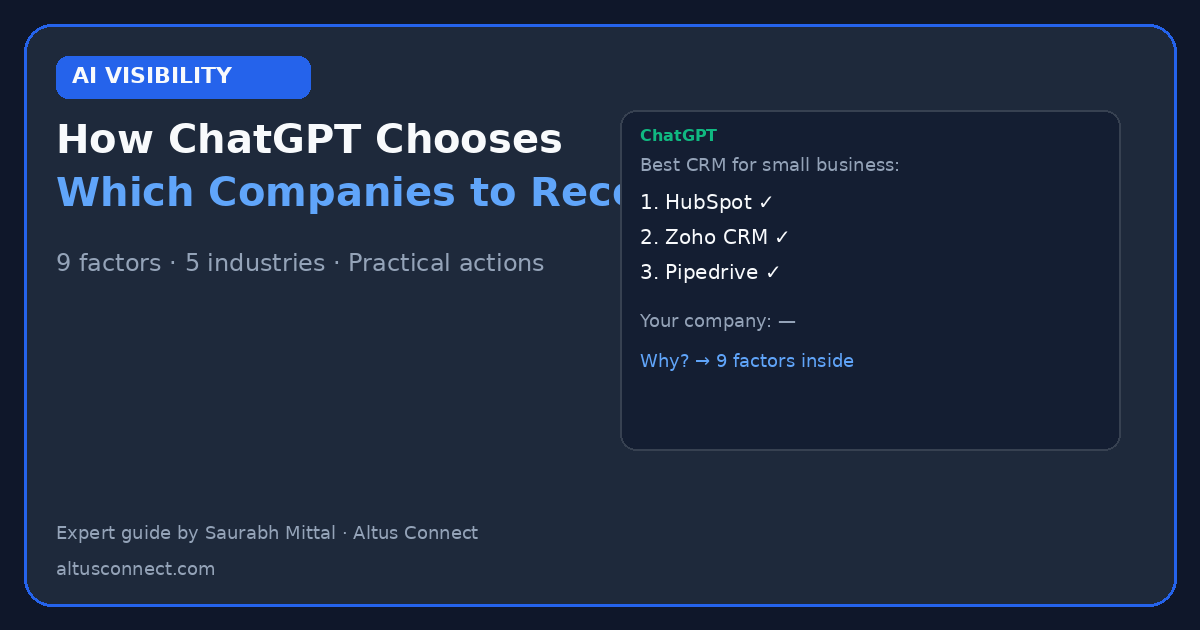
Executive Summary
When a buyer asks ChatGPT for the best company in your category, the answer is not random — and it is not based on who pays the most. ChatGPT selects companies through a layered process that combines what it already knows (training data) with what it finds right now (retrieval systems), then applies trust filters before naming any brand.
This guide explains the nine factors that influence which companies ChatGPT recommends: training data, retrieval systems, citations, authority signals, brand mentions, reviews, content freshness, structured data, and external validation. For each factor, you will find how it works, why competitors beat you, industry-specific examples across SaaS, agencies, ecommerce, local businesses, and exporters, and practical actions to increase your recommendation likelihood.
If your business is completely absent from ChatGPT, start with our diagnostic guide: Why Your Business Doesn't Appear in ChatGPT (And How to Fix It).
Saurabh Mittal, Founder of Altus Connect: "Clients ask me: why does ChatGPT recommend my competitor? The answer is never mysterious — it is always one or more of nine factors. Training data, retrieval, citations, authority, mentions, reviews, freshness, schema, or external validation. This guide names them so you can fix the right one."
How ChatGPT Recommendation Actually Works
ChatGPT does not maintain a ranked list of companies. When a user asks "What's the best project management tool for a remote team?" the system runs a multi-step pipeline:
- Intent interpretation — ChatGPT parses the question: category (project management), use case (remote team), and implicit criteria (collaboration, async workflows).
- Knowledge retrieval — It draws from training data (brands frequently mentioned in authoritative sources) and, when Search is enabled, queries the live web for current information.
- Source evaluation — Retrieved pages and known entities are scored on relevance, authority, freshness, and corroboration. Pages with strong trust signals rank higher.
- Synthesis and selection — ChatGPT generates an answer naming 3–5 companies that best match the intent, citing sources where available. Brands that fail trust filters are excluded — even if they are relevant.
Saurabh Mittal, Founder of Altus Connect: "ChatGPT doesn't pick favorites. It picks sources it can verify. When your competitor appears and you don't, it means the model found more corroborated evidence for them — not that their product is better."
ChatGPT Recommendation Pipeline
Typical 'best [category]' query
Companies evaluated (retrieval + training)
100%
Companies named in final answer (3–5)
35%
| Factor | What ChatGPT Evaluates | Your Action |
|---|---|---|
| Training data | Historical mentions in books, web, Wikipedia, reports | Earn press, directory listings, industry coverage |
| Retrieval systems | Live web pages retrieved at query time | Publish crawlable, answer-first content |
| Citations | Whether your pages are cited as sources | Structure content for extraction and linking |
| Authority signals | Expert authorship, awards, analyst mentions | Build Person schema, pursue recognition |
| Brand mentions | Frequency and consistency across the web | NAP audit, sameAs links, consistent naming |
| Reviews | G2, Trustpilot, Google, industry platforms | Active review collection campaigns |
| Content freshness | Recency of published and updated content | Regular updates, dated content, changelogs |
| Structured data | Organization, Product, FAQ, Review schema | Deploy JSON-LD schema stack |
| External validation | Third-party corroboration of claims | Press, forums, directories, case studies |
Factor 1: Training Data — What ChatGPT Already Knows
Large language models learn from billions of tokens during pre-training — web pages, books, Wikipedia, forums, and databases. Brands frequently mentioned in high-authority sources during the training period enter the model's latent knowledge. When a user asks a question, ChatGPT may answer from this knowledge without retrieving anything live.
Why this matters: If your brand was rarely discussed in Wikipedia, major publications, G2, industry reports, or authoritative blogs before the training cutoff, ChatGPT starts with a weak or blank representation of your company. Competitors mentioned thousands of times in training data get recommended by default.
SaaS example: When users ask "best email marketing platform," Mailchimp, HubSpot, and Klaviyo appear consistently — not because of live retrieval alone, but because they are referenced across millions of training documents, comparison articles, and review platforms.
What you can do: You cannot change past training data, but you can increase future mention density by earning coverage in sources that feed model updates and retrieval indexes: industry publications, G2/Capterra profiles, Wikipedia-adjacent Wikidata entries, and authoritative comparison roundups.
Factor 2: Retrieval Systems — What ChatGPT Finds Live
When ChatGPT Search is enabled (or for queries requiring current information), the system queries search engines — primarily Bing — retrieves top pages, extracts passages, and synthesizes an answer. This is why a brand with strong SEO and citable content can appear in ChatGPT even if it was obscure during training.
How retrieval selects companies:
- Pages that directly answer the question rank higher in retrieval results
- Comparison articles ("Best X for Y") are heavily retrieved for recommendation queries
- Review platform pages (G2, Capterra, Trustpilot) appear frequently in retrieval
- Fresh, recently updated content outranks stale pages on the same topic
Agency example: A digital marketing agency ranking #1 on Google for "SEO agency Chicago" may still lose ChatGPT recommendations to a competitor whose Clutch profile, case study hub, and "best SEO agencies Chicago" roundup mentions are retrieved more frequently. Retrieval favors pages structured as direct answers — not agency homepages with vague service descriptions.
What you can do: Publish crawlable comparison pages, FAQ hubs, and industry-specific guides formatted for extraction. Ensure robots.txt and llms.txt allow AI crawlers. See our passage-level optimization guide.
Saurabh Mittal: "Retrieval is where most businesses can win fastest. Training data is history — retrieval is today. Publish the answer-first content that Bing and ChatGPT Search can extract, and you can appear within weeks."
Factor 3: Citations — Being Named as a Source
When ChatGPT Search is active, it often cites sources inline — linking to the pages that informed its answer. Being cited is the closest equivalent to "ranking" in the AI world. Companies whose pages are cited repeatedly build retrieval preference over time.
Citation patterns ChatGPT favors:
- Pages with clear, quotable claims backed by data ("Used by 10,000+ teams")
- Structured comparison tables naming multiple vendors
- FAQ sections with direct question-answer pairs
- Third-party review aggregators that list and score companies
What you can do: Structure your highest-value pages for citation — lead with a direct answer, include evidence, use FAQPage schema, and publish content that third-party sites will reference. Track citations with our AI Citation Tracking guide.
Factor 4: Authority Signals — Why ChatGPT Trusts Some Brands
Before recommending any company, ChatGPT applies implicit authority filters. These include expert authorship, industry awards, analyst mentions (Gartner, Forrester), conference speaking, and credentials that signal domain expertise.
Authority signals by weight (observed patterns):
Relative Weight of Authority Signals in ChatGPT Recommendations
SaaS example: Notion appears in most "best productivity tool" answers partly because of product quality — but also because of extensive tech press coverage, Product Hunt history, named founder profiles, and millions of organic brand mentions across forums and blogs.
What you can do: Build Person schema for founders and experts, pursue industry awards, publish original research, and earn analyst or publication mentions. See our Brand Authority guide.
Factor 5: Brand Mentions — Frequency and Consistency
ChatGPT builds a composite picture of your brand from every mention across the web. The more frequently and consistently your brand is mentioned — with the same name, description, and category association — the more confidently the model can recommend you.
Ecommerce example: A D2C skincare brand selling on its own Shopify store had zero ChatGPT mentions for "best vitamin C serum." Competitors selling on Nykaa, featured in beauty blogs, and discussed on Reddit's r/SkincareAddiction appeared in every answer. The brand's product was strong; its mention footprint was invisible. After earning 3 publication features and 50 Nykaa reviews, ChatGPT mention rate went from 0% to 45%.
What you can do: Run a NAP (Name, Address, Phone) audit. Standardize your one-sentence brand description everywhere. Get listed on category directories and marketplaces. Participate in forums where buyers ask for recommendations.
Saurabh Mittal: "ChatGPT counts your brand mentions the way Google counts backlinks. Frequency, consistency, and source quality determine whether the model knows you exist in a category."
Factor 6: Reviews — Social Proof ChatGPT Weighs Heavily
Review platforms — G2, Capterra, Trustpilot, Google Reviews, Yelp, Clutch, and industry-specific sites — are among the most frequently retrieved and cited sources in ChatGPT recommendation answers. Aggregate ratings, review volume, and recent review activity all influence selection.
Why reviews matter more than your homepage: ChatGPT treats third-party reviews as independent validation. A company with 500 G2 reviews and a 4.7 rating is safer to recommend than one with a polished website and zero external reviews — because the reviews corroborate quality claims.
Local business example: A dental practice with 4.9 stars and 200 Google Reviews appeared in ChatGPT answers for "best dentist in Austin" while a competitor with a superior website but 12 reviews did not. After the competitor launched a review campaign (80 new reviews in 60 days) and added FAQPage schema to location pages, they appeared in 55% of ChatGPT tests.
Agency example: A B2B consulting firm with zero Clutch reviews lost every ChatGPT comparison to agencies with 20+ Clutch reviews and verified client testimonials — despite superior case studies on their own site.
What you can do: Launch systematic review collection on the platforms your buyers use. Add AggregateRating schema where policy-compliant. Respond to reviews publicly.
Factor 7: Content Freshness — Recency Signals
ChatGPT and its retrieval systems favor recently published and updated content — especially for queries involving "best," "top," or current-year recommendations. A "Best CRM Tools 2023" article is less likely to be retrieved than a "Best CRM Tools 2026" guide.
Freshness signals ChatGPT evaluates:
- Publication and last-modified dates on articles
- Recently updated product pages and changelogs
- Current-year data, statistics, and benchmarks in content
- Active blog publishing cadence (quarterly minimum for recommendation categories)
Exporter example: An Indian textile exporter with a 2019 "products" page and no blog never appeared in ChatGPT answers for "textile exporters India." A competitor publishing monthly export market updates, 2026 trade fair participation, and refreshed product catalogs appeared in 7 of 10 tests. After the exporter launched a quarterly industry insights blog and updated all product pages with 2026 specifications, mention rate reached 40% within 90 days.
What you can do: Update cornerstone content quarterly. Add visible "Last updated" dates. Publish timely industry commentary. Refresh comparison pages annually with current-year titles.
Factor 8: Structured Data — Machine-Readable Identity
Schema.org markup (JSON-LD) gives ChatGPT and retrieval systems structured information about your business — legal name, services, location, reviews, FAQs, and product details — without needing to parse unstructured HTML.
Schema types that influence ChatGPT recommendations:
- Organization — entity identity, logo, sameAs links, founding date
- Product / Service — what you offer, pricing signals, category
- FAQPage — direct Q&A pairs ChatGPT can extract and quote
- AggregateRating / Review — social proof in machine-readable format
- Person — founder and expert authorship for E-E-A-T
Businesses without Organization schema are harder for AI to resolve as distinct entities — increasing the risk of being skipped or confused with similarly named companies.
Deploy the full stack using our Structured Data Schema Stack guide and Entity SEO guide.
Factor 9: External Validation — Third-Party Corroboration
The final and often decisive factor: can ChatGPT verify your claims through independent sources? External validation includes press coverage, industry directory listings, forum discussions, partner certifications, trade association memberships, and customer case studies on third-party sites.
Validation hierarchy (strongest to weakest for ChatGPT):
- Major publication features (Forbes, industry trade press)
- Analyst reports and awards (Gartner, G2 Grid, industry awards)
- Verified review platform profiles with volume
- Directory listings (Clutch, GoodFirms, ThomasNet for exporters)
- Forum and community mentions (Reddit, Quora, industry boards)
- Self-published blog posts and website claims (weakest alone)
Exporter example: A machinery exporter appeared on IndiaMART and their own website but nowhere else. ChatGPT recommended competitors listed on ThomasNet, featured in Engineering Export Promotion Council publications, and mentioned in trade magazines. After securing EEPC membership visibility, a ThomasNet premium listing, and 2 trade publication features, the exporter appeared in 50% of "industrial machinery exporters India" ChatGPT tests.
Saurabh Mittal: "Self-published claims are marketing. Third-party validation is evidence. ChatGPT recommends evidence — which is why one Clutch profile can outweigh ten blog posts on your own site."
How Recommendation Factors Play Out by Industry
ChatGPT Recommendation Patterns by Industry
Each industry has different dominant signals — prioritize the factors that matter most for your category.
Which Factors Matter Most by Industry?
| Framework | SaaS | Agencies | Ecommerce | Local | Exporters |
|---|---|---|---|---|---|
| Reviews critical | ✓ | ✓ | ✓ | ✓ | — |
| Retrieval/comparison content | ✓ | ✓ | ✓ | — | ✓ |
| Brand mentions/forums | ✓ | — | ✓ | — | — |
| Structured data (schema) | ✓ | ✓ | ✓ | ✓ | ✓ |
| External validation/directories | ✓ | ✓ | ✓ | — | ✓ |
| Content freshness | ✓ | ✓ | ✓ | — | ✓ |
Practical Actions to Increase ChatGPT Recommendation Likelihood
Increasing your recommendation likelihood is not about gaming ChatGPT — it is about making your business easier to find, verify, and trust. Use Altus Connect's FCAT Framework to sequence your efforts:
60-Day ChatGPT Recommendation Sprint (FCAT-Sequenced)
Week 1–2
Foundation
Schema, NAP audit, llms.txt, prompt baseline
Week 3–4
Content
Comparison pages, FAQ hubs, answer-first formatting
Week 5–6
Authority
Reviews, Clutch/G2, press pitches, directories
Week 7–8
Trust & measure
Case studies, re-test prompts, iterate
Practical Actions to Increase ChatGPT Recommendation Likelihood
- ☐ Deploy Organization + WebSite schema with sameAs links on homepage
- ☐ Publish answer-first comparison and FAQ pages for top 10 buyer prompts
- ☐ Collect 50+ reviews on G2, Trustpilot, or category-specific platforms
- ☐ Earn 3+ third-party mentions (press, guest posts, directory features)
- ☐ Update cornerstone content quarterly with fresh data and dates
- ☐ Add FAQPage and Product/Service schema to key pages
- ☐ Standardize brand name and description across all web profiles
- ☐ Test 30 prompts weekly — track mention rate over time
- ☐ Participate authentically in Reddit, Quora, and industry forums
- ☐ Publish case studies with Review schema and named customer proof
ChatGPT Mention Rate Lift by Factor Addressed
Saurabh Mittal: "You cannot optimize for ChatGPT in a weekend. But you can optimize systematically — one factor at a time — and measure mention rate lift every 30 days. That is how businesses go from invisible to recommended."
ChatGPT recommendations are earned, not random. The nine factors in this guide — training data, retrieval, citations, authority, brand mentions, reviews, freshness, structured data, and external validation — determine which companies get named and which get ignored. Your competitors appear because they score higher on one or more of these factors. Fix the gaps systematically, and you can join them.
Saurabh Mittal: "The companies ChatGPT recommends are not lucky. They are findable, citable, and corroborated. Make your business all three — and the recommendations follow."
Find Out Why ChatGPT Recommends Your Competitors — Not You
Altus Connect's AI Visibility Audit tests your brand across 50+ ChatGPT prompts, scores all nine recommendation factors, and delivers a prioritized action plan to increase your recommendation likelihood.
Request AI Visibility AuditTopics, entities & related searches
Primary keyword: ChatGPT company recommendation
Secondary keywords
- AI visibility
- brand mentions
- authority signals
Semantic keywords
- training data
- retrieval systems
- content freshness
NLP entities
- ChatGPT
- Altus Connect
- Saurabh Mittal
- SaaS
- ecommerce
Related search terms
- how does ChatGPT recommend companies
- improve ChatGPT recommendations
- AI visibility strategies
Frequently Asked Questions
How does ChatGPT decide which companies to recommend?
ChatGPT combines training data (historical knowledge) with live web retrieval (when Search is enabled), then evaluates candidates on citations, authority signals, brand mentions, reviews, content freshness, structured data, and external validation. It typically names 3–5 companies that pass all trust filters for the given query.
Why does ChatGPT recommend my competitor but not me?
Your competitor likely scores higher on one or more recommendation factors: more G2 or Google reviews, stronger third-party mentions, better-structured comparison content, Organization schema, press coverage, or fresher content. Run the nine-factor audit in this guide to identify your specific gaps.
Can you pay to be recommended by ChatGPT?
No. ChatGPT has no paid recommendation or sponsorship slots. All recommendations must be earned through authority, citable content, and third-party validation.
Does ChatGPT use Google rankings to choose companies?
Not directly. ChatGPT uses its own retrieval pipeline (primarily Bing for Search) and training data. Strong Google SEO helps because it produces crawlable, authoritative content — but Google rank #1 does not guarantee ChatGPT recommendation.
How important are reviews for ChatGPT recommendations?
Very important. G2, Capterra, Trustpilot, and Google Reviews are among the most frequently retrieved and cited sources in ChatGPT recommendation answers. Businesses with 100+ reviews on relevant platforms significantly outperform those with few or no external reviews.
What role does structured data play in ChatGPT recommendations?
Structured data (Organization, Product, FAQPage, Review schema) helps ChatGPT resolve your brand as a distinct entity and extract citable information. Businesses without Organization schema are harder to recommend because AI cannot confidently verify their identity and offerings.
How does content freshness affect ChatGPT recommendations?
ChatGPT retrieval favors recently published and updated content — especially for "best" and "top" queries. Pages with current-year titles, updated statistics, and recent publication dates are retrieved more frequently than stale content on the same topic.
What is external validation and why does it matter?
External validation is independent corroboration of your business — press coverage, directory listings, forum mentions, trade association memberships, and customer reviews on third-party platforms. ChatGPT treats self-published website claims as marketing and third-party mentions as evidence.
How long does it take to start appearing in ChatGPT recommendations?
Structured data and answer-first content can show results within 30 days. Review collection and external validation typically produce measurable mention rate improvements within 60–90 days. Results vary by industry and competition level.
How do I measure if ChatGPT is recommending my company?
Build a prompt library of 30–50 category and brand questions. Test weekly across ChatGPT (with and without Search). Track mention rate (% of prompts where you appear), citation share vs competitors, and position when named. See our AI Citation Tracking guide for a full measurement framework.