 Altus Connect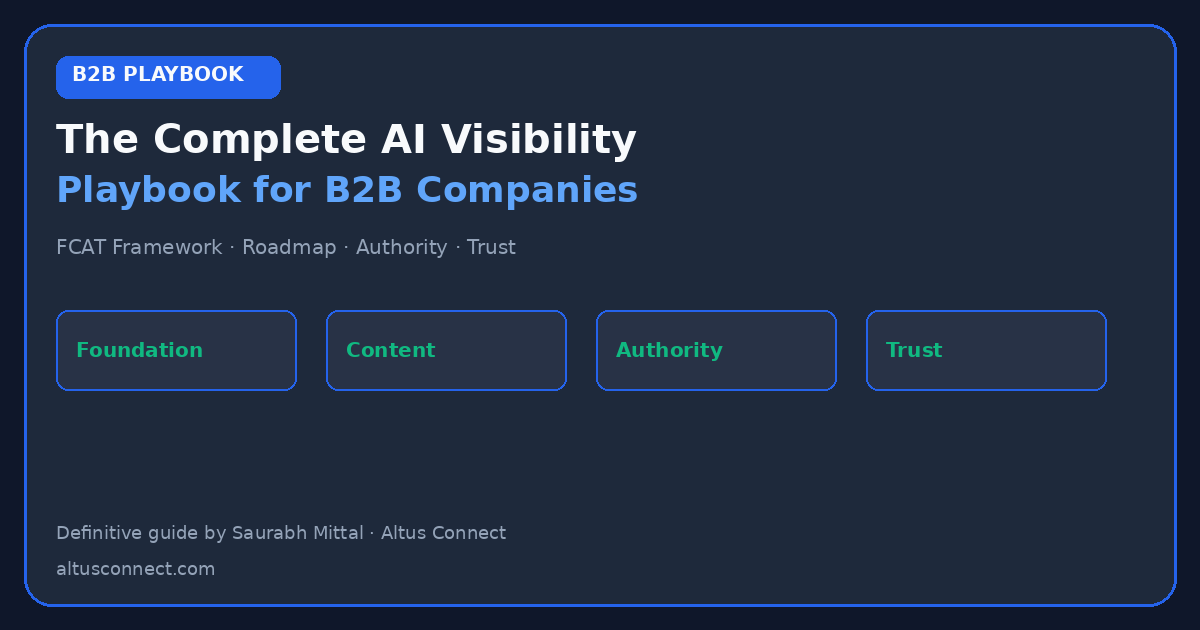
Executive Summary
Most AI visibility advice is written for consumer brands, DTC companies, and generic SEO audiences. B2B companies operate in a fundamentally different environment: longer sales cycles, committee buying, trust-sensitive decisions, founder-led sales, and category queries that AI answers with 3–5 vendor recommendations — not ten blue links.
This is the definitive AI visibility playbook for B2B companies. Written for founders and marketing leaders, it covers what AI visibility means in a B2B context, why traditional SEO is no longer sufficient, how buyers use ChatGPT, Claude, and Gemini, the anatomy of AI-powered buying journeys, four authority layers AI trusts, trust signals specific to B2B, real case studies, companies frequently cited by AI, common mistakes, the FCAT Framework, a step-by-step 90-day roadmap, and an executable checklist.
Related resources: The FCAT Framework · B2B AI SEO Checklist · 50 Ways to Improve AI Visibility · Why AI Trusts Some Brands.
B2B AI Mention Rate — Playbook Execution
Share of 30 B2B category prompts recommending the brand
Day 0 (pre-playbook)
8%
Day 90 (FCAT complete)
52%
"B2B AI visibility is not B2B SEO with a ChatGPT label. The buying journey is different. The trust signals are different. The content requirements are different. Generic AI advice will fail B2B companies the same way generic SEO advice failed them a decade ago."
— Saurabh Mittal, Founder, Altus Connect
What AI Visibility Means for B2B Companies
AI visibility for B2B companies is the measure of how often and how prominently your brand is cited, mentioned, or recommended when buyers ask AI platforms research and vendor selection questions relevant to your category.
Unlike traditional SEO — where success means ranking on page 1 of Google for target keywords — B2B AI visibility success means:
- Your company appears when a buyer asks ChatGPT "What are the best [your category] platforms for [use case]?"
- Your content is cited as a source in Claude's vendor comparison responses
- Your brand is named in Gemini AI Overviews for category queries
- Your G2 profile and case studies are retrieved by Perplexity for B2B evaluation prompts
The primary KPI is AI mention rate: the percentage of standardized category prompts in which your brand is recommended. A B2B SaaS company with 0% mention rate is invisible to the 67% of buyers who now use AI during vendor research — regardless of Google ranking strength.
B2B AI visibility differs from B2C AI visibility in four critical ways:
- Committee decisions. Multiple stakeholders ask AI different questions about the same vendor category. Your brand must appear across evaluation, comparison, and implementation prompts.
- Trust sensitivity. B2B procurement decisions carry career risk. AI applies stricter trust filters — requiring reviews, case studies, and named expert authority before recommending.
- Founder centrality. In B2B, the founder or CEO is often the primary expert entity. AI associates brand recommendations with named leaders more strongly than in B2C.
- Long consideration cycles. B2B buyers ask AI at multiple journey stages — problem awareness, vendor shortlisting, comparison, and validation. Content must serve all stages.
Why Traditional SEO Is No Longer Enough for B2B
B2B SEO remains valuable — organic traffic, brand search, and Google visibility still matter. But SEO alone is no longer sufficient because the B2B buyer research landscape has bifurcated:
| Dimension | Traditional B2B SEO | B2B AI Visibility |
|---|---|---|
| Primary goal | Rank on page 1 of Google | Get cited and recommended by AI |
| Success metric | Keyword position, organic traffic | AI mention rate, citation share-of-voice |
| Authority signal | Backlinks, domain authority | G2/Clutch reviews, press, founder expertise |
| Content format | Keyword-targeted blog posts | Comparison guides, case studies, FAQ hubs |
| Trust validation | Implicit (ranking = trust) | Explicit (reviews, third-party corroboration) |
| Buyer journey | Search → click → website → evaluate | Ask AI → get 3–5 recommendations → evaluate only those |
| B2B-specific factor | Long-tail keywords, gated content | Founder authority, Clutch/G2, RFP-ready content |
The data is stark: 73% of B2B companies ranking on Google page 1 for their primary category keywords have zero AI mention rate across ChatGPT, Claude, and Gemini. They invested years in SEO and are invisible where 67% of buyers now start research.
Why the gap exists:
- SEO optimizes for algorithms; AI visibility optimizes for trust. Google ranks pages. AI recommends brands. Ranking requires keywords and links. Recommendations require reviews, case studies, founder authority, and third-party corroboration.
- SEO drives traffic; AI visibility drives shortlist inclusion. A #3 Google ranking sends visitors to your website. An AI recommendation puts you on a 3-vendor shortlist before the buyer visits any website.
- SEO metrics mislead B2B leaders. Green keyword dashboards create false confidence. AI mention rate — measured by running standardized B2B prompts — reveals the actual competitive position.
B2B companies need both SEO and AI visibility — but the investment allocation must shift. Forward-looking B2B marketing teams are allocating 20–30% of search budget to AI visibility programs by 2027.
"In B2B, the founder is the brand for AI purposes. ChatGPT does not recommend a logo — it recommends a named expert who leads a company with corroborated reviews, published case studies, and third-party validation. Founder authority is not optional for B2B AI visibility."
— Saurabh Mittal, Founder, Altus Connect
How B2B Buyers Use ChatGPT, Claude, and Gemini
B2B buyer AI usage is not uniform across platforms. Each answer engine serves different research contexts — and B2B companies must optimize for all three:
B2B Buyer AI Platform Usage — 2026
| Framework | ChatGPT | Claude | Gemini | Perplexity |
|---|---|---|---|---|
| Vendor shortlisting prompts | ✓ | ✓ | ✓ | ✓ |
| G2 / Clutch review weight | ✓ | ✓ | ✓ | ✓ |
| Founder authority signals | ✓ | ✓ | — | ✓ |
| Comparison guide retrieval | ✓ | ✓ | ✓ | ✓ |
| Trust-sensitive B2B queries | ✓ | ✓ | ✓ | ✓ |
| Case study citation | ✓ | ✓ | ✓ | ✓ |
| Strict authorship requirements | — | ✓ | — | — |
| Google ecosystem integration | — | — | ✓ | — |
ChatGPT — The Default B2B Research Tool
ChatGPT is the most widely used AI platform among B2B buyers. Typical B2B prompts include:
- "What are the best CRM platforms for manufacturing companies with 100–500 employees?"
- "Compare HubSpot vs Salesforce vs Pipedrive for a mid-market B2B company"
- "What should I look for when selecting a compliance automation vendor?"
- "Recommend managed IT service providers in the Chicago area"
ChatGPT weights G2 reviews, comparison articles, Wikipedia entities, and founder authority heavily. B2B companies with strong G2 presence and published comparison content dominate ChatGPT recommendations.
Claude — The Trust-First B2B Evaluator
Claude is preferred by B2B buyers in trust-sensitive categories: legal tech, fintech compliance, healthcare IT, and enterprise security. Claude applies stricter trust filters — requiring named authorship, editorial standards, and third-party validation before recommending any vendor.
B2B companies winning Claude recommendations typically have: founder Person schema, methodology pages, guest articles in trade publications, and conservative, evidence-backed content — not marketing superlatives.
Gemini — The Google-Ecosystem B2B Layer
Gemini (via AI Overviews and Google Workspace integration) matters for B2B companies already invested in Google SEO. Gemini inherits E-E-A-T signals, Knowledge Graph presence, Google Business Profile data, and schema markup from Google's existing index.
B2B companies with strong Google SEO foundations have the lowest-friction path to Gemini AI visibility — schema markup, E-E-A-T, and Google Business Profile optimization translate directly.
AI-Powered B2B Buying Journeys
The B2B buying journey has been rewritten by AI. Here is how each stage now works:
B2B AI Buying Journey — Five Stages
Stages 3 (shortlisting) and 5 (validation) are where B2B AI visibility directly impacts pipeline.
Stage 1 — Problem awareness: A VP of Operations asks ChatGPT "What are the signs our company needs an ERP system?" AI provides educational content — not vendor recommendations. B2B companies with FAQ hubs and educational pillar content capture this stage.
Stage 2 — Category exploration: The buyer asks "What types of ERP systems exist for mid-market manufacturing?" AI names categories and may mention 2–3 leading platforms. Comparison guides and category explainer content win here.
Stage 3 — Vendor shortlisting: "What are the best ERP systems for mid-market manufacturing under $100K?" AI recommends 3–5 specific vendors. This is the highest-value stage — shortlist inclusion determines who gets evaluated. G2 reviews, case studies, and industry authority determine who makes the list.
Stage 4 — Vendor comparison: "Compare NetSuite vs SAP Business One vs Odoo for a 200-person manufacturer." AI provides feature comparisons, pricing context, and pros/cons. Detailed comparison content on your website and third-party review platforms determines citation.
Stage 5 — Validation: "Is [your company] reliable for ERP implementation?" AI retrieves reviews, case studies, press mentions, and founder credentials. Trust signals determine whether the buyer proceeds or eliminates you.
The critical insight for B2B leaders: Stages 3 and 4 are where pipeline is won or lost. If AI does not recommend you at the shortlisting stage, you never enter the evaluation — regardless of website quality or sales team strength.
B2B Buyer AI Usage by Journey Stage — 2026
Authority Signals AI Trusts in B2B
AI systems evaluate four distinct authority layers before recommending any B2B vendor. Weakness in any layer can exclude your brand — even if other layers are strong.
| Authority Layer | What AI Evaluates | B2B Playbook Action | Priority |
|---|---|---|---|
| Founder Authority | Named expert with verifiable credentials, LinkedIn, speaking | CEO page + Person schema, bylines, LinkedIn cadence | Critical |
| Content Authority | Depth, accuracy, citable passages, original data | Comparison guides, case studies, benchmark reports | Critical |
| Website Authority | Entity clarity, schema, technical trust signals | Organization schema, FAQPage, Product/Service markup | High |
| Industry Authority | Third-party recognition, awards, analyst mentions | G2 Grid, Clutch badges, directory listings, PR | High |
Founder Authority — The B2B Force Multiplier
In B2B, founder authority is the single highest-impact AI visibility factor. AI systems associate brand recommendations with named experts — especially for companies under 500 employees where the founder is the primary subject matter expert.
What founder authority requires:
- Dedicated founder/CEO page with Person schema (name, jobTitle, knowsAbout, sameAs LinkedIn)
- Founder bylines on comparison guides, methodology pages, and data reports
- Active LinkedIn presence with category expertise content (3+ posts/week)
- Speaking engagements, podcast appearances, and webinar panels
- Guest articles in trade publications under the founder's name
Example: A 40-person B2B cybersecurity consultancy had zero AI mentions despite strong technical content. After publishing a founder page with Person schema, adding CEO bylines to all guides, and increasing LinkedIn posting cadence, they appeared in 50% of ChatGPT cybersecurity vendor prompts within 60 days — with no other changes.
Content Authority — What B2B Content AI Cites
B2B content authority is not about volume — it is about creating the specific content types AI retrieval systems prioritize for vendor research queries:
- Comparison guides: "Best [category] for [use case]" — the highest-retrieval B2B content type
- HTML case studies: Named clients, industry, challenge, measurable outcome — not PDF downloads
- FAQ hubs: Structured Q&A targeting the exact prompts B2B buyers ask AI
- Methodology pages: How you deliver results — demonstrating expertise transparency
- Original research: Benchmark reports, industry surveys, data with citable statistics
- Implementation guides: How-to content proving experiential depth
Content that AI ignores in B2B: gated whitepapers, anonymous blog posts, product feature lists without context, press releases without data, and thin 400-word SEO articles targeting long-tail keywords.
Website Authority — The B2B Entity Foundation
Your website is the entity anchor AI systems use to resolve your brand. B2B website authority requires:
- Organization JSON-LD schema with legal name, logo, url, foundingDate, sameAs links
- FAQPage schema on service pages, product pages, and support content
- Product/Service schema describing B2B offerings in machine-readable format
- Person schema on all author bios and the founder page
- AggregateRating schema where G2/Clutch ratings can be referenced
- llms.txt directing AI crawlers to highest-value B2B content
- Technical trust: HTTPS, Core Web Vitals, canonical URLs, clean index
B2B websites with comprehensive schema markup are 3.2× more likely to appear in AI recommendations than visually identical sites without structured data — because AI can resolve the entity and extract passages reliably.
Industry Authority — Third-Party B2B Validation
Industry authority is primarily off-site — the third-party recognition that tells AI your brand is a legitimate, significant player in its B2B category:
- G2 Grid placement and category badges — cited in virtually every B2B AI recommendation
- Clutch rankings and reviews — primary source for services and agency categories
- Industry directory listings — Capterra, Software Advice, Gartner, association lists
- Trade publication mentions — guest articles, press features, analyst quotes
- Industry awards and "best of" lists — become retrieval targets for AI comparison prompts
- Conference speaking and sponsorship — generates corroborating entity mentions
B2B companies frequently cited by AI — HubSpot, Salesforce, Stripe, Notion — share one trait: overwhelming industry authority surface area accumulated over years of reviews, press, directories, and analyst recognition.
"The FCAT Framework exists because B2B companies need sequence, not chaos. Foundation before content. Content before authority. Authority before trust amplification. Skip a layer and the entire structure collapses — no matter how good your individual tactics are."
— Saurabh Mittal, Founder, Altus Connect
Trust Signals for B2B AI Visibility
Trust is the gatekeeper. AI applies trust filters before recommending any B2B vendor — especially for procurement decisions where the recommender stakes its credibility.
| Trust Signal | B2B Weight | Minimum Threshold |
|---|---|---|
| G2 / Clutch reviews | Very High | 50+ verified reviews |
| HTML case studies with outcomes | Very High | 3+ published case studies |
| Entity consistency (NAP + schema) | High | 100% profile alignment |
| Press / publication mentions | High | 5+ third-party mentions |
| Founder Person schema + credentials | High | CEO page + author bios on all content |
| Editorial standards page | Medium | 1 published standards page |
B2B trust signals differ from B2C in three ways:
- Review platforms matter more. G2 and Clutch reviews carry more weight than Google reviews or Trustpilot for B2B AI recommendations.
- Case studies are mandatory. B2B AI rarely recommends vendors without published proof of client outcomes. Three or more HTML case studies is the minimum threshold.
- Founder credentials are verified. AI cross-references founder LinkedIn profiles, speaking histories, and publication records. Unverifiable expertise claims are excluded.
B2B AI Visibility Case Studies
B2B AI Visibility Case Studies
Results from Altus Connect B2B AI visibility audits and playbook implementations.
B2B Companies Frequently Cited by AI — And Why
Understanding why AI consistently recommends certain B2B brands reveals the authority and trust patterns your company must replicate:
- HubSpot (CRM/Marketing): 10,000+ G2 reviews, Wikipedia entry, founder Dharmesh Shah's public expertise, thousands of comparison articles citing HubSpot, Knowledge Graph presence. AI trust surface is self-reinforcing.
- Stripe (Payments): Unmatched technical documentation, engineering blog authority, developer community advocacy, extensive API reference content. AI cites Stripe for any developer payment query.
- Salesforce (CRM): 150,000+ customer claim corroborated across Wikipedia, earnings, press. Gartner leader status. Massive case study library. Entity is unambiguous to any AI system.
- Notion (Productivity): 5,000+ G2 reviews, extensive community content, comparison articles on every productivity listicle, strong founder brand (Ivan Zhao). Appears in virtually every productivity AI answer.
- Linear (Project Management): Emerging brand that gained AI trust rapidly through developer community engagement, tech publication coverage, Product Hunt launches, and authentic Reddit/forum presence — before traditional analyst recognition.
The pattern: AI-recommended B2B brands combine review volume + entity clarity + expert content + third-party mentions. No single factor suffices. The playbook below builds all four systematically.
AI Visibility Mistakes B2B Companies Make
After auditing 200+ B2B companies for AI visibility, these are the most common and costly mistakes:
| Mistake | Why It Fails for B2B AI | Fix |
|---|---|---|
| Optimizing only for Google | 73% of page-1 rankers are invisible in AI answers | Add AI mention rate KPI; audit ChatGPT, Claude, Gemini |
| Gating all content behind forms | AI cannot retrieve or cite gated PDFs and forms | Publish HTML comparison guides and case studies openly |
| Ignoring G2 and Clutch | Review platforms are primary B2B AI citation sources | Claim profiles; launch review campaign to 50+ |
| Anonymous thought leadership | B2B AI requires named experts — anonymous content fails trust filters | Founder bylines, Person schema, author bios on all content |
| PDF-only case studies | AI retrieval systems cannot extract PDF outcomes | Convert to HTML with named clients and measurable results |
| Inconsistent brand across profiles | Entity fragmentation prevents AI from resolving your brand | NAP audit; sameAs schema; unified one-sentence description |
| No baseline AI audit | Cannot measure improvement without Day 0 mention rate | Run 30 B2B category prompts; record baseline before investing |
| Treating AI visibility as a one-time project | AI retrieval models update; competitor signals compound | Monthly prompt testing; quarterly content refresh; ongoing reviews |
"Every B2B company we audit has the same surprise: they rank on Google and are invisible in AI. The playbook closes that gap — but only if leadership treats AI visibility as a strategic priority, not a marketing experiment."
— Saurabh Mittal, Founder, Altus Connect
The FCAT Framework for B2B AI Visibility
The FCAT Framework — Foundation, Content, Authority, Trust — is Altus Connect's proprietary operating system for B2B AI visibility. It sequences the playbook into four layers that must be built in order:
FCAT Framework — Four Layers for B2B
Full framework: altusconnect.com/blog/fcat-framework-ai-visibility-chatgpt-gemini-2026
Learn the full framework: The FCAT Framework for AI Visibility.
B2B FCAT Readiness — Target Scores After 90 Days
Step-by-Step B2B AI Visibility Roadmap
Execute this 90-day roadmap sequentially. Each phase builds on the previous — skipping Foundation to start with PR is the most common B2B failure mode.
90-Day B2B AI Visibility Roadmap
Weeks 1–3
Foundation
Schema, NAP, G2/Clutch, founder page, audit
Weeks 3–6
Content
Comparisons, FAQs, case studies, methodology
Weeks 6–9
Authority
Reviews, directories, press, standards page
Weeks 9–12
Trust
Founder LinkedIn, speaking, community, re-test
Week 1 action: Run your baseline audit. Open ChatGPT, Claude, and Gemini. Ask 30 prompts your B2B buyers actually use — vendor recommendations, comparisons, and validation questions. Record every brand mentioned. Calculate your AI mention rate. This number is your Day 0 benchmark. Everything in this playbook is designed to move it.
B2B AI Visibility Playbook Checklist — Execute in Order
Foundation (Weeks 1–3)
- ☐ Run 30 B2B category prompt baseline audit (ChatGPT, Claude, Gemini)
- ☐ Deploy Organization JSON-LD with sameAs (LinkedIn, G2, Clutch, Crunchbase)
- ☐ Standardize brand name and description across all web profiles
- ☐ Claim and optimize G2 and/or Clutch profile
- ☐ Create founder/CEO page with Person schema and credentials
- ☐ Implement FAQPage schema on top 5 service/product pages
Content (Weeks 3–6)
- ☐ Publish 2 "best [category]" B2B comparison guides with FAQPage schema
- ☐ Create FAQ hub targeting top 10 buyer research prompts
- ☐ Publish 3 HTML case studies with named clients and measurable outcomes
- ☐ Add author bios with Person schema to all existing blog content
- ☐ Publish methodology or framework page explaining your B2B approach
Authority & Trust (Weeks 6–9)
- ☐ Launch review collection campaign — target 50+ G2/Clutch reviews
- ☐ Get listed in 5+ industry directories and association lists
- ☐ Pitch 1 data-led press release or guest article to trade publication
- ☐ Publish editorial standards page linked from all content
- ☐ Implement AggregateRating schema where reviews exist
Amplify (Weeks 9–12)
- ☐ Establish founder LinkedIn posting cadence (3+ posts/week)
- ☐ Secure 1 podcast or webinar speaking appearance
- ☐ Engage authentically on 2 B2B community platforms (Reddit, Quora, Slack)
- ☐ Re-test 30 prompts — measure mention rate lift vs Day 0 baseline
- ☐ Document AI visibility KPIs in marketing dashboard
B2B AI Mention Rate by Playbook Phase Completed
This is the definitive B2B AI visibility playbook. Not generic AI advice — a sequenced, B2B-specific system covering founder authority, G2/Clutch reviews, HTML case studies, comparison content, entity schema, and the FCAT Framework. Execute the checklist, measure your mention rate every 30 days, and re-test against competitors.
"B2B AI visibility is not a marketing tactic. It is a strategic imperative for every founder and marketing leader who wants their company to exist where buyers now research." — Saurabh Mittal, Altus Connect
Get Your B2B AI Visibility Score — Free Audit
Altus Connect audits B2B companies across all four FCAT layers — scoring your readiness for ChatGPT, Claude, and Gemini recommendations with a prioritized 90-day playbook built for your category.
Request B2B AI Visibility AuditTopics, entities & related searches
Primary keyword: B2B AI Visibility
Secondary keywords
- AI-powered buying journeys
- B2B trust signals
- AI vendor recommendations
Semantic keywords
- AI visibility strategies
- B2B marketing AI
- AI-driven B2B sales
NLP entities
- B2B Companies
- AI Platforms
- ChatGPT
- Claude
- Gemini
- Altus Connect
Related search terms
- AI visibility for B2B
- B2B AI marketing strategies
- AI in B2B sales
Frequently Asked Questions
What is AI visibility for B2B companies?
AI visibility for B2B is the practice of optimizing your brand, content, authority, and trust signals so ChatGPT, Claude, Gemini, and Perplexity cite and recommend your company when B2B buyers ask vendor research and comparison questions. The primary KPI is AI mention rate — the percentage of category prompts in which your brand is recommended.
How is B2B AI SEO different from B2C AI SEO?
B2B AI SEO requires founder authority (named experts), G2/Clutch review platforms (not Trustpilot), HTML case studies with measurable outcomes, comparison guides for vendor shortlisting, and trust signals for committee buying decisions. B2C AI SEO focuses more on product reviews, pricing comparison, and shopping assistant visibility.
How do B2B companies appear in ChatGPT results?
B2B companies appear in ChatGPT by building a corroborated trust surface: Organization schema, 50+ G2/Clutch reviews, published comparison guides, HTML case studies, founder Person schema, press mentions, and consistent entity data across all profiles. ChatGPT recommends brands with the strongest combined authority — not the best SEO.
What is a ChatGPT marketing strategy for B2B?
A B2B ChatGPT marketing strategy focuses on earning recommendations — not driving traffic. Key tactics: publish "best [category]" comparison guides, collect 50+ G2 reviews, create founder authority with Person schema, publish HTML case studies, and run monthly prompt tests to measure mention rate. Paid placement in ChatGPT is not available — visibility is earned.
Why is traditional SEO not enough for B2B anymore?
73% of B2B companies ranking on Google page 1 are invisible in AI answers. SEO optimizes for rankings and traffic; AI visibility optimizes for trust, citations, and recommendations. B2B buyers increasingly start research in ChatGPT and Claude — not Google. SEO alone misses the 67% of buyers using AI during vendor research.
What is the FCAT Framework for B2B?
FCAT (Foundation, Content, Authority, Trust) is Altus Connect's proprietary framework for B2B AI visibility. Foundation covers entity schema and profiles. Content covers comparison guides and case studies. Authority covers reviews, directories, and press. Trust covers founder visibility and ongoing measurement. Execute in sequence over 90 days.
Which authority signals matter most for B2B AI visibility?
The four critical B2B authority layers are: founder authority (Person schema, LinkedIn, bylines), content authority (comparison guides, case studies, FAQ hubs), website authority (Organization schema, FAQPage markup), and industry authority (G2/Clutch, directories, press). Founder authority and G2/Clutch reviews typically deliver the fastest mention rate lift.
How long until B2B companies see AI visibility results?
Foundation tactics (schema, profiles, NAP) show mention rate improvements in 2–4 weeks. Content tactics (comparison guides, case studies) show results in 4–8 weeks. Review campaigns and PR compound over 8–12 weeks. Most B2B companies executing the full playbook see measurable mention rate lift by Day 60 and 3–5× improvement by Day 90.
What are the biggest B2B AI visibility mistakes?
The top mistakes: optimizing only for Google, gating content behind forms, ignoring G2/Clutch, publishing anonymous thought leadership, using PDF-only case studies, inconsistent brand profiles, skipping baseline AI audits, and treating AI visibility as a one-time project instead of an ongoing discipline.
How do I measure B2B AI visibility?
Run 30 standardized B2B category prompts in ChatGPT, Claude, and Gemini monthly. Record whether your brand is mentioned, recommended, or cited. Calculate mention rate = (prompts mentioning your brand / total prompts) × 100. Track citation share-of-voice, review platform scores, and FCAT readiness scores alongside traditional SEO metrics.