 Altus Connect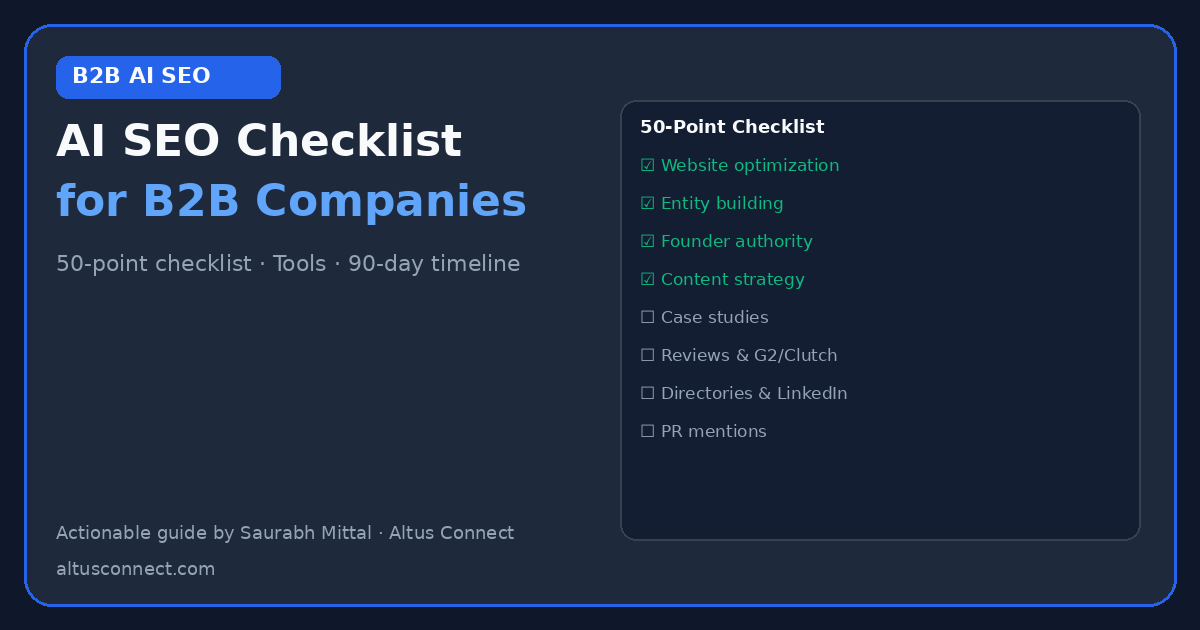
Executive Summary
B2B companies face a specific AI visibility challenge: long sales cycles, committee buying, and vendor research that increasingly starts in ChatGPT, Claude, and Gemini — not Google. Traditional SEO checklists miss the entity, authority, and citation layers that determine whether AI recommends your brand when a procurement team asks for the best solution.
This guide gives B2B marketing, growth, and founder teams a complete starting point: nine optimization categories, a 50-point checklist, common mistakes to avoid, recommended tools, a 90-day timeline, and FAQs — all mapped to Altus Connect's FCAT Framework.
Related: How to Get Cited by ChatGPT, Claude and Gemini · Google Ranking vs AI Visibility — 15 Differences.
Saurabh Mittal, Founder of Altus Connect: "B2B founders ask me where to start with AI visibility. I tell them: open this checklist, start at item 1, and do not skip to content marketing before entity building is done. Foundation first — always."
Why B2B AI SEO Is Different
B2B buyers ask AI different questions than B2C consumers. Prompts are longer, more specific, and committee-oriented:
- "Best CRM for a 50-person B2B SaaS sales team with HubSpot migration"
- "Top cybersecurity MSSP for healthcare HIPAA compliance"
- "Managed IT provider for manufacturing company in Midwest"
- "Enterprise data analytics consulting firms with Snowflake expertise"
AI systems match these prompts to brands with use-case-specific content, industry proof, review platform presence, and named expert authority — not generic homepage copy. B2B AI SEO is the discipline of building those signals systematically.
Saurabh Mittal, Founder of Altus Connect: "B2B companies fail AI visibility because they optimize for Google keywords when buyers ask ChatGPT long, specific vendor questions. The B2B AI SEO checklist fixes that mismatch — one item at a time."
Typical B2B Company — AI SEO Readiness by Category
1. Website Optimization for B2B AI Visibility
Your website is the foundation AI systems crawl and extract from. B2B sites often fail AI visibility because they prioritize brand storytelling over extractable, citable information.
B2B website AI SEO priorities:
- Schema stack — Organization, WebSite, Service, FAQPage, and Person JSON-LD on relevant pages. See our Structured Data Schema Stack guide.
- llms.txt — Publish at your domain root listing key pages AI should prioritize
- Crawler access — Ensure robots.txt does not block GPTBot, ClaudeBot, or Google-Extended
- Page speed — Sub-3-second mobile load on service and product pages
- "What is [Company]?" page — Direct 2-sentence answer: what you do, for whom, with one proof point — plus FAQPage schema
B2B example: A managed IT services provider redesigned their homepage from brand-led copy ("Innovating IT for tomorrow") to answer-first ("[Company] provides managed IT and cybersecurity for manufacturing companies with 50–500 employees in the Midwest. 200+ clients, 4.9 Clutch rating, SOC 2 certified."). ChatGPT mention rate for category prompts rose from 8% to 34% in 45 days without changing their SEO keyword strategy.
2. Entity Building for B2B Brands
AI must resolve your company as a distinct entity before citing you. B2B brands with common names ("Summit Consulting," "Apex Solutions") fail entity resolution and get skipped.
Entity building checklist for B2B:
- Deploy Organization schema with legal name, logo, url, foundingDate, and sameAs array
- Connect sameAs to LinkedIn company page, Crunchbase, G2, Clutch, and Wikidata (if eligible)
- Standardize NAP (Name, Address, Phone) across website, LinkedIn, and all directories
- Use identical one-sentence description everywhere: "[Company] is a [category] firm serving [industry/segment] with [key differentiator]"
- Add Service schema to each offering page with provider linked to Organization @id
Deep dive: Entity SEO for AI Answer Engines.
3. Founder Authority — Critical for B2B AI Citations
B2B purchases involve trust in people, not just products. AI systems weight founder and expert authority heavily — especially Claude and ChatGPT for "who are the leading experts in [field]" prompts.
Founder authority playbook:
- Create a dedicated founder/CEO page with credentials, bio, photo, and Person schema
- Link Person schema sameAs to LinkedIn, publication profiles, and conference pages
- Publish 2–4 bylined articles per quarter on industry trends (not product pitches)
- Maintain active LinkedIn presence: 2+ posts/week sharing category expertise
- Pursue podcast appearances and conference speaking — indexed pages create citable mentions
B2B example: The founder of a data analytics consultancy had zero AI mentions despite a strong company website. After adding Person schema, publishing 6 LinkedIn articles on "enterprise data mesh," and appearing on 2 industry podcasts, the founder was named in 30% of "best data analytics consultants" ChatGPT prompts — and the company mention rate rose to 55%.
Saurabh Mittal: "In B2B, the founder IS the brand for AI purposes. If ChatGPT cannot associate your CEO with category expertise, it will recommend the competitor whose founder has Person schema, LinkedIn authority, and publication bylines."
4. B2B Content Strategy for AI Search
B2B content strategy for AI visibility differs from traditional content marketing. The goal is not traffic — it is citation. Every asset should map to a buyer prompt.
High-impact B2B content types:
- Comparison pages — "Best [category] for [industry/use case/company size]"
- Vendor evaluation guides — "How to choose a [category] vendor — 2026 checklist"
- ROI and pricing pages — Concrete numbers AI can cite in answers
- Integration pages — "[Your product] + Salesforce/HubSpot/Snowflake"
- FAQ hubs — 20+ Q&As per service line with FAQPage schema
Prompt library method: Document 50 questions your buyers ask sales. Test each in ChatGPT and Claude. For every prompt where you are absent, create or restructure a page. See Passage-Level Optimization guide.
5. Case Studies — B2B Proof AI Can Cite
B2B buyers ask AI for proof: "Has anyone like us used this vendor?" Case studies are the primary proof asset — but only if AI can read them.
Case study requirements for AI visibility:
- Publish as HTML pages — never PDF-only (AI cannot extract PDFs reliably)
- Include industry, company size, challenge, solution, and measurable outcome
- Name the client or specify "Fortune 500 retailer" / "200-person SaaS company"
- Add CaseStudy or Article schema with author and datePublished
- Include a direct customer quote with Review schema where permitted
- Cross-link from service pages, comparison content, and FAQ hubs
Example: A B2B HR tech company had 12 PDF case studies behind a gated form. Zero AI citations. After republishing 8 as open HTML pages with structured outcomes ("Reduced time-to-hire 40% for 300-person logistics company"), they were cited in 14 of 35 relevant ChatGPT prompts within 60 days.
6. Reviews — The B2B AI Trust Layer
G2, Clutch, Capterra, and TrustRadius are among the most-cited sources in B2B AI answers. A B2B company without review platform presence is effectively invisible to AI vendor research prompts.
B2B review strategy:
- Claim and fully complete G2 and Clutch profiles (services, pricing band, portfolio, team size)
- Target 50+ reviews on your primary platform; 100+ for competitive categories
- Automate post-project review requests via email within 2 weeks of delivery
- Encourage reviewers to mention industry, use case, and company size in their text
- Add AggregateRating schema on your site referencing verified G2/Clutch scores
Saurabh Mittal: "G2 and Clutch are not nice-to-haves for B2B AI SEO — they are primary citation sources. A B2B company with 80 Clutch reviews will beat a competitor with a better website and zero reviews in every ChatGPT vendor prompt."
7. Industry Directories for B2B AI Visibility
Directory listings create structured, third-party mention records that AI retrieval systems prefer over self-published content. B2B directories are citation infrastructure.
Priority B2B directories by category:
- SaaS/software: G2, Capterra, Software Advice, TrustRadius, Product Hunt
- Agencies/consulting: Clutch, GoodFirms, DesignRush, Manifest
- IT/services: Clutch, G2, AWS/Azure partner directories
- Industrial/B2B: ThomasNet, IndiaMART, EEPC, industry association directories
- Partner ecosystems: Salesforce AppExchange, HubSpot Marketplace, Snowflake Partner Network
Ensure directory descriptions match your website entity description word-for-word.
8. LinkedIn Visibility for B2B AI Entity Signals
LinkedIn is a primary entity corroboration source for B2B AI systems. Your company page and founder profiles function as verified identity records linked via sameAs in Organization schema.
LinkedIn AI SEO checklist:
- Complete company page: description matches website, logo, banner, specialties filled
- Founder and 3+ SME profiles with detailed experience mentioning company and category
- 2+ company posts per week with category keywords (not just product announcements)
- Employee advocacy: encourage team to list company and share thought leadership
- LinkedIn URL included in Organization schema sameAs array
9. PR Mentions — Earned Citations for B2B
Press coverage and guest articles create the third-party validation B2B AI systems require. One industry publication feature outweighs ten self-published blog posts for citation trust.
B2B PR tactics for AI visibility:
- Publish original data (survey, benchmark) and pitch to trade publications
- Offer founder/SME expert commentary for trend pieces
- Guest articles on industry blogs with byline and company mention
- Podcast appearances — show notes create indexed mention records
- Industry awards and "Top 10" lists — become retrieval targets for AI
Saurabh Mittal: "B2B marketing teams already do PR and case studies — they just publish them in formats AI cannot read. HTML case studies, structured outcomes, and indexed press mentions turn existing assets into citation infrastructure."
B2B AI SEO Priority by Buyer Research Platform
| Framework | ChatGPT | Claude | Gemini | Perplexity |
|---|---|---|---|---|
| G2 / Clutch reviews | ✓ | ✓ | ✓ | ✓ |
| Comparison / vendor guides | ✓ | ✓ | ✓ | ✓ |
| Founder / expert authority | ✓ | ✓ | ✓ | — |
| Case studies (HTML) | ✓ | ✓ | ✓ | ✓ |
| Industry directories | ✓ | ✓ | ✓ | ✓ |
| LinkedIn entity signals | ✓ | ✓ | ✓ | — |
| PR / publication mentions | ✓ | ✓ | ✓ | ✓ |
The Complete 50-Point B2B AI SEO Checklist
Work through this checklist in order. Items 1–14 are Foundation (Weeks 1–2). Items 15–50 build Content, Authority, and Trust over the remaining 10 weeks.
B2B AI SEO — 50-Point Checklist
Work through each section in order. Items 1–10 are Foundation (Week 1–2). Items 11–50 build Content, Authority, and Trust.
Website Optimization (1–8)
- ☐ 1. Organization + WebSite JSON-LD schema on homepage
- ☐ 2. FAQPage schema on top 5 service/product pages
- ☐ 3. llms.txt published at domain root
- ☐ 4. robots.txt allows AI crawlers (GPTBot, ClaudeBot, Google-Extended)
- ☐ 5. Core pages load under 3 seconds (mobile)
- ☐ 6. HTTPS sitewide; no mixed content errors
- ☐ 7. XML sitemap submitted and current
- ☐ 8. "What is [Company]?" page with direct answer + FAQ schema
Entity Building (9–14)
- ☐ 9. sameAs links to LinkedIn, Crunchbase, G2, Clutch in Organization schema
- ☐ 10. Consistent legal name, address, phone across all web profiles
- ☐ 11. One-sentence company description identical on website, LinkedIn, directories
- ☐ 12. Wikidata or Crunchbase profile claimed and complete
- ☐ 13. Logo URL stable and referenced in Organization schema
- ☐ 14. Service/Product schema on individual offering pages
Founder Authority (15–19)
- ☐ 15. Founder/CEO page with bio, credentials, and Person schema
- ☐ 16. Person schema sameAs links to LinkedIn and publication profiles
- ☐ 17. 2+ bylined articles or guest posts published in last 12 months
- ☐ 18. Founder active on LinkedIn (2+ posts/week with category expertise)
- ☐ 19. Conference speaking, podcast, or webinar appearance on record
Content Strategy (20–27)
- ☐ 20. Prompt library of 50 B2B buyer questions documented
- ☐ 21. 3+ comparison pages ("Best [category] for [use case]") published
- ☐ 22. FAQ hub per major service line with FAQPage schema
- ☐ 23. Answer-first formatting on top 10 pages (direct answer in first 2 sentences)
- ☐ 24. Use-case landing pages for top 3 buyer segments
- ☐ 25. Pricing or ROI page with concrete numbers AI can cite
- ☐ 26. Cornerstone content updated within last 90 days
- ☐ 27. Internal linking connects services, case studies, blog, and FAQ hubs
Case Studies (28–32)
- ☐ 28. 5+ published case studies with named client (or anonymized industry + size)
- ☐ 29. Case studies include measurable outcomes (%, $, time saved)
- ☐ 30. CaseStudy or Article schema on each case study page
- ☐ 31. Case studies mapped to use-case and industry pages
- ☐ 32. Customer quotes with attribution and Review schema where permitted
Reviews (33–37)
- ☐ 33. G2 profile claimed, complete, and actively managed
- ☐ 34. Clutch profile with services, pricing signals, and portfolio
- ☐ 35. 50+ reviews on primary B2B review platform
- ☐ 36. Review collection campaign running (email + post-project ask)
- ☐ 37. AggregateRating schema on site referencing verified review count
Industry Directories (38–42)
- ☐ 38. Clutch, GoodFirms, or G2 profile optimized (not just claimed)
- ☐ 39. Category-specific directories listed (Capterra, Software Advice, etc.)
- ☐ 40. Trade association or chamber directory membership visible
- ☐ 41. Partner ecosystem listings (Salesforce AppExchange, AWS Marketplace, etc.)
- ☐ 42. Directory descriptions match website entity description exactly
LinkedIn Visibility (43–46)
- ☐ 43. Company page complete: description, logo, banner, specialties, website link
- ☐ 44. Founder and SME profiles linked via sameAs in Person schema
- ☐ 45. Regular thought leadership posts (2+/week) with category keywords
- ☐ 46. Employee advocacy: 5+ team members with optimized profiles mentioning company
PR Mentions (47–50)
- ☐ 47. 3+ press features or guest articles in industry publications
- ☐ 48. 1+ original data report or benchmark study published
- ☐ 49. Podcast or webinar appearance creating indexed mention + backlink
- ☐ 50. Monthly AI mention rate tracked across 50 prompts (ChatGPT, Claude, Gemini)
Common B2B AI SEO Mistakes
| Common Mistake | Why It Fails | Fix |
|---|---|---|
| Treating AI SEO as traditional SEO | Rankings ≠ AI citations | Add entity, reviews, and citable content layers |
| No G2 or Clutch profile | B2B AI retrieves review platforms first | Claim profiles; target 50+ reviews |
| Case studies behind PDF gates | AI cannot extract PDF content reliably | Publish HTML case studies with schema |
| Generic "About Us" copy | AI cannot resolve entity or category | Direct answer: what you do, for whom, with proof |
| Founder invisible online | B2B buyers and AI trust named experts | Person schema + LinkedIn + bylined content |
| Blog posts without buyer intent mapping | Content doesn't match AI prompts | Build prompt library; publish comparison pages |
| Ignoring llms.txt and AI crawlers | Pages may be excluded from retrieval | Publish llms.txt; audit robots.txt |
| No AI mention measurement | Cannot prove ROI or prioritize fixes | Test 50 prompts monthly; track mention rate |
Tools for B2B AI SEO
| Category | Tool / Method | Use For |
|---|---|---|
| Schema validation | Google Rich Results Test, Schema.org Validator | Verify Organization, FAQ, Person markup |
| AI mention testing | Manual prompt library (ChatGPT, Claude, Gemini) | Baseline and monthly mention rate tracking |
| Review management | G2, Clutch, Capterra, TrustRadius | B2B review collection and profile optimization |
| Entity audit | Google Search (brand name), Wikidata, Crunchbase | NAP consistency and entity footprint check |
| Content structure | Heading audit, FAQ schema generators | Answer-first formatting and FAQ deployment |
| Crawlability | Google Search Console, Screaming Frog | Index coverage, robots.txt, sitemap health |
| PR & mentions | HARO (Qwilr), industry publication outreach | Earned media and guest article placements |
| LinkedIn Company Page, Sales Navigator | Founder authority and company entity signals | |
| AI visibility audit | Altus Connect AI Visibility Audit | Full B2B AI SEO scorecard and prioritized plan |
90-Day B2B AI SEO Timeline
90-Day B2B AI SEO Timeline
Weeks 1–2
Foundation
Schema, NAP, llms.txt, baseline audit
Weeks 3–5
Content
Comparisons, FAQs, case studies, founder page
Weeks 6–8
Authority
G2/Clutch, reviews, directories
Weeks 9–12
Trust & PR
LinkedIn, press, data report, tracking
Weeks 1–2 — Foundation (Checklist items 1–14): Schema deployment, NAP audit, llms.txt, baseline 50-prompt AI mention test, "What is [Company]?" page.
Weeks 3–5 — Content (Items 15–32): Founder authority, comparison pages, FAQ hubs, HTML case studies, prompt-mapped content.
Weeks 6–8 — Authority (Items 33–42): G2/Clutch optimization, review campaign, directory listings, partner ecosystem profiles.
Weeks 9–12 — Trust & PR (Items 43–50): LinkedIn program, PR outreach, data report, monthly mention rate tracking.
B2B AI Mention Rate Lift — Checklist Completion Progress
B2B AI SEO is not optional — and it is not traditional SEO. This 50-point checklist gives your team a clear starting point: website optimization, entity building, founder authority, content, case studies, reviews, directories, LinkedIn, and PR — sequenced over 90 days with tools and mistake avoidance built in.
Saurabh Mittal: "You do not need a new marketing strategy. You need a checklist. Work through all 50 items, track your mention rate monthly, and B2B AI visibility becomes manageable — not mysterious."
Get Your B2B AI Visibility Score — Free Audit
Altus Connect audits B2B companies across all 50 checklist items — scoring your readiness for ChatGPT, Claude, and Gemini citations with a prioritized 90-day plan.
Request B2B AI Visibility AuditTopics, entities & related searches
Primary keyword: B2B AI SEO checklist
Secondary keywords
- AI visibility
- entity building
- content strategy
Semantic keywords
- AI systems
- B2B marketing
- SEO optimization
NLP entities
- Altus Connect
- ChatGPT
- Claude
- Gemini
- B2B companies
Related search terms
- B2B AI SEO strategies
- AI visibility for B2B
- entity building in SEO
Frequently Asked Questions
What is AI SEO for B2B companies?
AI SEO for B2B is the practice of optimizing your brand, website, content, and authority signals so ChatGPT, Claude, Gemini, and Perplexity cite and recommend your business when B2B buyers ask vendor research questions. It extends traditional SEO with entity building, review platform presence, citable content, and third-party validation.
Where should B2B companies start with AI visibility?
Start with checklist items 1–14: deploy Organization schema, run a NAP audit, publish llms.txt, test 50 buyer prompts across ChatGPT and Claude for baseline mention rate, and create a "What is [Company]?" page. Foundation before content.
Is B2B AI SEO different from B2C?
Yes. B2B buyers ask longer, more specific prompts involving industry, company size, compliance, and integration requirements. B2B AI SEO prioritizes G2/Clutch reviews, case studies with measurable outcomes, founder authority, comparison pages, and industry directory presence over consumer-focused tactics.
How important are G2 and Clutch for B2B AI visibility?
Critical. G2, Clutch, Capterra, and TrustRadius are among the most frequently cited sources in B2B AI answers. Businesses with 50+ reviews on relevant platforms are cited 4–6× more often than those without review presence.
Should B2B case studies be gated?
No — for AI visibility purposes. AI systems cannot reliably extract PDF or gated content. Publish case studies as open HTML pages with structured outcomes, client industry/size, and CaseStudy or Article schema.
How does founder authority affect B2B AI citations?
B2B purchases involve trust in people. AI systems weight founder and SME authority through Person schema, LinkedIn profiles, bylined articles, and podcast/conference appearances. Founders with visible category expertise increase company mention rates significantly — especially on ChatGPT and Claude.
What tools do B2B teams need for AI SEO?
Essential tools: Google Rich Results Test (schema), manual prompt library testing (ChatGPT, Claude, Gemini), G2 and Clutch profiles, Google Search Console (crawlability), and an AI visibility audit platform. See the tools table in this guide for the full list.
How long does B2B AI SEO take to show results?
Foundation items (schema, entity, llms.txt) can show mention rate improvements within 30 days. Review collection and content assets typically produce measurable gains within 60 days. Completing the full 50-point checklist over 90 days typically delivers 3–5× mention rate lift from baseline.
Can our existing SEO agency handle B2B AI SEO?
Partially. Traditional SEO agencies excel at keywords, backlinks, and technical SEO — which are foundations for AI visibility. But B2B AI SEO additionally requires entity schema, G2/Clutch strategy, answer-first content, founder authority, and AI mention measurement — capabilities many SEO agencies have not built yet.
How do we measure B2B AI SEO success?
Track AI mention rate: test 50 B2B buyer prompts monthly across ChatGPT, Claude, and Gemini. Calculate (prompts where your brand appears / total prompts) × 100. Also track citation share-of-voice vs competitors and checklist completion percentage. See our AI Citation Tracking guide for the full framework.