 Altus Connect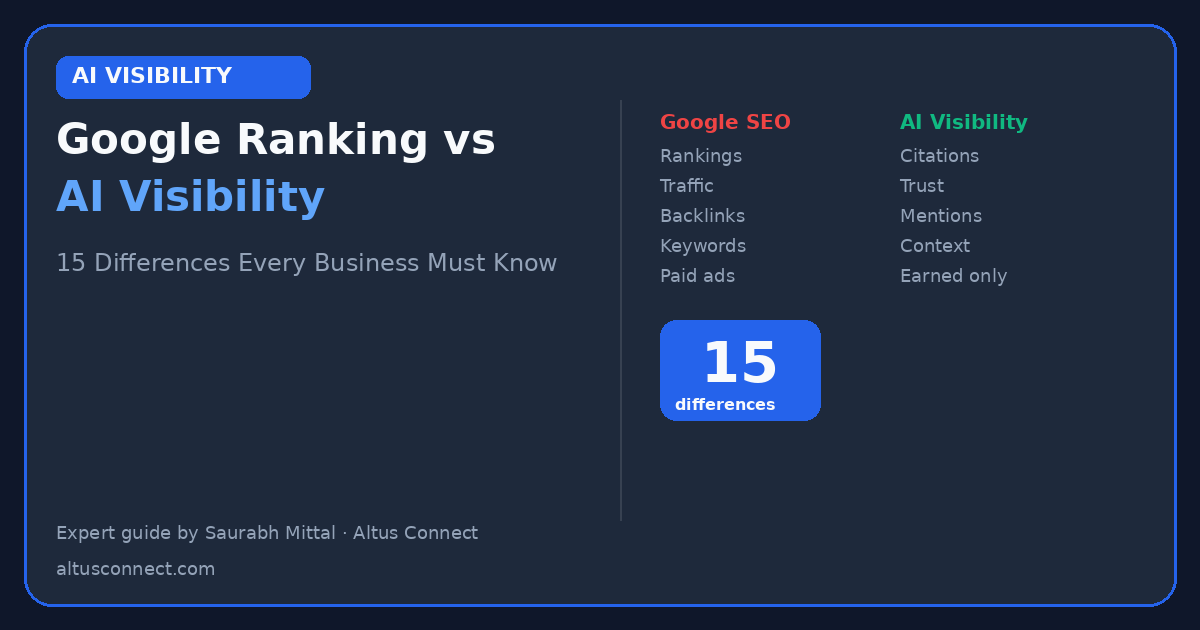
Executive Summary
Most marketing teams still treat Google SEO and AI visibility as the same discipline. They are not. Google ranking optimizes for position in search results. AI visibility optimizes for citation and recommendation in AI-generated answers. One measures where you appear on a page of links. The other measures whether ChatGPT, Gemini, Claude, and Perplexity trust you enough to mention your brand when buyers ask for the best solution.
This guide compares Google SEO and AI visibility across 15 structural differences — including ranking vs citation, traffic vs trust, links vs mentions, keywords vs context, backlinks vs authority, ads vs earned visibility, search results vs AI answers, position tracking vs citation tracking, SEO metrics vs AI metrics, and user journey differences. Each difference includes a real-world case study, actionable implications, and a mapped fix from Altus Connect's FCAT Framework.
If you already rank well on Google but AI ignores you, start with our companion guide: Why Your Business Doesn't Appear in ChatGPT (And How to Fix It).
Saurabh Mittal, Founder of Altus Connect: "Every month, a CMO tells me: 'Our SEO agency says we're crushing it — why doesn't ChatGPT know we exist?' The answer is always the same: they are measuring rankings and traffic in a world where citations and trust determine AI recommendations. This guide names all 15 differences so you stop guessing."
Why Businesses Assume SEO and AI Visibility Are the Same
The confusion is understandable. Both disciplines involve content, keywords, and authority. Google itself states that traditional SEO best practices support visibility in generative AI experiences. Strong SEO provides crawlable pages, structured data, and domain signals that AI systems leverage.
But the objective has shifted. SEO asks: Can people find your website? AI visibility asks: Will AI recommend your business? That second question introduces requirements SEO alone was never designed to solve — entity resolution, passage extractability, cross-platform brand consistency, third-party corroboration, and probabilistic mention tracking across multiple AI ecosystems.
Saurabh Mittal, Founder of Altus Connect: "SEO and AI visibility share vocabulary — content, authority, keywords — but they optimize for different outcomes. SEO gets you the click. AI visibility gets you the recommendation. Most teams are still playing the first game."
The SEO–AI Visibility Gap
B2B SaaS company — top-3 Google rankings for 12 category keywords
Google top-3 keyword rate
91%
AI mention rate (category prompts)
11%
Google Ranking vs AI Visibility — 15 Differences at a Glance
Use this table as your quick-reference cheat sheet. If your team only tracks metrics in the left column, you are optimizing for search engines — not answer engines.
| # | Google SEO | AI Visibility |
|---|---|---|
| 1 | Ranking position (#1–#10) | Citation & recommendation inclusion |
| 2 | Traffic & click volume | Trust & corroboration signals |
| 3 | Backlinks & referring domains | Brand mentions & third-party citations |
| 4 | Keyword targeting & density | Context, intent & entity understanding |
| 5 | Domain authority via links | Multi-signal authority (reviews, press, schema) |
| 6 | Paid ads for instant visibility | Earned visibility only — no paid slots |
| 7 | 10 blue links on SERP | Direct synthesized answer + 3–5 sources |
| 8 | Rank tracking (position #3 → #1) | Citation tracking (mention rate, SOV) |
| 9 | CTR, impressions, bounce rate | Mention rate, citation share, prompt coverage |
| 10 | Search → click → browse → convert | Ask AI → get answer → trust recommendation → convert |
| 11 | Page-level optimization | Brand-entity & passage-level optimization |
| 12 | Deterministic rank positions | Probabilistic mention likelihood |
| 13 | Single platform (Google-first) | Multi-ecosystem (ChatGPT, Gemini, Claude, Perplexity) |
| 14 | Published SEO guidelines | Proprietary, opaque recommendation algorithms |
| 15 | Index pages for matching queries | Resolve entities & verify trust before citing |
Which Differences Matter Most by AI Platform?
| Framework | ChatGPT | Gemini | Claude | Perplexity |
|---|---|---|---|---|
| Citation over ranking (#1) | ✓ | ✓ | ✓ | ✓ |
| Trust over traffic (#2) | ✓ | ✓ | ✓ | ✓ |
| Mentions over links (#3) | ✓ | ✓ | ✓ | ✓ |
| Context over keywords (#4) | ✓ | ✓ | ✓ | ✓ |
| Entity verification (#15) | ✓ | ✓ | ✓ | ✓ |
| Live retrieval dependency | ✓ | ✓ | — | ✓ |
| Google Knowledge Graph (#13) | — | ✓ | — | — |
All 15 Differences Explained
1. Ranking vs Citation
Google SEO: Success is measured by position on the search engine results page (SERP). Rank #1 for "best project management software" and you win the click.
AI Visibility: Success is measured by whether AI includes your brand in the generated answer — as a recommended option, a cited source, or a named entity. There is no Position #7 in an AI answer. You are mentioned or you are not.
Case study: A B2B analytics platform ranked #2 on Google for its primary category keyword (4,200 monthly searches). In 50 ChatGPT tests for the equivalent natural-language prompt ("What's the best analytics platform for mid-market SaaS?"), it appeared zero times. Competitors ranking #4–#8 on Google appeared in 70% of AI answers because they had G2 profiles, comparison content, and third-party roundup mentions that AI could cite.
2. Traffic vs Trust
Google SEO: The primary KPI is organic traffic — sessions, pageviews, and click-through rate from search results.
AI Visibility: The primary KPI is trust — whether AI systems corroborate your claims through independent sources. A user may never visit your website but choose your brand because ChatGPT recommended it. Trust signals (reviews, press, schema, expert authorship) matter more than visit volume.
Case study: A legal-tech startup drove 12,000 monthly organic sessions through SEO but had zero G2 reviews, no press coverage, and no Person schema for its founders. When prospects asked AI for recommendations, a competitor with half the traffic but 150 G2 reviews and 3 industry publication features dominated every answer. After a 60-day trust buildout, AI mention rate rose from 5% to 48% — with no change to their SEO program.
Saurabh Mittal: "Traffic proves people found you. Trust proves AI should recommend you. A brand with 10,000 monthly sessions and zero third-party validation will lose every AI answer to a competitor with 1,000 sessions and 200 G2 reviews."
3. Links vs Mentions
Google SEO: Backlinks from authoritative domains remain a core ranking signal. Link building — guest posts, digital PR, resource link acquisition — is a standard SEO practice.
AI Visibility: Brand mentions across the open web matter as much as or more than hyperlinks. AI systems evaluate whether your brand is discussed on G2, Reddit, industry publications, podcasts, and directories — not just whether other sites link to you. An unlinked mention in a Forbes article can outweigh ten blog backlinks for AI trust scoring.
Case study: A fintech company had 2,400 referring domains (strong DA 62) but appeared in only 2 of 40 Perplexity tests. Analysis revealed nearly all backlinks came from SEO-driven guest posts on low-relevance blogs. Meanwhile, a competitor with 180 referring domains but 40 press mentions, active Reddit presence, and a Wikipedia-adjacent Wikidata entry appeared in 32 of 40 tests.
4. Keywords vs Context
Google SEO: Keyword research drives content strategy. Teams optimize title tags, headings, and body copy for specific query terms and search volume.
AI Visibility: AI interprets intent and context, not just keywords. "Best CRM" and "What CRM should a 20-person marketing agency use with HubSpot integration?" require different evaluation. AI rewards content that demonstrates expertise and answers the underlying question — not pages that repeat a keyword 14 times.
Case study: An IT managed services provider optimized 30 pages for "MSP Dallas" and ranked #1–#3 for every variant. AI prompts like "Which managed IT provider should a 50-person healthcare company in Texas choose?" never returned their name. Restructuring content around use-case answers (healthcare compliance, HIPAA, 50-user pricing) — not keyword variants — lifted AI mention rate from 0% to 35% in 45 days.
5. Backlinks vs Authority
Google SEO: Domain authority, primarily built through backlinks, predicts ranking potential. Ahrefs DR and Moz DA are standard benchmarks.
AI Visibility: Authority is multi-dimensional: customer reviews, analyst mentions, expert authorship (Person schema), industry awards, structured data completeness, and cross-platform brand consistency. A high-DA site with thin trust signals can lose to a lower-DA brand with comprehensive third-party validation.
See our Brand Authority & Trust Signals guide for the full authority stack.
6. Ads vs Earned Visibility
Google SEO: Google Ads provides instant SERP visibility. Paid and organic strategies run in parallel — bid on keywords today, rank organically over months.
AI Visibility: There are zero paid placement options in ChatGPT, Claude, or Perplexity recommendations. AI visibility must be earned through authority, credibility, and third-party validation. Google AI Overviews may show ads separately, but organic AI citations cannot be purchased at any price.
Saurabh Mittal: "Google visibility can be rented with ads. AI visibility must be earned. There is no AdWords for ChatGPT — and that is exactly why it matters more."
7. Search Results vs AI Answers
Google SEO: The SERP displays 10 blue links (plus features). Users scan, compare, and choose which result to click. Your job is to earn the click.
AI Visibility: AI synthesizes a direct answer and cites 3–5 sources. Users often get everything they need without clicking anything. Your job is to become one of the brands the AI names — not just one of the links below the answer.
8. Position Tracking vs Citation Tracking
Google SEO: Rank trackers report position changes daily: "We moved from #5 to #3 for [keyword]." Rankings are relatively stable and deterministic.
AI Visibility: Citation tracking measures mention rate across a prompt library — "We appear in 34% of category prompts on ChatGPT, 28% on Perplexity." Results vary by prompt phrasing, platform, geography, and model version. Tracking requires probabilistic measurement, not single rank checks.
See our AI Citation Tracking guide for a full measurement framework.
9. SEO Metrics vs AI Metrics
Traditional SEO dashboards do not capture AI visibility. You need a parallel measurement layer.
| SEO Metric | AI Visibility Equivalent | What It Tells You |
|---|---|---|
| Organic rank position | Mention rate (% of prompts where brand appears) | Are you included in AI answers at all? |
| Impressions | Prompt coverage (prompts tested vs prompts won) | Breadth of AI visibility across buyer questions |
| Click-through rate | Citation share-of-voice vs competitors | How often AI picks you over alternatives |
| Domain authority | Trust signal score (reviews, press, schema) | Whether AI trusts enough to recommend you |
| Backlink count | Third-party mention count | Independent corroboration depth |
| Keyword rankings | Prompt win rate by intent category | Performance on brand, category, and comparison queries |
10. User Journey Differences
Google SEO user journey: Buyer has a question → searches Google → scans 10 results → clicks 2–3 links → reads websites → compares options → converts (days to weeks).
AI visibility user journey: Buyer asks ChatGPT/Perplexity → receives synthesized answer with 3–5 recommended brands → trusts AI's curation → visits 1–2 sites to confirm → converts (hours to days). The AI answer replaces the comparison step. If you are not in the answer, you are not in the consideration set.
Case study: A commercial cleaning company tracked lead sources for six months. Google organic drove 40% of leads (consistent with rankings). After ChatGPT adoption surged in their market, they discovered 22% of new clients came from AI-assisted research — yet the company appeared in zero AI answers for "best commercial cleaning [city]." Competitors with Google Business Profile optimization, 80+ reviews, and FAQ schema captured those AI-influenced leads without ranking higher on Google.
Saurabh Mittal: "The user journey changed. Buyers no longer compare ten websites — they trust one AI answer. If you are not in that answer, you are not in the funnel. Period."
11. Page-Level vs Brand-Entity Optimization
Google SEO: You optimize individual pages for specific keywords. Each URL is a ranking unit.
AI Visibility: AI evaluates your brand as an entity — connecting your website, LinkedIn, reviews, press, and directories into one machine-readable identity. Entity SEO matters more than any single page.
See our Entity SEO guide for the knowledge graph playbook.
12. Deterministic Rankings vs Probabilistic Mentions
Google SEO: Rank #3 today is rank #3 for most users in most locations (modulo personalization).
AI Visibility: Mention probability fluctuates. The same prompt may produce different recommendations across sessions, model updates, and retrieval results. You track trends over time — not fixed positions.
13. Single Platform vs Multi-Ecosystem
Google SEO: Google captures 90%+ of search investment. Bing and others exist but receive minimal optimization effort.
AI Visibility: Buyers use ChatGPT, Gemini, Claude, Perplexity, and Google AI Overviews — each with different retrieval pipelines and trust signals. Optimization must span the ecosystem, not a single platform.
14. Transparent Guidelines vs Black Box Algorithms
Google SEO: Google publishes Search Essentials, structured data guidelines, and core update documentation. The playbook is imperfect but public.
AI Visibility: Recommendation algorithms are proprietary. OpenAI, Anthropic, Google, and Perplexity do not publish ranking factors for AI answers. Strategy relies on observed patterns, citation analysis, and frameworks like FCAT — not documented rules.
15. Index-Based Discovery vs Entity-Based Verification
Google SEO: Google crawls, indexes, and ranks pages that match query terms. If your page is relevant and authoritative, it can rank.
AI Visibility: Before citing any business, AI systems attempt to resolve the brand entity, verify claims through third-party sources, and assess trust. A page can be indexed and ranked on Google but fail entity verification entirely — making it invisible to AI.
15 Differences — Quick Reference Cards
Expand for summaries. Full explanations with case studies are in the sections above.
Case Studies: When Strong SEO Did Not Equal AI Visibility
Three Businesses, Strong SEO, Zero AI Visibility — Until They Fixed It
All three maintained their SEO programs. AI visibility was additive — not a replacement.
The User Journey Shift — Search Engines vs Answer Engines
The most underappreciated difference is behavioral. When buyers used Google, your website had a chance to compete on design, copy, and conversion optimization after the click. When buyers use AI, the recommendation happens before any website visit. This shifts competitive advantage from on-site experience to pre-click authority.
Buyer Journey: Google Search vs AI Answer Engine
Average B2B software purchase decision
Buyer touchpoints with Google search journey
78%
Buyer touchpoints with AI answer journey
34%
Businesses that win in the AI era are not necessarily those with the best websites. They are those with the strongest combination of citable content, entity clarity, and third-party trust — the brands AI can confidently name when a buyer asks for the best.
Mapping the 15 Differences to the FCAT Framework
Scattered fixes produce scattered results. Saurabh Mittal, Founder of Altus Connect, developed the FCAT Framework to give businesses a sequenced operating system for the SEO-to-AI transition:
- F — Foundation: Addresses differences #11, #15 — entity identity, Organization schema, sameAs links, NAP consistency. Without Foundation, AI cannot resolve your brand.
- C — Content & Consistency: Addresses #4, #7 — context-rich, answer-first content structured for AI extraction, not keyword-stuffed pages.
- A — Authority: Addresses #3, #5, #6 — brand mentions, third-party citations, reviews, press, and earned visibility (no ads).
- T — Trust: Addresses #2, #14 — corroborated claims, expert authorship, cross-platform consistency, and the trust signals AI verifies before recommending.
Citation tracking (#8) and AI metrics (#9) form the measurement layer across all four pillars. User journey optimization (#10) is the outcome — not the input.
Saurabh Mittal: "FCAT is how you transition without abandoning SEO. Foundation extends your technical SEO. Content extends your content marketing. Authority extends your link building. Trust extends your brand building — into the answer engine era."
FCAT Pillar Impact on AI Mention Rate (Client Benchmarks)
Action Plan: Transitioning from SEO to AI Visibility
You do not abandon SEO. You extend it. This 90-day plan assumes you have an existing SEO program and adds the AI visibility layer on top — sequenced by FCAT.
90-Day SEO-to-AI Visibility Transition
Phase 1
Days 1–14
Audit, prompt baseline, entity check
Phase 2
Days 15–45
Schema, answer-first content, FAQ hubs
Phase 3
Days 46–75
Reviews, press, directories, forums
Phase 4
Days 76–90
Re-test, dashboard, next sprint plan
Phase 1 — Audit & Baseline (Days 1–14):
- Export top 50 keywords by traffic from Google Search Console
- Convert each keyword into 2–3 natural-language prompts (how a buyer would ask ChatGPT)
- Test all prompts across ChatGPT, Gemini, Perplexity, and Claude — record mention rate
- Compare: keywords where you rank top-5 vs prompts where AI mentions you — calculate the visibility gap
- Run an entity audit: schema markup, sameAs links, NAP consistency, Wikidata presence
Phase 2 — Foundation & Content (Days 15–45):
- Deploy Organization + WebSite + FAQPage schema on homepage and top 10 pages
- Restructure top 5 ranking pages with answer-first formatting (direct answer in first 2 sentences)
- Publish 3 comparison pages and 2 FAQ hubs targeting prompts where you are absent
- Add Person schema for founder and top 2 subject-matter experts
- See our Structured Data Schema Stack guide for deployment patterns
Phase 3 — Authority & Trust (Days 46–75):
- Launch review collection on G2, Trustpilot, or category-specific platforms
- Pitch 3 guest articles or podcast appearances to industry publications
- Claim and optimize directory profiles (Clutch, GoodFirms, category directories)
- Participate authentically in 10 relevant Reddit/Quora threads
Phase 4 — Measure & Iterate (Days 76–90):
- Re-run full prompt library — compare mention rate to Day 1 baseline
- Build monthly AI visibility dashboard: mention rate, citation SOV, prompt coverage
- Identify remaining gaps and plan next 90-day sprint
- Schedule quarterly AI Visibility Audit
Cumulative Mention Rate Lift During SEO-to-AI Transition
SEO is not dead — but it is no longer sufficient. The 15 differences in this guide explain why businesses with green keyword dashboards still lose to competitors in AI-generated answers. The fix is not to abandon SEO. It is to extend your strategy into citation, trust, entity identity, and cross-platform authority.
Saurabh Mittal: "The businesses that win the next decade will not choose between SEO and AI visibility. They will understand the 15 differences and build for both — starting today."
Ready to Close the SEO–AI Visibility Gap?
Find out where your Google rankings and AI mention rate diverge — and get a prioritized transition plan. Altus Connect's AI Visibility Audit scores your brand across all 15 differences with FCAT-mapped recommendations.
Request AI Visibility AuditTopics, entities & related searches
Primary keyword: AI visibility
Secondary keywords
- Google ranking
- SEO
- AI recommendations
Semantic keywords
- AI-generated answers
- citation tracking
- entity resolution
NLP entities
- ChatGPT
- Gemini
- Claude
- Perplexity
- Altus Connect
Related search terms
- AI visibility vs SEO
- optimize for AI visibility
- AI citation strategies
Frequently Asked Questions
Is SEO the same as AI visibility?
No. SEO optimizes for rankings, traffic, and clicks in search engine results pages. AI visibility optimizes for citations, mentions, and recommendations in AI-generated answers. They share foundations (content, authority, structured data) but measure success differently and require distinct strategies beyond traditional SEO.
What is the difference between Google ranking and AI citation?
Google ranking is your position on a search results page (e.g., #3 for a keyword). AI citation is inclusion as a recommended brand or source in an AI-generated answer. You can rank #1 on Google and receive zero AI citations if AI systems cannot resolve your entity or corroborate your authority.
Does good SEO automatically mean good AI visibility?
No. Research shows 73% of businesses ranking on Google remain invisible in AI answers for the same category queries. SEO provides crawlable content and domain signals that AI leverages, but AI visibility additionally requires entity resolution, answer-first content, third-party corroboration, and cross-platform brand consistency.
What is the difference between traffic and trust in AI visibility?
SEO traffic measures how many people visit your website from search. AI trust measures whether AI systems corroborate your brand through independent sources — reviews, press, schema, and third-party mentions. A user may choose your brand based on an AI recommendation without ever visiting your site.
Are backlinks or brand mentions more important for AI?
Both matter, but AI weights brand mentions and third-party citations heavily — often more than raw backlink count. An unlinked mention in a major publication, a G2 review, or a Reddit discussion can outweigh multiple SEO-driven guest post backlinks for AI trust scoring.
Can you pay for AI visibility like Google Ads?
No. ChatGPT, Claude, and Perplexity have no paid recommendation slots. AI visibility must be earned through authority, credibility, and third-party validation. Google AI Overviews may show ads separately, but organic AI citations cannot be purchased.
How do you track AI visibility instead of rankings?
Build a prompt library of 50–100 brand and category questions. Test weekly across ChatGPT, Gemini, Perplexity, and Claude. Track mention rate (% of prompts where you appear), citation share-of-voice vs competitors, and prompt coverage by intent category. See our AI Citation Tracking guide for the full framework.
What SEO metrics map to AI visibility metrics?
Organic rank position maps to mention rate. Impressions map to prompt coverage. Click-through rate maps to citation share-of-voice. Domain authority maps to trust signal score. Backlink count maps to third-party mention count. Keyword rankings map to prompt win rate by intent category.
What is the FCAT Framework and how does it relate to SEO?
FCAT (Foundation, Content & Consistency, Authority, Trust) is Altus Connect's proprietary framework for AI visibility. It extends SEO rather than replacing it: Foundation extends technical SEO with entity schema, Content extends content marketing with answer-first formatting, Authority extends link building with third-party validation, and Trust extends brand building into the answer engine era.
How long does it take to transition from SEO to AI visibility?
Foundation and content improvements can show measurable mention rate gains within 30 days. Authority and trust buildout typically produces significant improvements within 60–90 days. A full SEO-to-AI transition using the FCAT Framework usually delivers 3–5× mention rate lift within one quarter — without pausing existing SEO programs.