 Altus Connect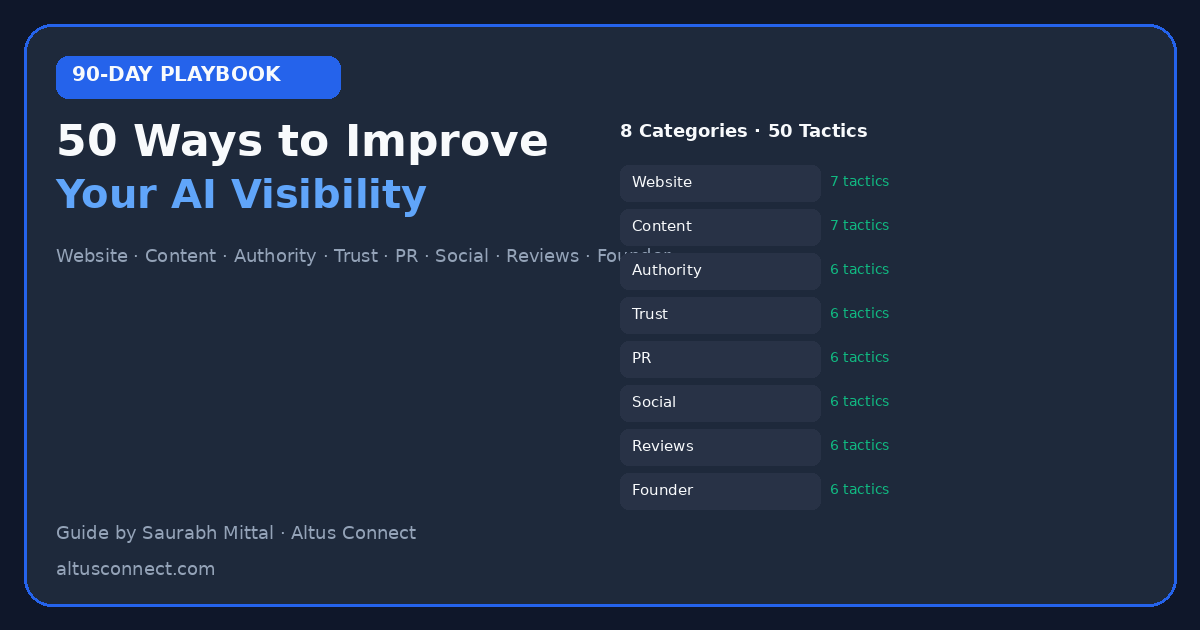
Executive Summary
AI visibility is not a single optimization — it is the cumulative result of fifty or more trust, authority, and discoverability signals working together. When ChatGPT recommends HubSpot over your company, the difference is not product quality. It is signal density: schema, reviews, comparison content, founder authority, press mentions, and consistent entity data accumulated over years.
This guide gives you the complete list. 50 actionable tactics grouped into eight categories — Website, Content, Authority, Trust, PR, Social, Reviews, and Founder Branding. Each tactic includes why it matters, a difficulty rating, impact level, and realistic time estimate. Use the downloadable scorecard to track progress and the 90-day roadmap to sequence work by impact.
Related guides: AI SEO Checklist for B2B · Why AI Trusts Some Brands · The FCAT Framework · How to Get Cited by ChatGPT, Claude & Gemini.
Download: 50-Tactic AI Visibility Scorecard
Track all 50 tactics across 8 categories. Score progress weekly, record your baseline AI mention rate, and re-test on Day 90. Print or save as PDF from your browser.
AI Mention Rate — 90-Day Tactic Execution
Share of 30 category prompts where brand is recommended
Day 0 (baseline)
12%
Day 90 (35+ tactics)
58%
How to Use This List
Do not attempt all 50 tactics simultaneously. Use this sequence:
- Baseline audit (Day 1). Run 30 category prompts in ChatGPT, Claude, and Gemini. Record which brands appear, how often, and in what context. This is your Day 0 mention rate.
- Score yourself (Day 1–2). Download the scorecard and mark completed tactics. Most companies score 8–15 out of 50 on first pass.
- Execute by FCAT sequence (Days 3–90). Foundation (Website + Trust) first, then Content, then Authority + Reviews, then PR + Social + Founder Branding. The roadmap below maps tactics to weeks.
- Prioritize by impact × ease. Start with Easy + High/Very High impact tactics. Defer Hard + Medium impact items (Wikipedia, analyst relations) to Days 60–90 or beyond.
- Re-test on Day 30, 60, and 90. Re-run your 30 prompt tests. Track mention rate improvement against scorecard completion.
Difficulty ratings: Easy = one person, under a day. Medium = small team, 1–4 weeks. Hard = sustained effort, 1–6 months. Impact ratings reflect correlation with AI mention rate improvements across 200+ brand audits.
"Most teams don't need another framework — they need a prioritized list. Fifty specific actions, honestly scoped, executed over ninety days, will outperform a year of unfocused SEO."
— Saurabh Mittal, Founder, Altus Connect
Website Tactics (1–7)
Your website is the foundation layer. AI systems must resolve your brand as a distinct entity before any recommendation is possible. These seven tactics deploy the structured data, crawlability, and technical signals that make everything else work. Complete all seven in Weeks 1–2.
Well-known brands like Stripe and HubSpot have had comprehensive Organization schema, Product schema, and FAQPage markup for years — giving AI systems instant entity resolution. Emerging brands like Linear closed the gap in months by deploying schema and llms.txt early, before scaling content.
| # | Tactic & Why It Matters | Difficulty | Impact | Time |
|---|---|---|---|---|
| 1 | Deploy Organization JSON-LD schema Why it matters: AI systems resolve brands as entities before recommending them. Organization schema with legal name, logo, url, and foundingDate gives LLMs a machine-readable identity anchor that prevents your brand from being confused with similarly named companies. | Easy | High | 2–4 hours |
| 2 | Add sameAs links to all official profiles Why it matters: sameAs tells AI which LinkedIn, G2, Crunchbase, and directory profiles belong to your brand. Without it, each profile is a separate entity fragment — weakening corroboration across the trust signals AI evaluates. | Easy | High | 2 hours |
| 3 | Publish an llms.txt file Why it matters: llms.txt is an emerging standard that tells AI crawlers which pages matter most — your comparison guides, FAQ hubs, and case studies. It reduces noise and directs retrieval toward your highest-value content. | Easy | Medium | 1 hour |
| 4 | Fix canonical URLs and index hygiene Why it matters: Duplicate URLs split your entity signals across multiple page versions. AI may retrieve an outdated duplicate instead of your optimized comparison guide. Clean canonicals and sitemap hygiene consolidate authority. | Medium | High | 1 week |
| 5 | Implement FAQPage schema on key pages Why it matters: FAQPage markup makes Q&A pairs directly extractable by answer engines. When a buyer asks the exact question your FAQ answers, structured data increases the probability your page is selected as a source passage. | Easy | High | 4–6 hours |
| 6 | Optimize Core Web Vitals on templates Why it matters: Slow pages reduce crawl frequency and increase bounce rates — both of which limit how much of your content enters AI training and retrieval corpora. CWV optimization is a baseline technical trust signal. | Medium | Medium | 1–2 weeks |
| 7 | Add Product/Service structured data Why it matters: Product and Service schema describe what you sell in machine-readable format. AI uses this to match your offerings to buyer intent prompts like "best CRM for manufacturing" or "top compliance automation platform." | Easy | High | 4 hours |
Content Tactics (8–14)
Content is what AI retrieves and cites. Without answer-first, comparison, and case study content, your brand has nothing to be recommended for. These seven tactics create the citable passages that answer engines extract when buyers ask category questions.
Notion appears in virtually every productivity tool AI answer because they publish deep comparison content, extensive help documentation, and use-case guides — all in HTML with clear structure. A regional consulting firm with 30 employees matched this pattern by publishing five comparison guides and three HTML case studies, appearing in 45% of local ChatGPT prompts within 60 days.
| # | Tactic & Why It Matters | Difficulty | Impact | Time |
|---|---|---|---|---|
| 8 | Create "best [category]" comparison guides Why it matters: Comparison and "best of" pages are the highest-retrieval content type for vendor research prompts. AI systems actively seek these pages when buyers ask for recommendations — making them your primary citation targets. | Medium | Very High | 1–2 weeks each |
| 9 | Publish answer-first content with question H2s Why it matters: Answer engines extract passages, not pages. Question-formatted headings ("What is the best X for Y?") with a concise 40–60 word answer in the first paragraph dramatically increase extractability. | Easy | High | Ongoing |
| 10 | Build FAQ hub pages for top buyer prompts Why it matters: Run 30–50 category prompts in ChatGPT and Claude. Group the questions your buyers actually ask into dedicated FAQ hub pages — each targeting a cluster of related AI queries with structured answers. | Medium | High | 2 weeks |
| 11 | Write 2,000+ word pillar guides Why it matters: Depth signals expertise. Thin 400-word blog posts rarely get cited for complex category questions. Comprehensive pillar guides with data, examples, and methodology demonstrate the expertise AI trust filters require. | Medium | High | 2–3 weeks each |
| 12 | Add "last updated" dates to all guides Why it matters: AI systems penalize undated content on time-sensitive topics. Visible publication and update dates — plus dateModified in schema — tell answer engines your information is current and accountable. | Easy | Medium | 1 day |
| 13 | Create HTML case studies (not PDF) Why it matters: PDF case studies are invisible to most AI retrieval systems. HTML case studies with named clients, measurable outcomes, and structured data provide the experience signals that trust filters demand. | Medium | Very High | 1 week each |
| 14 | Publish original benchmark/data reports Why it matters: Original research with citable statistics becomes a magnet for AI citations and press mentions. One well-designed industry report can generate hundreds of corroborating mentions across the web — compounding your authority. | Hard | Very High | 4–6 weeks |
"Start with tactics that make you findable before tactics that make you famous. Schema and NAP consistency take an afternoon. A Wikipedia page takes six months. Sequence matters."
— Saurabh Mittal, Founder, Altus Connect
Authority Tactics (15–20)
Authority signals tell AI your brand is a recognized player — not a unknown vendor making self-asserted claims. Directory listings, awards, analyst mentions, and Knowledge Graph presence provide the third-party validation trust filters require.
Salesforce and HubSpot dominate AI recommendations partly because their authority surface is enormous: G2 Leader badges, Gartner mentions, Wikipedia entries, and thousands of directory listings. Plausible Analytics, an emerging privacy analytics startup, built authority through Product Hunt, Hacker News, and niche directory dominance before achieving mainstream AI citations.
| # | Tactic & Why It Matters | Difficulty | Impact | Time |
|---|---|---|---|---|
| 15 | Claim and optimize G2/Capterra/Clutch profiles Why it matters: Review platforms are among the highest-weight authority sources for B2B AI recommendations. An optimized G2 or Clutch profile with complete descriptions, screenshots, and categories is often cited before your own website. | Easy | Very High | 1 week |
| 16 | Get listed in industry directories Why it matters: Category directories (Capterra, Software Advice, industry association lists) provide third-party entity validation. AI cross-references directory listings to confirm your brand exists and operates in the claimed category. | Easy | High | 2 weeks |
| 17 | Pursue G2 Grid or category awards Why it matters: Award badges (G2 Leader, Capterra Shortlist) are frequently cited in AI answers as shorthand for category authority. They also generate press coverage and directory backlinks that compound trust. | Medium | High | 4–8 weeks |
| 18 | Submit to "best of" and top 10 lists Why it matters: Third-party "best [category]" listicles are primary retrieval targets for AI recommendation prompts. Getting listed — even at #8 — puts your brand in the corpus AI retrieves when buyers ask for options. | Medium | High | 2–4 weeks |
| 19 | Build Wikidata/Wikipedia presence (where eligible) Why it matters: Knowledge Graph entities are the strongest authority signals available. Brands with Wikipedia or Wikidata entries are resolved instantly by AI systems — often recommended before better-funded competitors without entity presence. | Hard | Very High | 3–6 months |
| 20 | Build analyst firm relationships Why it matters: Gartner, Forrester, and category analysts produce reports that AI systems heavily weight for enterprise recommendations. Even unpaid briefings and inclusion in market maps increase your authority surface. | Hard | High | 3–6 months |
Trust Tactics (21–26)
Trust signals demonstrate transparency, consistency, and accountability. AI systems apply trust filters before citing any source — especially on B2B procurement and YMYL topics. These six tactics build the trust layer that converts retrievable content into citable recommendations.
Brands that publish editorial standards pages, maintain consistent NAP data, and attribute content to named experts cite at 2.1× the rate of brands with anonymous, undated content. Trust is the most underinvested category in AI visibility — and the fastest to fix.
| # | Tactic & Why It Matters | Difficulty | Impact | Time |
|---|---|---|---|---|
| 21 | Publish an editorial standards page Why it matters: An editorial standards page documenting your review process, fact-checking, and correction policy is a high-leverage trust anchor. Most competitors lack one — giving you a differentiation signal AI systems can detect. | Easy | Medium | 1 week |
| 22 | Standardize NAP across all platforms Why it matters: Name, Address, Phone (and description) consistency across website, LinkedIn, G2, Google Business Profile, and directories prevents entity fragmentation. Inconsistent data is the #1 trust failure in AI visibility audits. | Easy | High | 1 week |
| 23 | Display verifiable client logos with permission Why it matters: Client logos with linked case studies provide visual social proof that AI corroborates against review platforms and press mentions. Unverifiable logo walls without case study backing carry minimal trust weight. | Easy | Medium | 1 week |
| 24 | Publish methodology/framework pages Why it matters: Methodology pages explain how you deliver results — demonstrating expertise transparency. AI systems prefer brands that can articulate their approach over those making unsupported "best-in-class" claims. | Medium | High | 2 weeks |
| 25 | Add a correction and update policy Why it matters: Accountability signals matter for YMYL and B2B procurement topics. A public correction policy shows AI systems your content is maintained responsibly — reducing the risk of citing outdated or inaccurate information. | Easy | Medium | 2 days |
| 26 | Deploy Person schema on expert authors Why it matters: Person schema on author bios links content to verifiable experts. Anonymous commercial content is retrievable but rarely cited. Named experts with credentials, jobTitle, and knowsAbout properties pass trust filters. | Easy | High | 1 week |
PR Tactics (27–32)
Digital PR creates the off-site mentions AI systems use to corroborate your authority and expertise. Press coverage, guest articles, and podcast appearances generate entity associations on trusted domains that your own website cannot replicate.
One data-led press release citing original survey results can generate 15–30 media mentions — each adding to the corroboration corpus AI evaluates. Stripe and Shopify maintain continuous PR engines that feed AI retrieval with fresh, authoritative third-party content.
| # | Tactic & Why It Matters | Difficulty | Impact | Time |
|---|---|---|---|---|
| 27 | Pitch data-led press releases Why it matters: Press coverage on authoritative domains (.com media, industry publications) transfers trust to your brand entity. Data-led releases ("Our survey of 500 companies found…") give journalists a reason to cite specific numbers. | Medium | Very High | 2–3 weeks per campaign |
| 28 | Contribute guest articles to industry publications Why it matters: Guest bylines on established publications create expert entity associations and backlink authority. AI systems weight author names that appear across multiple trusted sources higher than self-published claims. | Medium | High | 2–4 weeks per article |
| 29 | Secure podcast interview appearances Why it matters: Podcast transcripts enter AI training and retrieval corpora. A 45-minute category interview generates thousands of words of expert content associated with your founder's name — building entity depth over time. | Medium | High | 4–8 weeks |
| 30 | Partner for co-marketing with complementary brands Why it matters: Co-marketing with non-competing brands in adjacent categories generates mutual mentions on trusted domains. These cross-entity references help AI understand your market position and category associations. | Medium | Medium | 4 weeks |
| 31 | Issue quarterly industry trend reports Why it matters: Recurring research publications create a predictable citation source. AI systems prefer brands that consistently produce citable data over one-time content efforts — quarterly reports build compounding authority. | Hard | Very High | 6 weeks per report |
| 32 | Respond to journalist HARO/Connectively queries Why it matters: Help A Reporter Out (HARO) and Connectively provide low-effort paths to media mentions. One quoted expert comment in a trade publication can generate an authority signal that persists in AI corpora for years. | Easy | Medium | 1 hour/week |
Social Tactics (33–38)
Social platforms are increasingly indexed by AI retrieval systems. LinkedIn, Reddit, Quora, and YouTube content associated with your brand and founder builds the community corroboration layer that supplements your owned media.
Linear built significant AI visibility through authentic developer community engagement on Twitter, Reddit, and Hacker News before traditional PR kicked in. Social signals are especially high-impact for emerging brands competing against incumbents with larger PR budgets.
| # | Tactic & Why It Matters | Difficulty | Impact | Time |
|---|---|---|---|---|
| 33 | Optimize your LinkedIn company page Why it matters: LinkedIn is a primary entity source for B2B AI systems. A complete company page with standardized description, logo, industry, company size, and specialties feeds directly into how AI resolves and describes your brand. | Easy | High | 4 hours |
| 34 | Publish consistent LinkedIn thought leadership Why it matters: Regular LinkedIn posts build an expert content corpus associated with your brand. AI retrieval systems index public LinkedIn content — making your posts part of the evidence base for category expertise claims. | Medium | High | Ongoing (2–3 posts/week) |
| 35 | Engage authentically on Reddit and Quora Why it matters: Community platforms are increasingly cited in AI answers for product comparisons and category advice. Authentic, non-promotional answers from named experts build the community corroboration AI trust filters seek. | Easy | Medium | 2 hours/week |
| 36 | Share content on YouTube with transcripts Why it matters: YouTube transcripts enter multimodal AI retrieval. A 10-minute explainer video with full transcript creates extractable passages for category questions — especially for how-to and comparison queries. | Hard | High | 4–8 weeks to launch |
| 37 | Build X/Twitter category expertise presence Why it matters: X/Twitter content is indexed by AI systems for real-time category discourse. Consistent, expert commentary on industry trends creates mention density that reinforces your brand's category association. | Easy | Medium | Ongoing |
| 38 | Participate in industry Slack/Discord communities Why it matters: Niche communities generate highly specific category mentions that AI retrieves for specialized queries. Genuine participation — not spam — builds the long-tail corroboration emerging brands need to compete with incumbents. | Easy | Medium | 1 hour/week |
"The brands winning AI recommendations aren't doing anything magical. They're doing fifty ordinary things consistently — and their competitors are doing three things sporadically."
— Saurabh Mittal, Founder, Altus Connect
Reviews Tactics (39–44)
Reviews are among the highest-weight trust signals for AI recommendations. G2, Clutch, Trustpilot, and Google Business Profile ratings provide independent customer validation that AI cannot fabricate — making them hard filters in recommendation pipelines.
Notion (5,000+ G2 reviews) and monday.com (4,000+ reviews) appear in AI answers partly because review volume crosses the statistical threshold where AI treats ratings as meaningful. A 25-person B2B consultancy went from zero to 52 Clutch reviews in 75 days and appeared in 55% of category ChatGPT prompts — their single highest-impact tactic category.
| # | Tactic & Why It Matters | Difficulty | Impact | Time |
|---|---|---|---|---|
| 39 | Launch a systematic review collection campaign Why it matters: Review volume is a threshold signal. Brands with fewer than 20 reviews on their primary platform are rarely recommended by AI for category queries. A structured campaign targeting satisfied customers closes this gap fastest. | Medium | Very High | 4–8 weeks |
| 40 | Implement AggregateRating schema Why it matters: AggregateRating schema makes your review scores machine-readable. When AI evaluates trust, structured rating data on your website corroborates what G2, Trustpilot, and Google Business Profile report independently. | Easy | High | 2 hours |
| 41 | Respond to all reviews publicly Why it matters: Public review responses demonstrate engagement and accountability. While not directly cited, they signal to AI-adjacent systems (Google, review platforms) that your brand is active and accountable — supporting overall trust scoring. | Easy | Medium | 1 hour/week |
| 42 | Encourage specific outcome mentions in reviews Why it matters: Reviews that say "Reduced our onboarding time by 40%" provide experience evidence AI can extract. Generic "great service" reviews carry minimal weight. Prompt customers to mention specific outcomes in review requests. | Easy | High | Ongoing |
| 43 | Claim and optimize Google Business Profile Why it matters: For local and regional AI recommendations, Google Business Profile is the primary trust signal. Complete profiles with photos, services, posts, and reviews appear in Gemini and AI Overviews for location-based queries. | Easy | High | 2 hours |
| 44 | Target 50+ reviews on your primary platform Why it matters: Fifty reviews is the inflection point where AI systems treat review data as statistically meaningful rather than anecdotal. Brands crossing this threshold on G2, Clutch, or Trustpilot see disproportionate mention rate lifts. | Medium | Very High | 60–90 days |
Founder Branding Tactics (45–50)
Founder visibility is the force multiplier for every other category. AI systems increasingly attribute brand recommendations to named experts — especially for B2B, consulting, and category questions where personal expertise matters.
Plausible Analytics founders Uku Taht and Marko Saric built AI visibility through personal LinkedIn authority, conference talks, and bylined privacy regulation content — creating expert entities that AI associates with the brand. For small and mid-size companies, founder branding often delivers the fastest mention rate lift of any category.
| # | Tactic & Why It Matters | Difficulty | Impact | Time |
|---|---|---|---|---|
| 45 | Create a founder/CEO page with Person schema Why it matters: Founder pages with Person schema (name, jobTitle, knowsAbout, sameAs LinkedIn) create a named expert entity AI can attribute recommendations to. This is the single highest-impact tactic for brands with zero AI visibility. | Easy | Very High | 1 week |
| 46 | Publish founder bylines on key content Why it matters: Content attributed to a named founder passes E-E-A-T trust filters that anonymous content fails. Bylines on comparison guides, methodology pages, and data reports link expertise claims to a verifiable person. | Easy | High | Ongoing |
| 47 | Build founder LinkedIn posting cadence Why it matters: Founder LinkedIn activity creates a personal expert corpus separate from corporate content. AI systems increasingly associate founder expertise with brand recommendations — especially for ChatGPT and Claude B2B queries. | Medium | High | Ongoing (3–5 posts/week) |
| 48 | Secure founder speaking engagements Why it matters: Conference talks, webinar panels, and podcast guest spots generate third-party expert associations. Event pages, recordings, and transcripts create corroborating evidence that the founder is a recognized category authority. | Medium | High | 4–12 weeks |
| 49 | Launch a founder podcast or newsletter Why it matters: Owned media channels build long-form expert content at scale. A weekly newsletter or podcast generates 50+ expert-attributed content pieces per year — each adding to the corpus AI retrieves for category questions. | Hard | High | 8+ weeks to launch |
| 50 | Add author bios with credentials on all articles Why it matters: Every article without an author bio is anonymous commercial content — retrievable but uncitable. Author bios with credentials, headshot, and Person schema on all blog posts, guides, and case studies close this gap systematically. | Easy | High | 1 week |
90-Day Sequencing Roadmap
Map the 50 tactics to a realistic 90-day execution plan. Adjust based on team size — a solo founder should focus on 25–30 tactics; a 5-person marketing team can target 40+.
90-Day Tactic Sequencing
Weeks 1–3
Foundation
Website 1–7, Trust 21–26, baseline audit
Weeks 3–6
Content
Content 8–14, FAQ hubs, case studies
Weeks 6–9
Authority
Authority 15–20, Reviews 39–44
Weeks 9–12
Amplify
PR 27–32, Social 33–38, Founder 45–50
Mention Rate Lift by Tactics Completed
Priority Matrix — Start Here
If you can only do ten things in the next 30 days, execute these — all Easy/Medium difficulty with High or Very High impact:
- Deploy Organization schema with sameAs (Tactics 1, 2)
- Standardize NAP across all profiles (Tactic 22)
- Claim G2/Clutch profile (Tactic 15)
- Create founder page with Person schema (Tactic 45)
- Publish one "best [category]" comparison guide (Tactic 8)
- Implement FAQPage schema on top 3 pages (Tactic 5)
- Launch review collection campaign (Tactic 39)
- Optimize LinkedIn company page (Tactic 33)
- Publish 2 HTML case studies (Tactic 13)
- Run baseline + Day 30 prompt tests (scorecard)
Sample AI Visibility Scorecard — Target After 90 Days
Fifty tactics. Ninety days. One scorecard. AI visibility is not built by a single optimization — it is the compound result of schema, content, reviews, founder authority, and third-party validation working together. Download the scorecard, execute in FCAT sequence, and re-test your mention rate every 30 days.
"The list is the strategy. Execution is the moat." — Saurabh Mittal, Altus Connect
Get Your AI Visibility Score — Free Audit
Altus Connect scores your brand across all 50 tactics — identifying gaps, prioritizing by impact, and delivering a 90-day execution plan for ChatGPT, Claude, and Gemini visibility.
Request AI Visibility AuditTopics, entities & related searches
Primary keyword: AI visibility
Secondary keywords
- AI discoverability
- AI trust signals
- AI authority
Semantic keywords
- AI optimization
- AI branding
- AI PR strategies
NLP entities
- Altus Connect
- ChatGPT
- Claude
- Gemini
- Saurabh Mittal
Related search terms
- AI visibility strategies
- improve AI discoverability
- AI authority building
Frequently Asked Questions
How many AI visibility tactics should I complete in 90 days?
Target 35 or more of the 50 tactics within 90 days. Solo founders should prioritize the ten-item quick-start list (schema, NAP, G2 profile, founder page, one comparison guide, review campaign). Teams of 3–5 can execute 40+ tactics by parallelizing content and PR work.
Which AI visibility tactics have the highest impact?
The highest-impact tactics are: Organization schema with sameAs (#1–2), "best [category]" comparison guides (#8), HTML case studies (#13), G2/Clutch profile optimization (#15), review collection to 50+ (#39, #44), and founder page with Person schema (#45). These six alone can move mention rates from under 15% to over 40%.
What is the difference between AI visibility and traditional SEO?
Traditional SEO optimizes for Google rankings. AI visibility optimizes for citation and recommendation in ChatGPT, Claude, Gemini, and Perplexity. AI systems weight entity clarity, third-party validation (reviews, press), founder authority, and extractable content structure more heavily than keyword density or backlink volume.
Do I need to complete all 50 tactics?
No. Brands completing 35+ tactics typically see 3–5× mention rate improvements. The remaining 15 tactics (Wikipedia, analyst relations, podcast launch) are long-term investments that compound over 6–12 months. Use the scorecard to track and prioritize.
How do I measure AI visibility improvement?
Run 30 standardized category prompts in ChatGPT, Claude, and Gemini on Day 0, 30, 60, and 90. Record whether your brand is mentioned, recommended, or cited as a source. Calculate mention rate = (prompts mentioning your brand / total prompts) × 100. Track this alongside scorecard completion in the downloadable scorecard.
What order should I execute the 50 tactics?
Follow FCAT sequencing: Foundation first (Website + Trust, Weeks 1–3), then Content (Weeks 3–6), then Authority + Reviews (Weeks 6–9), then PR + Social + Founder Branding (Weeks 9–12). Never skip foundation to start with PR — AI cannot recommend a brand it cannot resolve as an entity.
Which tactics are best for small businesses with limited budget?
Focus on Easy difficulty tactics: schema deployment (#1–2, #5, #7), NAP consistency (#22), G2/Clutch profile (#15), founder page (#45), LinkedIn optimization (#33), review collection (#39–44), and one comparison guide (#8). These require time, not budget, and deliver disproportionate mention rate lifts for small brands.
How long until I see results from AI visibility tactics?
Foundation tactics (schema, NAP, profiles) can show mention rate improvements within 2–4 weeks. Content and review tactics typically show results in 4–8 weeks. PR and founder branding compound over 8–12 weeks. Re-test every 30 days — do not wait until Day 90 to measure progress.
What is the downloadable scorecard?
The 50-Tactic AI Visibility Scorecard is a printable HTML checklist covering all tactics organized by category. Track completion, score each category, record baseline and Day 90 mention rates, and save as PDF. Download it from the top of this guide or at /downloads/ai-visibility-50-tactics-scorecard.html.
Can I improve AI visibility without changing my website?
Partially. Off-site tactics (G2 reviews, LinkedIn, PR, founder branding) can improve mention rates without website changes — but foundation tactics (schema, FAQPage markup, HTML case studies) dramatically amplify off-site efforts. Brands that skip website optimization plateau at 20–25% mention rates regardless of PR spend.