 Altus Connect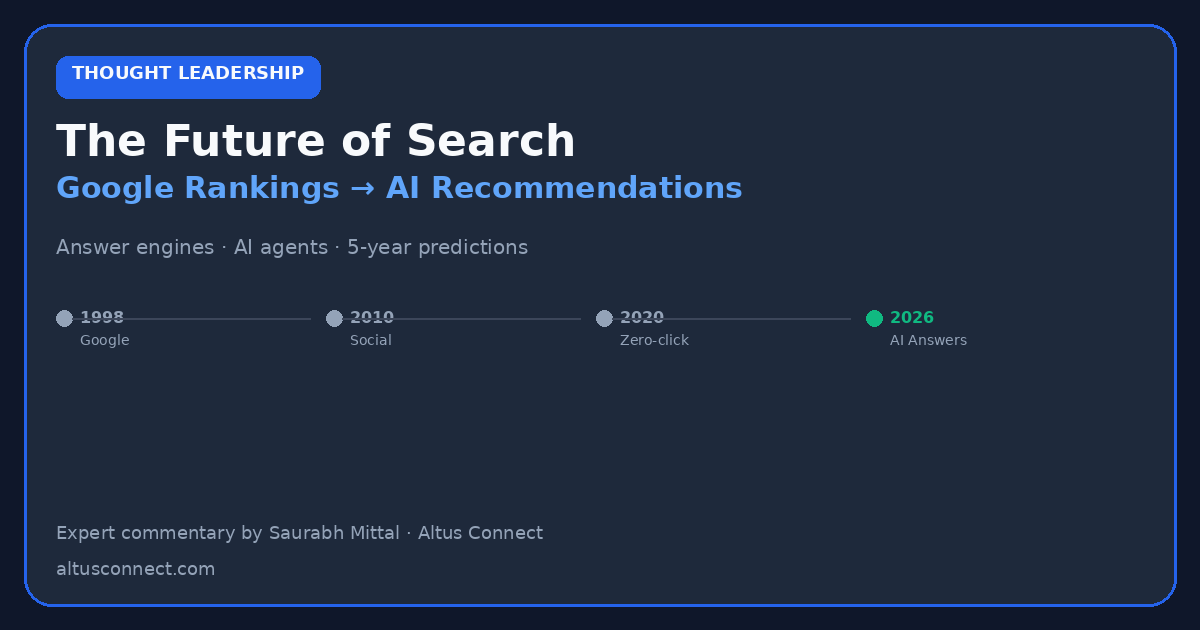
Executive Summary
Search is undergoing its most significant transformation since Google indexed the web in 1998. For two decades, the formula was simple: rank higher, get more traffic, generate more leads. In 2026, a growing share of buyer research bypasses search engines entirely — happening inside conversational AI platforms that synthesize answers and recommend 3–5 brands per response.
This thought-leadership guide maps the future of search from Google rankings to AI recommendations. You will find the evolution of search across five eras, deep analysis of ChatGPT, Claude, Gemini, and Perplexity as answer engines, the rise of AI shopping assistants and autonomous agents, impacts on marketing, SEO, and lead generation, five-year predictions, expert commentary from Saurabh Mittal, and strategic recommendations to prepare your business now.
Related: Google Ranking vs AI Visibility · The FCAT Framework · 50 Ways to Improve AI Visibility · How ChatGPT Chooses Companies.
Share of Buyer Research — Search vs AI Recommendations
Percentage of vendor/product research starting in each channel
2023 (Google Search)
78%
2026 (AI + Search)
42%
"We are not witnessing the death of search. We are witnessing the birth of recommendation. The user no longer wants ten blue links — they want one trusted answer with three options. Businesses that optimize for the list will lose to businesses that optimize for the answer."
— Saurabh Mittal, Founder, Altus Connect
The Evolution of Search — Five Eras in Three Decades
Understanding the future requires understanding the past. Search has evolved through five distinct eras, each changing what businesses must optimize for:
| Era | Period | User Behavior | Business Imperative |
|---|---|---|---|
| Directory Search | 1990s | Browse categorized listings (Yahoo, DMOZ) | Get listed in directories |
| Algorithmic Search | 2000–2015 | Query → ranked blue links → click → website | Rank on page 1 of Google (SEO) |
| Zero-Click Search | 2015–2023 | Query → featured snippet / knowledge panel → no click | Win featured snippets, local pack, PAA boxes |
| AI Recommendation | 2023–present | Conversational query → synthesized answer with 3–5 brand recommendations | Earn AI citations and recommendations (AEO/GEO) |
| Agentic Search | 2026–2030 | Goal → autonomous agent researches, compares, and transacts | Become agent-retrievable: API-ready, structured, trusted |
Era 1 — Directory Search (1990s): Before algorithms, search meant browsing human-curated directories. Yahoo, DMOZ, and AltaVista organized the web into categories. Business success meant getting listed. Relevance was manual, not computational.
Era 2 — Algorithmic Search (2000–2015): Google's PageRank revolutionized search by ranking pages algorithmically based on link authority and keyword relevance. SEO was born. Businesses optimized for the "ten blue links" model: rank on page 1, earn clicks, convert on your website. This era created the $80 billion SEO industry and defined digital marketing for a generation.
Era 3 — Zero-Click Search (2015–2023): Google began answering questions directly on the results page — featured snippets, knowledge panels, People Also Ask boxes, and local packs. By 2023, 65% of Google searches ended without a click to any website. Businesses that only optimized for rankings started losing traffic even while ranking #1.
Era 4 — AI Recommendation (2023–present): ChatGPT, Claude, Gemini, and Perplexity introduced a fundamentally new model: conversational queries answered with synthesized recommendations. Instead of ten links, users receive one answer naming 3–5 brands. There is no page 2. There is no scroll. You are either recommended or invisible.
Era 5 — Agentic Search (2026–2030): The emerging frontier. AI agents receive goals ("find the best CRM for a 50-person manufacturing company under $50K/year") and autonomously research, compare, and transact — often without the user ever visiting a vendor website. Agent-ready brands with structured data, API access, and trusted entity profiles will capture transactions that traditional search never surfaces.
Search Evolution Timeline
1990s
Directory
Yahoo, DMOZ — get listed
2000s
Algorithmic
Google PageRank — rank #1
2015–23
Zero-Click
Featured snippets — win the box
2023–26
AI Answers
ChatGPT, Claude — get recommended
2026–30
AI Agents
Autonomous — be agent-ready
The Rise of Answer Engines
Answer engines are AI platforms that respond to user queries with synthesized answers rather than ranked lists of links. They represent the most significant shift in information retrieval since Google's launch — and they operate on fundamentally different logic than search engines.
Where Google ranks pages, answer engines recommend brands. Where SEO optimizes for keywords and backlinks, Answer Engine Optimization (AEO) and Generative Engine Optimization (GEO) optimize for entity clarity, trust signals, citable content, and third-party corroboration.
Key statistics driving the shift:
- 67% of B2B buyers now use AI tools during vendor research (Gartner, 2025)
- 58% of consumers consult ChatGPT or similar tools before making purchase decisions
- 40% of Google searches now display AI Overviews — Google's own answer engine layer
- 800 million weekly users interact with ChatGPT (OpenAI, 2026)
- 73% of businesses ranking on Google page 1 are invisible in AI recommendations
The answer engine market is not winner-take-all. ChatGPT, Claude, Gemini, and Perplexity each serve different user bases, apply different trust filters, and retrieve from different source corpora. Businesses must optimize across all four — not bet on a single platform.
Answer Engine Platform Comparison — 2026
| Framework | ChatGPT | Claude | Gemini | Perplexity |
|---|---|---|---|---|
| G2 / review platforms | ✓ | ✓ | ✓ | ✓ |
| Wikipedia / Knowledge Graph | ✓ | ✓ | ✓ | ✓ |
| Founder / expert authority | ✓ | ✓ | — | ✓ |
| Real-time web retrieval | ✓ | ✓ | ✓ | ✓ |
| Citation transparency | — | ✓ | — | ✓ |
| Google Business Profile | — | — | ✓ | — |
| Conservative trust filters | — | ✓ | — | — |
| Shopping / commerce features | ✓ | — | ✓ | — |
"Google is not going away — but it is no longer the only search engine that matters. ChatGPT, Claude, Gemini, and Perplexity are search engines with different ranking logic: trust over links, entities over keywords, recommendations over results."
— Saurabh Mittal, Founder, Altus Connect
ChatGPT — The Default Answer Engine
ChatGPT is the most widely used answer engine, with over 800 million weekly active users. For most businesses, ChatGPT is the first platform where AI visibility matters — because it is where the majority of buyers ask category questions.
How ChatGPT search works: When a user asks "What is the best project management tool for remote teams?", ChatGPT runs a multi-stage pipeline: intent classification, web retrieval (via Bing integration and training data), trust scoring, passage extraction, and synthesis. The model recommends 3–5 brands based on corroborated authority — not keyword density or backlink count.
What ChatGPT weights heavily:
- G2 and Capterra reviews and ratings
- Comparison articles and "best of" listicles from trusted publications
- Wikipedia and Knowledge Graph entity presence
- Founder and expert authority (LinkedIn, bylines, speaking)
- Structured content with clear, extractable passages
Example: When asked for CRM recommendations, ChatGPT consistently names HubSpot, Salesforce, and Zoho — not because their websites rank highest, but because their combined trust surface (reviews, press, entity clarity, content depth) exceeds every competitor in the retrieval and trust-scoring pipeline.
ChatGPT Search (launched 2024, expanded 2025–2026) adds real-time web retrieval, making fresh content, recent reviews, and current press coverage increasingly important. Brands that were invisible in training-data-only responses can now appear through optimized web content that ChatGPT Search retrieves in real time.
Claude — The Trust-First Answer Engine
Anthropic's Claude has emerged as the preferred answer engine for professional, research-intensive, and B2B queries. Enterprise adoption is driven by Claude's emphasis on accuracy, citation transparency, and conservative recommendation behavior.
How Claude differs from ChatGPT: Claude applies stricter trust filters before recommending any brand. It prefers sources with named authorship, editorial standards, and third-party validation. Anonymous commercial content is retrievable but rarely cited. Claude's enterprise user base — legal, finance, consulting, healthcare — generates high-value B2B queries where recommendation trust is paramount.
What Claude weights heavily:
- Named expert authorship with verifiable credentials
- Editorial standards and methodology transparency
- Academic, government, and established media sources
- Conservative, evidence-backed claims over marketing superlatives
- Fresh, dated content with clear update history
Example: A compliance automation startup appeared in 60% of Claude's fintech vendor prompts after publishing a methodology page, adding Person schema to founder bios, and securing three guest articles in trade publications — despite ranking page 3 on Google for the same queries. Claude's trust-first model rewarded corroborated expertise over SEO authority.
Gemini — Google's AI-Native Search Layer
Google Gemini represents the search incumbent's response to the answer engine revolution. Integrated across Google Search (AI Overviews), Google Workspace, Android, and Google Ads, Gemini has distribution advantages no standalone AI platform can match.
How Gemini works: Gemini combines Google's search index, Knowledge Graph, and generative AI to synthesize answers. AI Overviews appear above organic results for an increasing share of queries — meaning Gemini recommendations appear even when users "search on Google." This blurs the line between traditional SEO and AI visibility.
What Gemini weights heavily:
- Google's existing ranking signals (E-E-A-T, Core Web Vitals, structured data)
- Knowledge Graph entity presence and Wikipedia references
- Google Business Profile completeness and reviews
- YouTube content and Google-indexed passages
- Schema markup (Organization, FAQPage, Product, Review)
Example: A local law firm appeared in Gemini AI Overviews for "best employment lawyer in Austin" after optimizing their Google Business Profile (120+ reviews, complete services, weekly posts), publishing FAQPage schema on practice area pages, and earning three local press mentions — despite ranking #7 in traditional organic results. Gemini's integration with Google's local ecosystem created a path to AI visibility that pure SEO could not.
Strategic implication: For businesses already investing in Google SEO, Gemini represents the lowest-friction entry point to AI visibility. Schema markup, E-E-A-T signals, and Google Business Profile optimization translate directly to AI Overview inclusion.
Perplexity — The Citation-Transparent Answer Engine
Perplexity AI has carved a distinct position as the answer engine that shows its work. Every response includes numbered citations linking to source pages — making Perplexity the most transparent platform for understanding which brands and content AI systems trust.
How Perplexity differs: Perplexity retrieves from the live web in real time, cites specific passages, and displays source URLs prominently. This makes it the best platform for citation tracking and competitive intelligence — you can see exactly which pages AI retrieves for your category queries.
What Perplexity weights heavily:
- Recent, fresh content with clear publication dates
- Authoritative domains (.edu, major publications, established industry sites)
- Directly relevant passages that answer the specific query
- Comparison and review content from trusted third parties
- Structured data that aids passage extraction
Example: A B2B SaaS company discovered through Perplexity citation analysis that their competitor's G2 comparison page was cited in 80% of category queries — while their own website was never retrieved. They published three comparison guides with FAQPage schema and appeared in Perplexity citations within 21 days — a faster feedback loop than any other platform.
"By 2030, the question will not be 'Do you rank on Google?' It will be 'Does AI recommend you?' The brands preparing for that question today will own their categories tomorrow. The rest will wonder why their SEO agency reports green while their pipeline dries up."
— Saurabh Mittal, Founder, Altus Connect
AI Shopping Assistants — The Commerce Layer
Beyond research and recommendations, AI is entering the transaction layer. AI shopping assistants — embedded in ChatGPT, Google Shopping, Amazon Rufus, and standalone apps — are changing how consumers discover and purchase products.
Current state (2026): ChatGPT's shopping features allow users to ask "Find me a standing desk under $500 with good reviews" and receive product recommendations with prices, ratings, and purchase links. Google Shopping AI generates personalized product comparisons. Amazon's Rufus answers product questions using review data and product specifications.
Impact on businesses:
- Product data becomes critical. AI shopping assistants retrieve structured product information — specifications, pricing, reviews, availability. Unstructured product pages are invisible to shopping AI.
- Review volume drives recommendations. Products with 100+ verified reviews on Amazon, Google, or category platforms dominate AI shopping recommendations.
- Price comparison is automated. AI shopping assistants compare prices across retailers instantly — making competitive pricing and value proposition clarity essential.
- Brand matters less than data. Unknown brands with complete product data and strong reviews can outrank established brands with incomplete listings.
Example: A DTC skincare brand with 200+ Amazon reviews and complete Product schema on their Shopify store began appearing in ChatGPT shopping recommendations within 30 days — outranking legacy brands with weaker review profiles. The AI did not care about brand heritage; it cared about structured, corroborated product data.
AI Agents — The Autonomous Search Frontier
AI agents represent the most transformative — and least understood — evolution in search. Where answer engines recommend brands to humans, AI agents act on behalf of humans: researching vendors, comparing options, filling forms, scheduling demos, and executing transactions autonomously.
What AI agents do today (2026):
- Research agents compile vendor comparison reports from web sources
- Procurement agents evaluate SaaS tools against requirements and budget constraints
- Travel agents book flights, hotels, and itineraries based on preferences
- Shopping agents find, compare, and purchase products within budget parameters
- Outreach agents identify and contact potential vendors or partners
What agent-ready means for businesses:
- Structured entity data — Organization, Product, and Service schema that agents parse
- API-accessible information — pricing, features, and availability in machine-readable formats
- Trust signals at scale — reviews, certifications, and third-party validation agents verify
- Clear comparison content — agents need extractable feature comparisons, not marketing copy
- Transactional readiness — demo booking, trial signup, and purchase flows agents can execute
Example: OpenAI's Operator and similar agent frameworks can navigate websites, fill forms, and complete purchases. A SaaS company with a simple trial signup flow, clear pricing page, and structured Product schema is agent-convertible. A competitor with a gated demo request form requiring human sales contact is agent-invisible — losing trials that never reach a human buyer.
"AI agents are the next frontier. When a procurement agent evaluates vendors autonomously, your website is not the interface — your entity data, reviews, and structured content are. Agent-ready brands will win transactions that never touch a browser."
— Saurabh Mittal, Founder, Altus Connect
Impact on Marketing — From Funnels to Recommendations
The shift from search to AI recommendations rewrites core marketing assumptions:
Discovery is compressed. Traditional marketing funnels assume awareness → consideration → decision across multiple touchpoints. AI recommendations collapse this into a single interaction: the buyer asks, AI recommends 3–5 brands, the buyer evaluates only those. If you are not recommended, you are not in the funnel.
Content marketing shifts from traffic to citation. The goal is no longer driving clicks to your website. It is creating content that AI systems retrieve, extract, and cite when recommending your brand. Comparison guides, FAQ hubs, and data reports become primary assets — not blog posts optimized for long-tail keywords.
Brand building becomes machine-verifiable. Marketing claims must be corroborated by third-party sources AI can retrieve. "Industry-leading" without G2 badges, press mentions, or analyst recognition is invisible to answer engines. Brand building in the AI era is about building a corroboration surface — not just awareness.
Paid media cannot buy AI recommendations. Unlike Google Ads, there is no paid placement in ChatGPT, Claude, or Perplexity recommendations. AI visibility is entirely earned through trust, authority, and content quality. This makes AI visibility a moat — harder to buy, harder to fake, and more durable once established.
Marketing attribution breaks. When a buyer discovers your brand through a ChatGPT recommendation and visits your website three days later, no analytics platform attributes the conversion to AI. Marketing teams need new measurement frameworks — AI mention rate, citation share-of-voice, and recommendation frequency — alongside traditional metrics.
Marketing KPI Shift — 2023 vs 2026
Impact on SEO — Evolution, Not Extinction
SEO is not dead — but it is no longer sufficient. The discipline is evolving into a broader search optimization practice that includes Answer Engine Optimization (AEO) and Generative Engine Optimization (GEO).
What transfers from SEO to AI visibility:
- Technical site health (CWV, HTTPS, crawlability, index hygiene)
- Structured data and schema markup
- Content quality and topical authority
- E-E-A-T signals (expertise, experience, authoritativeness, trustworthiness)
- Google Business Profile and local SEO (feeds Gemini AI Overviews)
What does not transfer:
- Keyword density and exact-match optimization
- Backlink volume as primary authority metric
- Position tracking as primary KPI
- Meta title/description optimization for click-through rate
- Content strategy driven by search volume data alone
The new SEO skill stack includes: entity SEO (Organization schema, sameAs, Knowledge Graph), passage-level optimization (answer-first content structure), citation tracking (AI mention rate measurement), review platform optimization (G2, Clutch, Trustpilot), and founder authority building (Person schema, LinkedIn, bylines).
SEO professionals who add AEO and GEO skills will thrive. Those who optimize exclusively for Google rankings will watch their clients lose pipeline to AI-recommended competitors — even while reporting green keyword dashboards.
SEO Skill Transfer to AI Visibility — What Carries Over
Impact on Lead Generation — The Recommendation Economy
Lead generation is experiencing the most immediate impact from the search-to-recommendation shift:
Top-of-funnel discovery is AI-mediated. When a B2B buyer asks ChatGPT "What are the best HR automation platforms for companies with 200–500 employees?", the response names 3–5 vendors. Those vendors enter the buyer's consideration set. Everyone else is excluded before a single website visit occurs.
Lead quality from AI discovery is higher. Brands recommended by AI enter the buyer's shortlist with pre-built trust. Conversion rates from AI-discovered leads run 2–3× higher than organic search leads in early data — because the AI recommendation acts as a pre-qualification and trust transfer.
Lead volume redistributes to recommended brands. Category queries that previously distributed traffic across 10–20 organic results now concentrate attention on 3–5 AI-recommended brands. Winners gain disproportionate pipeline; losers lose visibility entirely — not gradually, but categorically.
Example — B2B SaaS: A project management startup tracked lead sources for six months. Leads self-reporting "I found you through ChatGPT" grew from 0% to 18% of inbound pipeline — with 2.4× higher demo-to-close rates than Google Ads leads. Meanwhile, organic search traffic remained flat despite improved rankings. The pipeline was shifting to AI discovery even while SEO metrics looked stable.
Example — Professional services: A regional accounting firm appeared in ChatGPT recommendations for "best CPA for startups in Denver" after optimizing their Google Business Profile (85 reviews), publishing three FAQ-rich service pages, and earning two local business press features. Inbound consultation requests increased 40% in 60 days — with no change to Google Ads spend or SEO investment.
Lead Quality by Discovery Channel — 2026 Benchmarks
Predictions for the Next 5 Years (2026–2030)
Based on platform trajectories, buyer behavior data, and patterns from 200+ AI visibility audits, here are our forecasts for the next five years:
| Year | Prediction | Confidence |
|---|---|---|
| 2026 | 40%+ of Google searches display AI Overviews; ChatGPT Search reaches 500M weekly users | High |
| 2027 | AI shopping assistants handle 25% of e-commerce product research; B2B RFP processes start in Claude/GPT | High |
| 2028 | Autonomous AI agents execute 15% of SaaS trial signups and software procurement workflows without visiting vendor websites | Medium-High |
| 2029 | Medium | |
| 2030 | AI recommendations influence more purchase decisions than Google organic results across B2B and B2C categories | Medium |
Five-Year Prediction Deep Dives
Predictions based on platform trajectories, buyer behavior data, and Altus Connect audit patterns.
What will NOT change: Google will remain a major discovery channel. SEO will continue to drive meaningful traffic for years. Paid search will persist. Websites will remain essential — as the destination AI-recommended buyers visit to evaluate and convert.
What WILL change: The relative importance of Google vs AI recommendations will invert for an increasing share of categories. By 2030, being AI-recommended will matter more than ranking #3 on Google for high-intent commercial queries. Marketing budgets, team skills, and KPIs will reflect this shift — the organizations that adapt in 2026–2027 will define their categories; those that wait will spend 2029–2030 catching up.
Strategic Recommendations — Prepare Now
- Audit your AI mention rate today. Run 30 category prompts across ChatGPT, Claude, Gemini, and Perplexity. Record baseline before investing.
- Build entity foundation. Organization schema, sameAs links, NAP consistency — make your brand machine-resolvable before optimizing content.
- Shift KPIs from rankings to citations. Add AI mention rate, citation share-of-voice, and recommendation frequency to your marketing dashboard.
- Invest in trust signals. Reviews, press, founder authority, and third-party validation matter more than backlinks for AI recommendations.
- Create agent-ready content. Structured comparison guides, FAQ hubs, API documentation, and machine-readable product data for AI agent retrieval.
- Train your team on AEO. SEO skills transfer partially — but entity SEO, passage optimization, and citation tracking are new disciplines.
- Allocate 20–30% of search budget to AI visibility by 2027. Rebalance from pure SEO toward answer engine optimization and generative engine optimization.
- Monitor platform evolution quarterly. ChatGPT, Claude, Gemini, and Perplexity update retrieval models regularly — what works today may shift in six months.
The future of search is already here. ChatGPT, Claude, Gemini, and Perplexity are not experiments — they are where your buyers research vendors, compare products, and make decisions. Google is evolving into an answer engine with AI Overviews. AI agents are executing transactions autonomously. The businesses that prepare now — entity foundation, citable content, trust signals, citation measurement — will own the recommendation economy. The rest will optimize for a search paradigm that is slowly becoming the secondary channel.
"The question is not whether search will change. It is whether your business will change with it." — Saurabh Mittal, Altus Connect
Prepare for the Future of Search — Free AI Visibility Audit
Altus Connect audits your brand across ChatGPT, Claude, Gemini, and Perplexity — scoring your readiness for the recommendation economy with a prioritized action plan for the next 90 days.
Request AI Visibility AuditTopics, entities & related searches
Primary keyword: AI search recommendations
Secondary keywords
- AI visibility
- SEO transformation
- AI in marketing
Semantic keywords
- AI shopping assistants
- answer engines
- autonomous agents
NLP entities
- ChatGPT
- Claude
- Gemini
- Perplexity
- Saurabh Mittal
Related search terms
- AI impact on SEO
- future of search engines
- AI in digital marketing
Frequently Asked Questions
Is Google search dying?
Google is not dying — but its monopoly on buyer research is eroding. AI answer engines now influence 67% of B2B vendor research and 58% of consumer purchase decisions. Google itself is becoming an answer engine with AI Overviews on 40%+ of searches. Businesses must optimize for both Google and AI recommendations — not choose between them.
What is the future of SEO?
SEO is evolving, not dying. Technical SEO, schema markup, content quality, and E-E-A-T transfer directly to AI visibility. What changes is the primary KPI (citations over rankings), new skill requirements (entity SEO, citation tracking, review optimization), and the addition of AEO and GEO alongside traditional SEO practice.
What is an answer engine?
An answer engine is an AI platform that responds to queries with synthesized answers and brand recommendations rather than ranked lists of links. ChatGPT, Claude, Gemini, Perplexity, and Google AI Overviews are answer engines. They optimize for trust and recommendation — not keyword ranking and click-through rate.
How will AI agents change search?
AI agents will execute research, comparison, and transactions autonomously — often without users visiting vendor websites. By 2028, an estimated 15% of SaaS trials and procurement workflows will be initiated by AI agents. Agent-ready brands with structured data, clear pricing, and simple signup flows will capture transactions invisible to traditional analytics.
Which AI platform matters most for my business?
It depends on your buyer profile. ChatGPT has the largest user base and matters for all categories. Claude is strongest for B2B, professional services, and trust-sensitive queries. Gemini matters for local businesses and Google ecosystem integration. Perplexity is best for citation tracking and research-intensive categories. Optimize across all four.
How do I prepare for search after Google?
Start with an AI mention rate audit across ChatGPT, Claude, Gemini, and Perplexity. Deploy Organization schema and entity foundation. Publish comparison guides and FAQ content. Build review platform presence and founder authority. Add AI visibility KPIs to your marketing dashboard. Follow the FCAT Framework: Foundation, Content, Authority, Trust.
Will AI shopping assistants replace e-commerce websites?
Not entirely — but they will become a primary discovery channel. AI shopping assistants recommend products based on structured data, reviews, and pricing — not brand heritage. Websites remain essential for conversion, but discovery is increasingly AI-mediated. Complete product schema, 100+ reviews, and competitive pricing are prerequisites for AI shopping visibility.
What KPIs should replace keyword rankings?
AI mention rate (% of category prompts recommending your brand), citation share-of-voice (% of AI citations linking to your content), recommendation frequency (how often you appear in top-3 recommendations), and review platform scores. Track these alongside — not instead of — traditional SEO metrics.
How quickly is search changing?
Faster than most businesses realize. AI recommendation share is growing approximately 12 percentage points per year across B2B and B2C categories. Businesses that begin AI visibility work in 2026 will have 12–18 months of compounding advantage over competitors who wait until 2028.
What is AI search optimization?
AI search optimization (also called Answer Engine Optimization or Generative Engine Optimization) is the practice of optimizing your brand, content, and authority signals so AI platforms cite and recommend your business. It encompasses entity SEO, passage-level content optimization, review platform presence, founder authority, digital PR, and citation tracking — sequenced through frameworks like FCAT.