 Altus Connect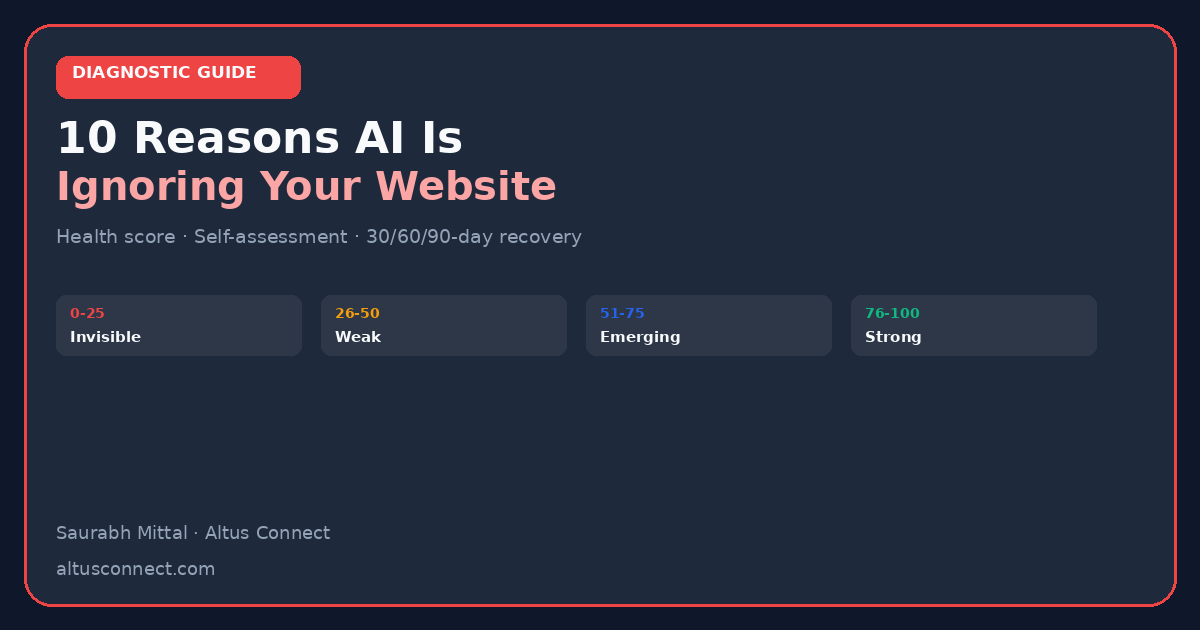
Introduction — The Frustration of Being Invisible to AI
You ask ChatGPT to recommend a vendor in your category — and your company is not mentioned. You search your own brand name — and AI gives a vague or wrong answer. You have invested in a professional website, SEO, and content marketing — yet AI systems act like you do not exist. This is the AI visibility gap, and it is diagnosable.
The frustration of searching ChatGPT and not finding your company
Founders describe this moment as alarming: a prospect says "ChatGPT recommended three vendors — you were not one of them." Your website traffic may be healthy. Your Google rankings may be fine. But AI recommendations operate on different logic — entity clarity, trust corroboration, structured data, and citable content — not keywords and backlinks alone.
Why visibility is earned, not guaranteed
AI does not owe any business a recommendation. Visibility is earned through machine-readable entity identity, third-party trust signals, structured content, and cross-source corroboration. A website that looks great to humans but lacks these signals will consistently lose to competitors who invested in AI visibility fundamentals — even competitors with inferior products.
How AI systems evaluate websites
When evaluating whether to recommend or cite your business, AI systems assess:
- Entity resolution — Can we identify this Organization uniquely?
- Trust corroboration — Do reviews, press, and directories confirm claims?
- Content citability — Are there quotable passages answering category queries?
- Structured data — Is schema markup present and consistent?
- Expert attribution — Are founders and authors identifiable Person entities?
Most businesses fail at steps 1 and 2 — AI never resolves their Organization entity or cannot corroborate trust claims. Steps 3–5 determine whether you are cited vs merely retrieved. The ten problems below map directly to failures at each evaluation step.
This guide maps the ten most common failures across these five evaluation layers — with symptoms, fixes, and a recovery plan.
How to use this diagnostic guide
- Step 1: Run 20 AI prompts in your category — log whether your brand appears (baseline mention rate)
- Step 2: Download and complete the self-assessment worksheet — score each problem 0–3
- Step 3: Calculate your AI Visibility Health Score using the methodology below
- Step 4: Read the problem sections matching your highest scores (3 = fix first)
- Step 5: Follow the 30/60/90-day recovery plan in priority order
- Step 6: Re-test monthly — Health Score and mention rate should climb together
Do not attempt all ten fixes simultaneously. Businesses that fix entity clarity (Problems 3, 8) and trust (Problems 6, 7) first see the fastest mention rate lift. Content depth (Problems 1, 2, 10) compounds over 60–90 days.
20 prompts to test your AI visibility today
Run these across ChatGPT, Gemini, Claude, and Perplexity. Log whether your brand is named:
- Best [your service] for [your target customer]
- Top [your category] companies in [your city or region]
- [Your service] vs [top competitor] — which is better?
- What is [your company name]?
- Who are the leading [your category] providers?
- Recommend a [your service] for [specific use case]
Expand to 20 variations covering your top services, locations, and comparison queries. Zero appearances across all 20 confirms Invisible band regardless of website aesthetics. Save results in a spreadsheet — date, platform, prompt, brands mentioned, your brand Y/N — to track recovery progress over 90 days.
Related: Why Your Business Doesn't Appear in ChatGPT · 15 Website Changes · AI-Friendly Content Guide.
Download: AI Visibility Self-Assessment Worksheet
Score all 10 problems 0–3. Calculate your Health Score band.
Download worksheetOpen printable version"AI visibility is earned, not guaranteed. A beautiful website with zero entity clarity, no reviews, and no structured data will always lose to an ugly website with 200 Google reviews and Organization schema. Diagnose before you redesign."
— Saurabh Mittal, Founder, Altus Connect
AI Visibility Health Score
Before diving into the ten problems, establish your baseline. The AI Visibility Health Score is a 0–100 diagnostic metric combining self-assessment and AI prompt testing.
AI Visibility Health Score — Methodology
| Score | Band | Meaning |
|---|---|---|
| 0–25 | Invisible | AI cannot resolve your entity. 0% mention rate expected. |
| 26–50 | Weak | Partial signals exist but trust/entity gaps block recommendations. |
| 51–75 | Emerging | Appearing in some prompts. Inconsistent across platforms. |
| 76–100 | Strong | Regular AI recommendations. Dense entity + trust graph. |
How to calculate: Complete the self-assessment worksheet (score each of 10 problems 0–3, max 30). Subtract from 100. Adjust: if AI mention rate is 0% on 20 test prompts, cap at 25 regardless of worksheet score. If mention rate exceeds 50%, floor at 51. Worksheet + prompt test combined gives final Health Score.
Health Score calculation — step by step
- Score each of 10 problems 0–3 on the worksheet (0 = not an issue, 3 = severe). Total possible: 30.
- Subtract problem total from 100: e.g., 100 − 22 = 78 (raw score).
- Run 20 category prompts across ChatGPT, Gemini, Claude, Perplexity. Calculate mention rate.
- If mention rate is 0%, cap final score at 25 (Invisible band) regardless of worksheet.
- If mention rate is 1–25%, apply −15 penalty to raw score.
- If mention rate exceeds 50%, set floor at 51 (Emerging minimum).
- Final score determines band: 0–25 Invisible · 26–50 Weak · 51–75 Emerging · 76–100 Strong.
Example: Worksheet total 18 → raw score 82. But mention rate 0% → capped at 25 (Invisible). This reflects reality: a website can look good on paper but AI still ignores it until prompts confirm visibility.
Track Health Score monthly alongside AI mention rate. The two metrics should move together — if worksheet score improves but mention rate stays at 0%, entity or trust problems (reviews, schema, About page) still block visibility and need priority attention.
Sample Health Score Dimensions — Weak vs Strong
"Most businesses we audit score 15–35 on the AI Visibility Health Score — firmly in Invisible or Weak. The good news: fixing the top three problems alone typically moves you to Emerging within 60 days. You do not need a full rebrand. You need a diagnostic recovery plan."
— Saurabh Mittal, Founder, Altus Connect
The 10 Reasons AI Is Ignoring Your Website
Problem 1: Thin Content
Symptoms: Most pages under 500 words. Blog posts are 300-word listicles. No FAQ sections, data, or depth.
Root causes: Content strategy prioritized volume over citability. Writers given keyword targets without depth requirements. Legacy pages never expanded.
Why AI dislikes this: AI extracts passages 40–167 words long. Thin pages lack quotable substance — nothing to cite for category queries.
Visibility impact: High — thin content is the #1 reason AI retrieves competitors with comprehensive guides instead.
How to fix it: Audit top 10 traffic pages. Expand each to 800+ words with FAQ section, one statistic, and named author. Consolidate thin posts into pillar guides.
Quick win: Add 8-question FAQ + FAQPage schema to your #1 service page today.
Long-term fix: Build content library using AI Content Blueprint: Problem, Explanation, Examples, Data, Expert, Actions, FAQ.
Example: A cybersecurity firm had 80 blog posts averaging 350 words — 0% AI mention rate. Consolidated into 8 pillar guides (2,000+ words each) with FAQs — 44% mention rate in 70 days.
Problem 2: Generic Service Pages
Symptoms: One "Services" page lists offerings in bullet points. No dedicated URLs per service. Vague descriptions like "we deliver excellence."
Root causes: Web design template treated services as a checklist. Sales team owns detail but it never reached the website. Fear of narrowing positioning.
Why AI dislikes this: AI matches specific intent to specific pages. "Best marketing attribution software" requires an attribution page — not a generic services list.
Visibility impact: Very high — service-specific AI queries cannot resolve generic pages to your offerings.
How to fix it: Create dedicated URL per core service. Minimum 800 words: scope, process, outcomes, pricing signals, FAQ, Service schema.
Quick win: Pick your #1 revenue service — publish a dedicated page with 5 FAQs this week.
Long-term fix: Full service page library with internal linking hub, case study per service, comparison pages.
Example: MSP listed 12 services on one page. Created /managed-it, /cloud-migration, /cybersecurity pages — appeared in 52% of local IT prompts within 60 days.
Problem 3: Weak About Us Page
Symptoms: About page is brand story without facts: no legal name, founding year, HQ, or category. Different description on LinkedIn.
Root causes: Copywriter prioritized narrative over entity clarity. Rebrand never updated About page. Founder uncomfortable with factual positioning.
Why AI dislikes this: Organization entity resolution requires factual anchors. AI cannot disambiguate "Summit Solutions" without founding date, location, and industry.
Visibility impact: High — failed entity resolution blocks all AI recommendation paths.
How to fix it: Rewrite first 150 words: legal name, founded [year], based in [city], we provide [category] for [audience]. Deploy Organization schema. Match LinkedIn exactly.
Quick win: Replace About page opening paragraph with entity-clear description today. Copy to LinkedIn.
Long-term fix: Organization @graph with sameAs to all profiles. Wikidata research. Quarterly NAP audit.
Example: Consulting firm About page said "we empower transformation." Rewrote: "Meridian Consulting Group, founded 2014 in Chicago, provides operations consulting for mid-market manufacturers." AI mention rate: 0% → 24% in 45 days.
Problem 4: No Founder Authority
Symptoms: CEO mentioned on About with photo only. No dedicated page, no Person schema, no LinkedIn linkage, no thought leadership.
Root causes: Founder prefers behind-the-scenes. Marketing never built founder brand. Privacy concerns blocked profile creation.
Why AI dislikes this: B2B AI heavily weights named experts. Founder Person entity without worksFor link means expert authority does not transfer to brand.
Visibility impact: High for B2B — Claude especially deprioritizes brands without named expert attribution.
How to fix it: Create /about/[founder] page with bio, credentials, knowsAbout topics, Person schema with worksFor → Organization @id, sameAs LinkedIn.
Quick win: Publish founder LinkedIn article linking to new founder page. Add Person schema.
Long-term fix: Monthly founder content, speaking listings, podcast appearances, guest articles for entity graph density.
Example: B2B SaaS CEO had no web presence beyond About caption. Added founder page + 4 LinkedIn articles — Claude began recommending the company for trust-sensitive queries within 50 days.
Problem 5: No Author Profiles
Symptoms: All blog posts authored by "Admin" or "Team." No author pages, bios, or Article schema author property.
Root causes: CMS default author setting never changed. Multiple contributors but no author workflow. Agency ghostwriting without attribution.
Why AI dislikes this: Article → Person → Organization citation chain breaks. AI treats anonymous content as untrusted — retrieved but not cited.
Visibility impact: Medium-high — blocks content citation even when topics match queries.
How to fix it: Create author page per contributor. Update all posts with named author. Deploy Article schema with author → Person @id.
Quick win: Fix author on your top 5 traffic blog posts today. Create one author profile page.
Long-term fix: Author template with Person schema auto-injected on publish. Editorial policy requiring named attribution.
Example: Agency blog had 120 "Admin" posts. Added 3 author profiles with credentials — citation rate for blog content increased 3× in Perplexity within 30 days.
Problem 6: Lack of Reviews
Symptoms: Under 30 Google reviews. No G2, Clutch, or industry platform presence. Website claims "trusted by hundreds" with no corroboration.
Root causes: Never systematized review requests. Fear of negative reviews. B2B assumed reviews do not matter.
Why AI dislikes this: Reviews are primary trust signal for local and B2B AI. Self-asserted claims without review corroboration fail trust filters.
Visibility impact: Very high — #2 reason after entity failure for AI exclusion.
How to fix it: Launch 90-day review campaign. Target 50+ Google reviews. Add AggregateRating schema matching live data. Claim G2/Clutch profiles.
Quick win: Email 10 happy customers for Google reviews this week.
Long-term fix: Automated post-project review request. Multi-platform strategy (Google + industry directory). Review response protocol.
Example: Law firm with 12 Google reviews absent from AI answers. Reached 78 reviews in 90 days — appeared in 65% of local legal prompts.
Problem 7: Poor E-E-A-T Signals
Symptoms: No visible credentials, press mentions, client logos with permission, or editorial standards. Claims without proof.
Root causes: Experience, Expertise, Authoritativeness, Trustworthiness never operationalized on website. PR wins not published. Credentials buried in PDFs.
Why AI dislikes this: AI applies E-E-A-T-style trust filters. Unverifiable expertise claims score lower than competitors with documented proof.
Visibility impact: High — especially for YMYL-adjacent categories (health, legal, finance, security).
How to fix it: Add credentials to author/founder pages. Publish 3 case studies with client names. Create /press or media mentions section. Link bar admissions, certifications.
Quick win: Add founder credentials and one client testimonial with full name and company to homepage.
Long-term fix: Quarterly original research, speaking calendar, press outreach, editorial standards page.
Example: Financial advisory firm with no credentials online. Added CFP listings, FINRA link, 4 case studies — Gemini AI Overviews began citing them for retirement planning queries.
Problem 8: Missing Structured Data
Symptoms: Zero JSON-LD on site. No Organization, Person, Article, or FAQ schema. View source shows only meta tags.
Root causes: Schema never prioritized. Developer left company. CMS plugin not configured. Assumed Google "figures it out."
Why AI dislikes this: Schema is machine-readable entity language. Without it, AI relies on inconsistent third-party data that may be wrong or outdated.
Visibility impact: Very high — schema is the fastest technical fix with measurable lift.
How to fix it: Deploy Organization schema on homepage. Person schema on founder page. FAQPage on FAQ sections. Article schema on blog template.
Quick win: Add Organization JSON-LD to homepage today. Validate at search.google.com/test/rich-results.
Long-term fix: Full @graph linking Organization, Person, Service entities. sameAs network. Automated schema via CMS template.
Example: E-commerce brand with no schema. Added Organization + Product schema — ChatGPT began including them in category recommendations within 3 weeks.
Problem 9: Weak Brand Mentions
Symptoms: Brand exists only on owned website. No LinkedIn company page, G2 profile, directory listings, press, or Wikipedia/Wikidata.
Root causes: Marketing focused on paid ads and website only. Never invested in directory presence or PR. Assumed product quality would generate mentions organically.
Why AI dislikes this: AI corroborates entity claims across independent sources. Single-source brands (website only) fail cross-source trust validation.
Visibility impact: High — competitors with dense mention graphs win by default.
How to fix it: Claim LinkedIn, G2, Crunchbase, industry directories. Ensure NAP consistency. Add sameAs to Organization schema. Pitch 2 local press stories.
Quick win: Claim and complete Google Business Profile and LinkedIn company page today.
Long-term fix: PR cadence, directory audit, chamber membership, review platforms, Wikidata research.
Example: Startup with website-only presence. Added LinkedIn, G2 (35 reviews), Crunchbase, 2 press mentions — AI mention rate 0% → 31% in 8 weeks.
Problem 10: No Original Insights
Symptoms: All content repackages competitor blogs. No surveys, benchmarks, proprietary data, or unique frameworks.
Root causes: Content team given keyword briefs without research budget. Fear of publishing non-consensus views. No data collection process.
Why AI dislikes this: AI prefers primary sources for statistical claims. Republished insights give citation credit to original publishers — not you.
Visibility impact: Medium-high — blocks long-term citation authority in category.
How to fix it: Run simple customer survey (50+ responses). Publish HTML benchmark report. Create proprietary framework (like FCAT). Include methodology and date.
Quick win: Publish one original stat from customer data or internal metrics this month.
Long-term fix: Annual benchmark report, quarterly survey, proprietary methodology, research-as-marketing program.
Example: HR software company republished SHRM stats only. Published "2026 SMB HR Tech Survey" (n=180) — became default AI citation for SMB HR statistics queries.
Problem Impact on AI Visibility — Severity Ranking
Health band action guide — what to do at each level
Invisible (0–25): Stop all new content production until foundation is fixed. Your entity does not exist in AI systems. Execute 30-day plan completely before measuring again. Do not invest in paid ads or content volume — pipeline is leaking upstream.
Weak (26–50): Partial signals exist but trust or entity gaps block recommendations. Focus on reviews (Problem 6), schema (Problem 8), and dedicated service pages (Problem 2). You are closer than Invisible — 60-day plan should reach Emerging.
Emerging (51–75): Appearing inconsistently across platforms. Optimize content depth (Problems 1, 10), strengthen brand mentions (Problem 9), and add comparison/case study content. 90-day plan targets upper Emerging or Strong.
Strong (76–100): Maintain and defend. Monthly prompt testing, quarterly content refresh, monitor competitor citation share. Invest in original research to widen moat. Strong band requires ongoing maintenance — not maintenance-free visibility.
Download: AI Visibility Self-Assessment Worksheet
Score all 10 problems 0–3. Calculate your Health Score band.
Download worksheetOpen printable versionRecovery Plan — 30, 60, and 90 Days
Fix problems in priority order — not all at once. This phased plan addresses highest-impact issues first. Map each phase to the problem numbers in this guide for cross-reference.
Priority matrix — which problems to fix when
- Days 1–30 (critical): Problems 3, 6, 8 — About page, reviews start, Organization schema
- Days 31–60 (high): Problems 2, 4, 5, 7 — Service pages, founder, authors, E-E-A-T proof
- Days 61–90 (compound): Problems 1, 9, 10 — Content depth, brand mentions, original research
30-day plan — Stop the bleeding
- Week 1: Run 20 AI prompt baseline test. Complete self-assessment worksheet. Rewrite About page. Deploy Organization schema.
- Week 2: Create founder page + Person schema. Add FAQ + FAQPage schema to top service page. Fix author on top 5 blog posts.
- Week 3: Launch review campaign (target 20 new reviews). Claim LinkedIn, G2, Google Business Profile. Add sameAs to schema.
- Week 4: Re-test 20 prompts. Log Health Score change. Publish one dedicated service page (800+ words).
Week 1 checklist: About page rewritten · Organization schema live · 20 prompt baseline logged · Worksheet completed
Week 2 checklist: Founder page + Person schema · FAQ on top service page · Top 5 blog authors fixed
Expected outcome: Move from Invisible (0–25) to lower Weak (26–40) band.
60-day plan — Build emerging signals
- Weeks 5–6: Publish 2 HTML case studies. Create 2 additional service pages. Internal linking audit.
- Weeks 7–8: Reach 50+ Google reviews. Add author profiles for all contributors. Deploy Article schema template.
Expected outcome: Move to Emerging (51–75) band on primary category prompts.
90-day plan — Compound authority
- Weeks 9–10: Publish comparison page. Launch industry glossary (20+ terms). Original benchmark or survey data.
- Weeks 11–12: Full @graph schema linkage. Press outreach (2 mentions). Monthly prompt testing protocol established.
Expected outcome: Upper Emerging (65–75) or lower Strong (76+) depending on category competitiveness.
Ongoing maintenance: After 90 days, shift to monthly prompt testing, quarterly content updates, and annual benchmark refresh. AI platform models update regularly — visibility requires maintenance, not one-time fixes.
90-Day AI Visibility Recovery Roadmap
Days 1–30
Foundation
About, schema, founder, FAQ, reviews start
Days 31–60
Proof
Case studies, service pages, authors
Days 61–90
Authority
Comparison, glossary, research, press
AI Mention Rate — Before vs After Recovery Plan
Share of 20 category prompts recommending your brand
Before (avg Health Score 22 — Invisible)
0%
After 90-day plan (Health Score 68 — Emerging)
52%
AI is not ignoring you randomly — it is responding to missing signals. Diagnose with the Health Score, fix the ten problems in priority order, and follow the 30/60/90-day recovery plan. Visibility is earned — and it is achievable.
"Find the problem before you fund the rebrand." — Saurabh Mittal
Get Your AI Visibility Audit — Find Out Why AI Ignores You
Altus Connect runs the full diagnostic: Health Score, 20-prompt mention rate test, worksheet scoring, and prioritized 90-day recovery plan — so you know exactly why AI ignores your website.
Request AI Visibility AuditTopics, entities & related searches
Primary keyword: AI visibility
Secondary keywords
- entity clarity
- trust signals
- structured data
Semantic keywords
- AI recommendations
- machine-readable content
- entity identity
NLP entities
- AI systems
- ChatGPT
- Bing
- Claude
- Perplexity
Related search terms
- AI visibility issues
- improve AI recommendations
- website AI optimization
Frequently Asked Questions
Why is AI ignoring my website?
Common reasons: thin content, generic service pages, weak About page, no founder authority, no author profiles, lack of reviews, poor E-E-A-T, missing structured data, weak brand mentions, and no original insights. Use the AI Visibility Health Score to diagnose.
What is the AI Visibility Health Score?
A 0–100 diagnostic metric: 0–25 Invisible, 26–50 Weak, 51–75 Emerging, 76–100 Strong. Calculated from self-assessment worksheet (10 problems scored 0–3) combined with AI prompt mention rate testing.
How do I test if AI mentions my business?
Run 20 category prompts (e.g., "best [service] for [audience]") across ChatGPT, Gemini, Claude, and Perplexity. Log which brands appear. Repeat monthly after fixes.
What is the fastest fix for AI visibility?
Deploy Organization schema, rewrite About page for entity clarity, and add FAQ + FAQPage schema to your top service page. These three changes can be done in 2–3 days.
Do Google rankings matter for AI visibility?
Partially. 73% of page-1 Google rankers have 0% AI mention rate. Rankings and AI visibility are related but distinct — optimize for both.
How important are reviews for AI recommendations?
Very important — reviews are the #2 trust signal after entity clarity. Target 50+ Google reviews plus industry platform presence (G2, Clutch, Avvo, etc.).
What is E-E-A-T and why does AI care?
Experience, Expertise, Authoritativeness, Trustworthiness — Google's quality framework that AI systems apply similarly. Credentials, case studies, press, and named authors demonstrate E-E-A-T.
Does schema markup help AI visibility?
Yes — significantly. Organization, Person, Article, and FAQPage schema are machine-readable entity language. Missing schema is problem #8 and one of the fastest fixes.
Why does my competitor appear in ChatGPT but I don't?
Your competitor likely has stronger entity clarity, more reviews, structured schema, dedicated service pages, or denser brand mentions. Run the self-assessment worksheet to identify specific gaps.
How long until AI starts recommending my business?
Foundation fixes (schema, About, FAQ) often show lift in 2–4 weeks. Full recovery plan typically moves businesses from Invisible to Emerging in 60–90 days.
Should I create more blog content?
Only if it follows AI-friendly structure — FAQ sections, named authors, original data, 800+ word depth. More thin content worsens the problem. Quality and structure over volume.
What is a founder authority page?
Dedicated /about/founder page with bio, credentials, Person schema, worksFor linking to Organization, knowsAbout topics, and sameAs LinkedIn URL. Critical for B2B AI trust.
Can I fix AI visibility without a developer?
Yes for Changes 1–7: About rewrite, FAQ content, founder page, review campaign, author profiles. Organization and FAQ schema can use CMS plugins (Yoast, Rank Math).
What is the self-assessment worksheet?
Downloadable worksheet scoring each of 10 problems 0–3 (max 30). Lower score = healthier. Combined with prompt testing to calculate AI Visibility Health Score.
What is included in an AI Visibility Audit?
Altus Connect audits Health Score, runs 20+ prompt tests across 4 AI platforms, scores the worksheet, identifies top 3 blocking problems, and delivers a prioritized 30/60/90-day recovery plan.