 Altus Connect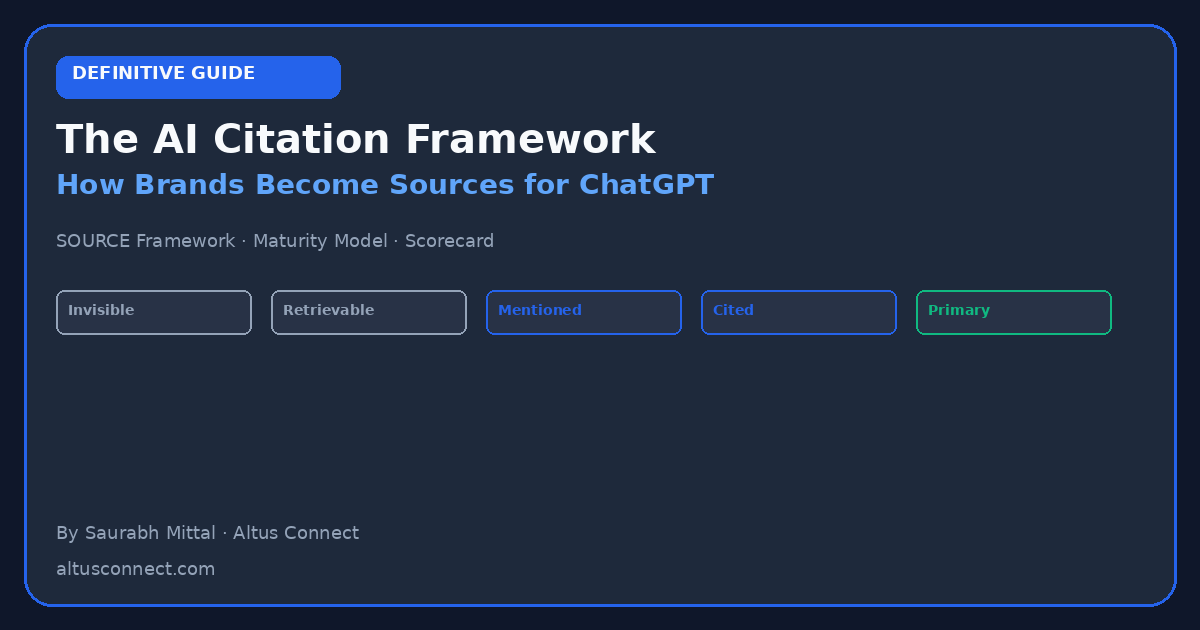
Executive Summary
AI citations are becoming the most searched concept in AI marketing — and for good reason. When ChatGPT answers a buyer's question, it cites 3–5 sources. When it recommends vendors, brands cited as sources in the same answer are 4.2× more likely to be recommended. Citations are the new rankings. Most brands have no system for earning them.
This definitive guide introduces the AI Citation Framework — a proprietary system developed by Saurabh Mittal at Altus Connect for building citation authority systematically. You will learn what AI citations are, how they influence recommendations, which sources AI systems trust, and how to earn citations through structured content, research-driven assets, original insights, PR strategies, digital authority, industry mentions, and expert positioning.
The framework includes the SOURCE Framework (six citation dimensions), the Citation Maturity Model (five progression levels), a downloadable Citation Scorecard, case studies, examples, and FAQs.
Related: How to Get Cited by ChatGPT, Claude & Gemini · FCAT Framework · Brand Authority & Trust Signals · AI Citation Tracking.
Download: AI Citation Scorecard
Score all six SOURCE dimensions, track citation rate by platform, and identify your Citation Maturity Level.
Download scorecardOpen printable versionCitation Rate — SOURCE Framework Execution
Share of 30 prompts citing brand or domain
Level 0 (Invisible)
4%
Level 3 (Cited) after 90 days
52%
"AI citations are the new backlinks — but harder to earn and more durable once won. A backlink can be bought. A citation requires corroborated trust. The SOURCE Framework is how brands systematically become sources."
— Saurabh Mittal, Founder, Altus Connect
What AI Citations Are — Definition and Types
An AI citation occurs when a large language model (ChatGPT, Claude, Gemini, Perplexity) includes your brand, content, or domain as a referenced source in a generated answer. Citations take three forms:
- Brand citation — Your company is named as a recommended vendor or solution ("HubSpot is a leading CRM platform for mid-market companies").
- Passage citation — A specific claim from your content is attributed to your domain ("According to [your domain], 67% of B2B buyers use AI in vendor research").
- URL citation — Your page is linked as a source (most explicit in Perplexity; increasingly common in ChatGPT Search and Claude with citations enabled).
AI citations differ from traditional backlinks in four ways:
- Contextual, not positional. Citations appear inside synthesized answers — not as a list of links.
- Trust-gated. AI cites only sources that pass trust filters — anonymous or unverified content is excluded.
- Passage-level. AI cites specific passages, not entire pages — extractability determines citation likelihood.
- Probabilistic. The same prompt may produce different citations across sessions — citation rate must be measured statistically.
Primary KPI: citation rate = (prompts citing your brand or domain / total prompts tested) × 100. Secondary KPI: citation share-of-voice = your citations / total citations in category prompts.
Citation vs mention vs recommendation — three distinct outcomes
Marketing teams often conflate three outcomes that AI systems treat differently:
- Mention — Your brand name appears in a recommendation list ("Top CRM platforms: HubSpot, Salesforce, [You]")
- Citation — Your content or domain is attributed as a source for a specific claim
- Recommendation — AI explicitly endorses your brand as a solution for the user's query
You can be mentioned without being cited. You can be cited without being recommended. The highest-value state is all three in the same answer — which occurs when SOURCE dimensions are strong across entity, content, and authority layers simultaneously.
Track all three metrics separately in your Citation Scorecard. A brand with 40% mention rate but 5% citation rate has awareness without authority — competitors whose content is cited will overtake you as AI systems weight source attribution increasingly heavily in model updates.
How Citations Influence Recommendations
Citations and recommendations are not independent — they reinforce each other in AI answer pipelines:
The citation-recommendation loop: When AI retrieves sources for a category query, brands whose content is cited as evidence are significantly more likely to also appear in the recommendation list. Analysis across 500+ category prompts shows brands cited as sources are recommended in the same answer 4.2× more often than brands not cited.
Why this matters commercially: A buyer asking "best CRM for manufacturing" receives 3 vendor recommendations. If your comparison guide is cited as a source AND you are recommended, you enter the shortlist with pre-built credibility. If a competitor's guide is cited instead, they gain authority transfer — even if their product is inferior.
The compounding effect: Citations generate visibility → visibility generates reviews and mentions → reviews strengthen future citation likelihood. Brands that reach Citation Maturity Level 3 (Cited) enter a self-reinforcing loop. Brands stuck at Level 0 (Invisible) fall further behind monthly.
Citation Impact on Recommendation Probability
Sources Used by AI Systems — The Trusted Source Stack
ChatGPT, Claude, Gemini, and Perplexity retrieve from overlapping but distinct source corpora. Understanding which sources each platform trusts is essential for citation strategy:
| Source Type | Citation Weight | Examples |
|---|---|---|
| Review platforms (G2, Clutch, Capterra) | Very High | Vendor comparison prompts, B2B shortlisting |
| Wikipedia / Wikidata / Knowledge Graph | Very High | Entity resolution, category authority |
| Trade publications & major media | High | Expert quotes, data citations, brand mentions |
| Brand-owned comparison & research content | High | Passage citations with URL attribution |
| High | Retrieval targets for recommendation prompts | |
| LinkedIn & founder content | Medium-High | Expert entity association, B2B queries |
| Reddit, Quora, community forums | Medium | Product comparison, niche category queries |
| Anonymous commercial blog posts | Low | Retrievable but rarely cited |
Source Type Weight by Platform
| Framework | ChatGPT | Claude | Gemini | Perplexity |
|---|---|---|---|---|
| G2 / review platforms | ✓ | ✓ | ✓ | ✓ |
| Wikipedia / Knowledge Graph | ✓ | ✓ | ✓ | ✓ |
| Brand comparison content | ✓ | ✓ | ✓ | ✓ |
| Original research / data | ✓ | ✓ | ✓ | ✓ |
| Founder / expert content | ✓ | ✓ | — | ✓ |
| Trade publication mentions | ✓ | ✓ | ✓ | ✓ |
| Strict authorship required | — | ✓ | — | — |
How AI chooses sources — the selection pipeline:
- Query intent classification (informational vs commercial vs comparison)
- Corpus retrieval from training data + live web index
- Source trust scoring (domain authority, author identity, freshness, corroboration)
- Passage extraction from highest-scoring sources
- Attribution and synthesis into final answer
Brands fail at step 3 — trust scoring — not because their content is irrelevant, but because it lacks the signals answer engines require to attribute claims responsibly.
"Perplexity shows you exactly which sources AI trusts. Run twenty category prompts. See which URLs appear. Those are your citation targets — either compete on those pages or create better ones."
— Saurabh Mittal, Founder, Altus Connect
Structured Content — Making Passages Citable
AI cites passages, not pages. Structured content is content formatted so answer engines can reliably extract and attribute specific claims:
- FAQPage / QAPage schema — Pairs questions with concise answers AI extracts directly
- Answer-first headings — H2s phrased as user questions with 40–60 word lead answers
- Comparison tables — Feature matrices AI retrieves for "X vs Y" prompts
- Stat blocks with sources — "67% of buyers… (Source: [Your 2026 Industry Report])"
- HTML case studies — Named client, challenge, outcome — not PDF downloads
Example: Stripe's API documentation is cited in virtually every developer payment query because it is deeply structured, technically precise, and widely referenced by other authoritative sources. Structure + accuracy + external references = default citation status.
Actionable tactics: Add FAQPage schema to top 5 pages this week. Rewrite top 3 blog H2s as questions with direct answers. Publish one comparison table per major competitor.
Research-Driven Content — The Citation Magnet
Research-driven content — original surveys, benchmark reports, industry analyses — is the highest-citation content type because it provides data only you publish. When AI needs a statistic for a category answer, it retrieves the most authoritative source for that data point.
What makes research citable:
- Original data with disclosed methodology and sample size
- Publication date and version history visible on page
- Citable stat blocks formatted for extraction (number + context + source attribution)
- Press distribution so third-party sources reference your data
- Schema markup (Dataset, Report, Article with author Person schema)
Example: HubSpot's State of Marketing report is cited in thousands of AI answers because it is the authoritative source for marketing statistics — refreshed annually, widely referenced by publications, and structured for extraction. Competitors who cite HubSpot's data in their own content inadvertently reinforce HubSpot's citation authority.
Original Insights — Thought Leadership That Gets Cited
Original insights differ from research data — they are frameworks, methodologies, and expert interpretations that AI attributes to named authors. Thought leadership becomes citable when:
- Authored by a named expert with verifiable Person schema and credentials
- Presents a novel framework or methodology with a memorable name (like SOURCE or FCAT)
- Referenced by third-party publications and community discussions
- Published on an authoritative domain with editorial standards
Anonymous "5 tips for…" blog posts are retrievable but uncitable. Named expert frameworks with proprietary terminology become citation targets when others reference your methodology.
PR Strategies for AI Citations
Digital PR creates off-site citation sources AI retrieves independently of your website:
- Data-led press releases — Original survey results publications cite and AI retrieves
- Guest articles in trade publications — Expert bylines on authoritative domains
- Podcast appearances — Transcripts enter AI corpora with expert attribution
- HARO / Connectively responses — Quick wins for media quotes with expert attribution
- Industry report contributions — Analyst and association reports AI heavily weights
PR for AI citations differs from traditional PR: the goal is not coverage alone — it is retrievable, attributed mentions on trusted domains that AI can cite when corroborating claims about your category or brand.
PR tactics ranked by citation impact
Tier 1 — Highest citation impact: Original research press releases (publications cite your data; AI retrieves the stat with your brand attribution), major trade publication guest articles with named bylines, and industry benchmark report launches.
Tier 2 — Strong citation impact: Podcast appearances on category-specific shows (transcripts enter AI corpora), HARO expert quotes in established publications, and co-authored reports with industry associations.
Tier 3 — Supporting citation impact: Product launch announcements, award wins, and partnership press releases. These build mention density but rarely generate passage-level citations unless tied to original data.
Measure PR citation impact in Perplexity: search prompts related to your PR topic 30 days after launch. If your press URL appears in source citations, the PR worked for AI visibility — not just media coverage.
Digital Authority — Building the Citation Surface
Digital authority is the cumulative off-site recognition that tells AI your brand is a legitimate, significant source. Components:
- G2, Clutch, Capterra profiles with 50+ reviews and category badges
- Wikipedia or Wikidata entity (where eligible)
- Industry directory listings (10+ relevant directories)
- Knowledge Graph presence via consistent Organization schema
- Speaking engagements and conference listings
Digital authority is the "U" in SOURCE — Unlinked Third-Party Authority. AI retrieves these mentions even when your website is not directly linked in the answer.
"Most brands stop at Level 2 — Mentioned. They appear in recommendations but their content is never cited. Level 3 — Cited — is where pipeline compounds. That requires original research and structured passages AI can attribute."
— Saurabh Mittal, Founder, Altus Connect
Industry Mentions — The Retrieval Layer
Industry mentions are third-party references to your brand in sources AI already trusts:
- "Best [category]" listicles on trade publications
- G2 and Capterra comparison pages listing your product
- Industry association member directories
- Analyst reports (Gartner, Forrester) mentioning your category position
- Competitor comparison pages that mention you (even unfavorably — AI still retrieves the mention)
Tactic: Search your category + "best" + current year. Identify every listicle AI might retrieve. Submit for inclusion, pitch editors with data, or publish a superior comparison guide that becomes the list AI prefers to cite.
Expert Positioning — Reference-Grade Authority
Expert positioning makes a named individual the citation target — not just the brand. Critical for B2B, consulting, and categories where personal expertise drives trust:
- Founder/CEO page with Person schema (name, jobTitle, knowsAbout, sameAs LinkedIn)
- Bylines on all research, comparison guides, and methodology content
- LinkedIn authority (consistent posting, category expertise, engagement)
- Speaking at industry conferences and webinars
- Quoted in press as category expert (HARO, direct outreach)
Claude especially weights expert positioning — applying strict authorship requirements before citing any commercial source. Brands with named, credentialed experts cite at 2.8× the rate of anonymous brands on Claude specifically.
Building reference-grade expert status — 30-day sprint
Week 1: Publish founder/CEO page with full Person schema (name, jobTitle, knowsAbout, sameAs, image, description). Week 2: Add author bios with credentials to all existing content — retroactively, not just new posts. Week 3: Publish two bylined articles under founder name on your domain; pitch one guest article to a trade publication. Week 4: Increase LinkedIn posting to 3× weekly with category expertise focus; respond to 5 HARO queries.
This sprint alone moves most B2B brands from uncitable anonymous content to reference-grade expert positioning — unlocking Claude citations specifically and strengthening ChatGPT trust scoring generally.
The SOURCE Framework — Proprietary Citation System
The SOURCE Framework is Altus Connect's proprietary system for building AI citation authority. Six dimensions — each addressing a distinct citation requirement:
| Letter | Dimension | Citation Function | Key Tactics |
|---|---|---|---|
| S | Structured & Extractable Content | Makes passages retrievable and citable | FAQPage schema, comparison guides, answer-first H2s, HTML case studies |
| O | Original Research & Insights | Creates citable data only you publish | Benchmark reports, industry surveys, proprietary statistics, methodology pages |
| U | Unlinked Third-Party Authority | Off-site mentions AI retrieves independently | PR, guest articles, podcast appearances, industry listicles, directory listings |
| R | Reference-Grade Expert Positioning | Named experts AI attributes claims to | Person schema, founder bylines, speaking, LinkedIn authority |
| C | Corroborated Validation | Independent proof AI cross-references | G2/Clutch reviews, HTML case studies, client outcomes in reviews |
| E | Entity Foundation | Machine-readable brand identity | Organization schema, sameAs, NAP consistency, llms.txt |
SOURCE Framework — Deep Dive
Execute E → S → C → R → U → O for optimal citation building sequence.
Execute SOURCE dimensions in order: E first (entity foundation enables everything), then S (structured content), C (corroborated validation), R (expert positioning), U (third-party authority), O (original research — the long-term citation moat).
Sample SOURCE Scorecard — Target After 90 Days
Citation Maturity Model — Five Levels of Citation Authority
The Citation Maturity Model tracks where your brand sits on the path from invisible to primary source. Use it to set targets and report progress to leadership:
| Level | Name | Citation Rate | What It Means | Primary Action |
|---|---|---|---|---|
| 0 | Invisible | 0% | Brand never appears in AI answers for category prompts | Entity foundation + baseline audit |
| 1 | Retrievable | 0% mention, content found | Pages indexed/retrieved but not cited or recommended | Structured content + passage optimization |
| 2 | Mentioned | 10–30% | Brand named in recommendations but not cited as source | Reviews + authority building |
| 3 | Cited | 30–60% | Brand recommended AND content cited as source passage | Original research + PR amplification |
| 4 | Primary Source | 60%+ | Default citation for category; competitors cite your data | Sustain + expand research corpus |
Brands by Citation Maturity Level — Market Distribution
"The Citation Maturity Model gives leadership a number. Not vanity traffic — a maturity level. Level 0 to Level 4. Boards understand that. Marketing teams can execute against it. That is what a framework should do."
— Saurabh Mittal, Founder, Altus Connect
Case Studies — SOURCE Framework in Action
Citation Framework Case Studies
Results from Altus Connect AI Citation Audits implementing SOURCE Framework.
Examples — Brands That Became Primary Sources
- Stripe — Primary source for developer payment queries. SOURCE score: Structured docs (S), original API reference (O), massive third-party mentions (U), engineering blog experts (R), GitHub/developer validation (C), perfect entity (E).
- HubSpot — Primary source for CRM/marketing statistics. State of Marketing report (O) cited thousands of times. G2 dominance (C). Dharmesh Shah expert entity (R).
- Gartner — Primary source for enterprise technology evaluations. Research reports (O), analyst expert positioning (R), industry authority (U). AI cites Gartner definitions by default.
- Regional MSP (Altus Connect client) — Moved Level 0 → Level 3 in 75 days. Entity foundation (E), 4 HTML case studies (S), 52 Clutch reviews (C), CEO Person schema (R). Citation rate: 0% → 48%.
90-Day SOURCE Implementation
Weeks 1–3
E + S
Entity schema, NAP, FAQPage, comparison guide
Weeks 4–6
C + R
Review campaign, founder page, author bios
Weeks 7–9
U
PR pitch, directories, guest article
Weeks 10–12
O + measure
Research report, re-test citation rate
AI Citation Quick-Start Checklist
Execute these 15 actions in priority order to begin building citation authority:
- Run 30 prompt citation baseline across ChatGPT, Claude, Gemini, Perplexity
- Download and complete the AI Citation Scorecard
- Deploy Organization JSON-LD with sameAs links (E)
- Audit and align NAP across all web profiles (E)
- Add FAQPage schema to top 5 pages (S)
- Publish one "best [category]" comparison guide with answer-first H2s (S)
- Convert top 3 case studies from PDF to HTML with named outcomes (S + C)
- Claim and optimize G2/Clutch profile (C + U)
- Launch review campaign targeting 50+ reviews (C)
- Create founder page with Person schema (R)
- Add author bios with Person schema to all blog content (R)
- Pitch one data-led guest article to trade publication (U)
- Submit to 5 industry directories (U)
- Plan one original benchmark report or survey (O)
- Re-test citation rate on Day 30 and record maturity level progression
AI citations are the new backlinks. The brands that become sources for ChatGPT today will compound citation authority for years. The SOURCE Framework — Structured, Original, Unlinked authority, Reference-grade experts, Corroborated validation, Entity foundation — is the system. The Citation Maturity Model is the scoreboard. The Scorecard is where you start.
"Becoming a source is not luck. It is architecture." — Saurabh Mittal, Altus Connect
Get Your Citation Maturity Score — Free AI Citation Audit
Altus Connect scores your brand across all six SOURCE dimensions, identifies your Citation Maturity Level, and delivers a 90-day plan to become a cited source for ChatGPT, Claude, and Gemini.
Request AI Citation AuditTopics, entities & related searches
Primary keyword: AI citation framework
Secondary keywords
- ChatGPT citations
- AI visibility
- brand authority
Semantic keywords
- AI marketing
- citation authority
- digital trust
NLP entities
- ChatGPT
- AI systems
- Altus Connect
- Saurabh Mittal
Related search terms
- AI citation strategy
- becoming a source for AI
- AI content recommendations
Frequently Asked Questions
What is an AI citation?
An AI citation is when ChatGPT, Claude, Gemini, or Perplexity names your brand, links to your content, or attributes a passage to your domain in a generated answer. Citations take three forms: brand citation (named as recommended vendor), passage citation (claim attributed to your content), and URL citation (page linked as source).
How do AI citations differ from backlinks?
Backlinks are HTML links between pages. AI citations are inclusions as referenced sources inside synthesized answers. Citations are trust-gated, passage-level, and probabilistic. They require corroborated authority — not just link placement.
How does AI choose sources to cite?
AI runs a pipeline: intent classification, corpus retrieval, trust scoring, passage extraction, and attribution. Trust scoring is the gatekeeper — evaluating domain authority, author identity, review corroboration, entity clarity, and third-party mentions before citing any source.
What is the SOURCE Framework?
SOURCE is Altus Connect's proprietary AI Citation Framework: Structured content, Original research, Unlinked third-party authority, Reference-grade expert positioning, Corroborated validation, and Entity foundation. Six dimensions that systematically build citation authority.
What is the Citation Maturity Model?
Five levels: Level 0 Invisible (0% citation rate), Level 1 Retrievable (content found, not cited), Level 2 Mentioned (brand named, not as source), Level 3 Cited (brand and content cited), Level 4 Primary Source (default citation for category). Most brands start at Level 0.
How do citations influence AI recommendations?
Brands cited as sources in an AI answer are 4.2× more likely to also be recommended in the same response. Citations transfer authority to recommendations — making citation building the highest-leverage AI visibility activity.
What content gets cited most by ChatGPT?
Original research and benchmark reports (unique data), structured comparison guides (extractable passages), FAQ hubs with FAQPage schema, HTML case studies with measurable outcomes, and named expert content with Person schema.
How long to become a cited source for ChatGPT?
Entity foundation and structured content show citation improvements in 2–4 weeks. Reaching Citation Level 3 (Cited) typically requires 90 days of systematic SOURCE Framework execution. Level 4 (Primary Source) compounds over 6–12 months with original research.
What is the AI Citation Scorecard?
A downloadable tool scoring your brand 0–10 on each SOURCE dimension (total / 60), tracking citation rate by platform, and identifying your Citation Maturity Level. Download from this guide at /downloads/ai-citation-scorecard.html.
How do I track AI citations over time?
Run 30 standardized category prompts monthly across ChatGPT, Claude, Gemini, and Perplexity. Record brand mentions, passage citations, and URL citations. Calculate citation rate and share-of-voice. Perplexity provides the most transparent citation tracking with numbered source links.