 Altus Connect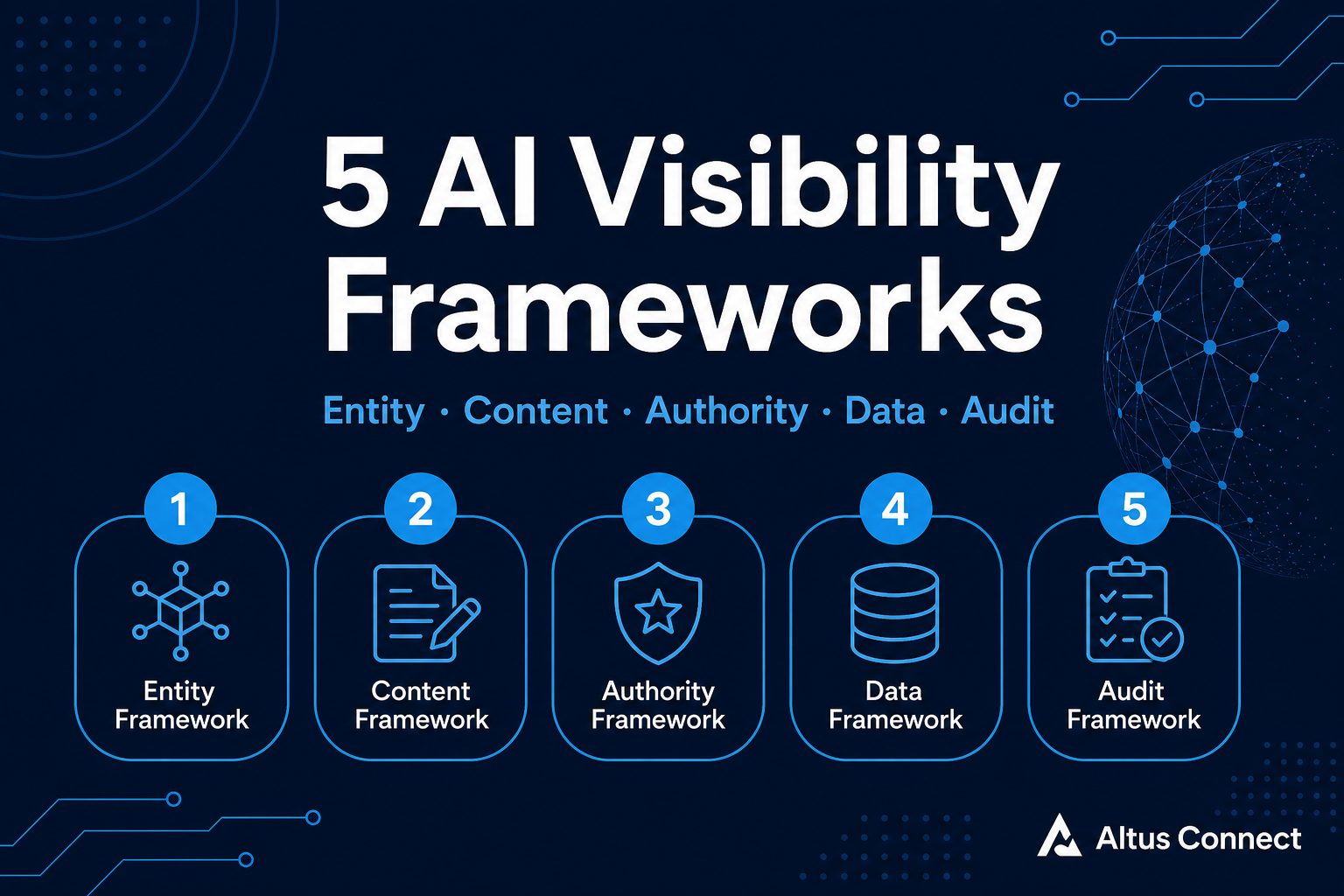
Executive Summary
Answer engine optimization (AEO) and generative engine optimization (GEO) are reshaping how brands earn visibility. Instead of ten blue links, buyers increasingly receive one-shot answers from ChatGPT, Google Gemini, Perplexity, and Google AI Overviews. In this environment, traditional SEO rankings alone are insufficient — brands must become the source AI systems trust enough to cite.
AI Recommendation Engineering™ focuses on aligning specific content to the prompts that trigger AI recommendations. This guide introduces five complementary AI visibility frameworks that address the broader foundation required for sustained citations in generative search:
- AI Entity Architecture™ — machine-readable brand identity
- AI Content Architecture™ — answer-ready content structure
- AI Authority Amplification™ — third-party credibility signals
- AI Data Integrity™ — technical data quality and schema
- AI Presence Audit™ — diagnostic visibility assessment
Each framework includes three to six components with definitions grounded in recent industry literature on AI search and trust signals. We outline target roles (SEO and content strategists, PR teams, data engineers), use cases (brand launches, content strategy, trust-building), key benefits (better AI trust, discoverability, brand clarity), and typical deliverables (schema markup, content hubs, audit reports). Implementation steps provide a practical roadmap for each framework.
Teams implementing these frameworks often start with an AI visibility audit or rank-in-AI-answers assessment to baseline share-of-voice before building entity schema, content hubs, and authority campaigns.
AI Share-of-Voice — Typical Before/After
Category prompt citation rate (50-query sample)
Before AEO
8%
After 90 days
41%
Percepture's Golden Triangle — Content Architecture, AI-Generated Answers, and Authority Signals — shows that structured content, entity clarity, and third-party trust must converge for AI systems to recommend your brand.
Percepture's Golden Triangle — How AI Visibility Converges
Pillar 1
Content Architecture
Answer-ready pages & FAQs
Pillar 2
Entity Clarity
Schema, sameAs & profiles
Pillar 3
Authority Signals
PR, backlinks & reviews
Output
AI-Generated Answer cites your brand
Typical lift: 3–5× citation rate vs. single-pillar efforts
Explore the 5 Frameworks — Click to Expand
Tap each card to reveal framework details. Use this as a quick reference before diving into each section.
AI Entity Architecture™
Definition: Build a clear, machine-readable identity for a brand or organization so AI systems can recognize and trust it as a distinct entity. This involves creating a formal ontology of the entity — its attributes and relationships — and ensuring consistency across all references.
Components
Entity Definition. Precisely define the brand's scope, legal identity, key people, services, and attributes (similar to a Brand Ontology). This ensures AI models treat the brand as a coherent object rather than a collection of disconnected pages.
Structured Profiles. Implement schema markup (Organization, Person, Logo) on websites and publish consistent profiles on LinkedIn, Google Business Profile, and industry directories. Structured data and sameAs links (for example, to Wikipedia or Wikidata) make the entity verifiable to AI systems.
Cross-Platform Consistency. Use identical names, descriptions, and key facts everywhere — website, social channels, directories. Consistency builds trust signals: AI models favor brands with uniform identity across sources, as noted in emerging AI search trust frameworks.
Authority Tagging. Highlight verifiable credentials (certifications, awards, expert bios) in content and metadata. This reinforces the entity's credibility by linking it to authoritative cues that generative engines weigh when selecting answer sources.
Knowledge Graph Integration. Map relationships between the entity and related concepts or products. Creating internal ontologies (brand → products → industry topics) and linking to external knowledge graphs helps AI models understand the entity's context and cite it accurately.
Entity Knowledge Graph — Example Structure
94%
Entity match accuracy after schema + sameAs
6
Platforms to sync (site, GBP, LinkedIn, etc.)
18
Avg. sameAs links on top-cited brands
Target Users & Use Cases
Target roles: SEO and content strategists, brand and marketing managers, data engineers, knowledge managers, CIOs.
Primary use cases: Launching or rebranding an entity; clarifying brand identity after mergers; managing crisis communications (removing ambiguity or misinformation); improving AI recognition for geographic locations or common names; enterprise knowledge management.
Key Benefits & Deliverables
Key benefits: AI systems consistently recognize and cite the brand, preventing confusion or omissions. Clear identity makes it easier for models to select the brand as a trusted answer. Reduces risk of AI misattribution or invisibility and enables accurate knowledge panels.
Example deliverables: Entity ontology diagrams (knowledge graph maps), schema markup inventory and implementation plan, updated business profiles (Google Business Profile, social media bios), structured data files, canonical brand guide for publishers, sameAs link schema.
Implementation Steps
- Audit existing identity signals: Crawl web listings, schema, and citations to catalog how AI currently sees the entity.
- Define or refresh formal attributes: Name, addresses, industry, leadership, and vocabulary (keywords used consistently).
- Implement structured data: Organization, LocalBusiness, Person schema on all web assets.
- Synchronize across platforms: Add missing sameAs links and correct inconsistent entries.
- Establish entity-level knowledge graph: Link related concepts (products, divisions) using schema and ontology tools.
- Monitor AI answers and citations: Confirm the entity is recognized via sample queries and refine gaps.
Differentiation: Unlike AI Recommendation Engineering™, which aligns specific content to high-intent prompts, Entity Architecture focuses on who the brand is, not which queries it answers. Compared to Content Architecture (what content says), Entity Architecture ensures the identity behind that content is clear. Versus Authority Amplification (external trust via PR and backlinks), Entity Architecture builds trust from within through consistent core brand data. Versus Data Integrity (technical schema and feeds), Entity Architecture is about conceptual schema and cross-platform identity. Versus Presence Audit (diagnostic), Entity Architecture is prescriptive — it builds the digital foundation so audits later find strong trust signals.
AI Content Architecture™
Definition: Structure and optimize content explicitly for AI understanding and answering. Design topics, formats, and writing style so AI can extract and cite answers easily.
Components
Content Taxonomy & Topic Clusters. Organize content into thematic clusters (pillar pages, subtopics) so AI sees comprehensive coverage of each area. Answer-ready architecture — hub pages with supporting FAQs — ensures AI finds complete, context-rich answers.
Answer/FAQ Structures. Incorporate direct Q&A formats: headings framed as questions, bullet lists, and paragraphs that front-load answers. Definitional sentences, step-by-step lists, and comparison tables improve extractability for generative engines.
Semantic Alignment. Use natural language that mirrors user prompts (long-tail, question-based phrasing) and interlink synonyms and related terms. Each page should address a clear query intent with simple, conversational tone — AI tools prefer well-written, human-friendly content that matches query language.
Content Formatting for AI. Leverage markup elements: h2 headings as questions, definition lists and bullet lists for concise answers, and structured snippets (tables, graphs) that AI can parse. Keep paragraphs concise so models latch onto key information.
Freshness & Relevance. Maintain up-to-date content on key topics. Many answer engines favor recent information; regularly update and expand clusters to remain the best source for target queries.
Target Users & Use Cases
Target roles: Content strategists, copywriters, SEO specialists, digital marketers, UX writers.
Primary use cases: Launching major content projects (website redesign, knowledge base); aligning marketing materials to voice assistants; preparing blog and FAQ content for generative search; improving content ROI by capturing AI-driven traffic.
Key Benefits & Deliverables
Key benefits: Content becomes AI-ready — easy for models to find, cite, and include in answers. Future-proofs content for new consumption habits where users ask AI directly. Well-structured content can improve overall organic visibility too.
Example deliverables: Content strategy maps, topic cluster plans, detailed outlines with Q&A sections, content templates (FAQ format, listicles), FAQPage and QAPage schema markup, content calendars prioritizing AI queries.
Implementation Steps
- Perform query and topical research to identify high-intent questions in your domain.
- Develop a content taxonomy: map core topics to pillar pages and support pages (clusters).
- Write or restructure content with clear answer elements: Q&A headings, bullet points, definitions at top, schema markup (FAQPage, HowTo).
- Ensure consistency in tone and keywords that match likely prompts.
- Publish with on-page linking to reinforce context; monitor engagement and AI answer incidence. Iterate on underperforming pages.
AI Content Architecture™ — Implementation Flow
Sample AI Visibility Scorecard — Target Scores After 90 Days
Differentiation: Unlike AI Recommendation Engineering™ (working back from chosen prompts), Content Architecture is forward design of the entire content landscape. Compared to Entity Architecture (identity), Content Architecture is about what is said and how. Versus Authority Amplification (external signals), it controls owned on-site content. Versus Data Integrity (technical feeds), it is creative and structural. Versus Presence Audit (evaluative), it is action-oriented. AI Content Architecture™ ensures the brand's content is laid out in an AI-friendly manner — the raw material all other signals operate on.
AI Authority Amplification™
Definition: Boost the brand's credibility signals so AI systems see it as a highly authoritative source. This framework engineers trust signals — media mentions, backlinks, testimonials — that AI models use to gauge authority.
Components
Third-Party Validation. Proactively earn coverage and citations in reputable outlets (press releases, industry news, podcasts, research reports). AI often cites external sources; securing mentions and links on trusted sites builds a credibility profile models can draw from.
Backlink Ecosystem. Build a strong, diverse backlink portfolio, especially from authoritative domains (.edu, .gov, recognized media). While SEO backlinks help Google, generative engines still scan the web — quality links indicate trustworthiness as an AI trust signal.
Social & Expert Proof. Showcase reviews, testimonials, endorsements, case studies, and client logos on website and in media. AI models read such proofs; high ratings or influencer endorsements in content and metadata strengthen perceived expertise.
Digital PR Campaigns. Use strategic PR placements (guaranteed publications, interviews) to align the brand with relevant topical authority. Repeated authoritative mentions reinforce brand legitimacy. As one SEO insight notes, LLMs need consistency across sources — PR helps ensure narrative consistency across platforms.
Reputation Management. Monitor and address negative signals (misinformation, outdated info) that could mislead AI. Ensure sameAs links and knowledge panel sources do not include defunct sites. A clean profile prevents unwanted entities from diluting trust.
Relative Weight of Authority Trust Signals (AI citation models)
Target Users & Use Cases
Target roles: PR teams, SEO and linkbuilding specialists, content marketers, communications directors, brand managers.
Primary use cases: Establishing thought leadership; launching new products or services; improving brand perception; competitive industries where AI mentions known players; crisis response (suppress misinformation by flooding authoritative signals).
Key Benefits & Deliverables
Key benefits: AI systems weigh confidence signals beyond a website. Authority Amplification delivers those signals, increasing the likelihood AI selects and cites your brand. Firms with strong PR and authority often appear as the answer in AI Overviews. Enhances general SEO and conversion as a byproduct.
Example deliverables: PR and influencer campaign briefs, media outreach calendar, target publication lists, press release content, authority signal matrix, backlink profile reports, media training materials.
Implementation Steps
- Identify high-value authority channels (industry journals, major news outlets, credible blogs) and story angles.
- Create and distribute high-quality PR content featuring the brand and key messages.
- Build backlinks via guest posts, partnerships, and editorial links on reputable platforms.
- Encourage authentic reviews and endorsements; publish with schema on your site.
- Use media monitoring to verify AI sources pick up signals; adapt strategy to reinforce weak points.
Differentiation: This framework centers on external validation, whereas AI Recommendation Engineering™ focuses on aligning internal content to queries. Compared to Content Architecture (on-site formatting), Authority Amplification brings third-party context. Compared to Entity Architecture (identity clarity), it validates the entity via others. Compared to Data Integrity (technical), it is marketing- and PR-driven. Compared to Presence Audit (diagnostic), Amplification is proactive execution.
AI Data Integrity™
Definition: Ensure all organizational data and technical signals are clean, structured, and accessible so AI can ingest them correctly. This framework focuses on the technical foundation behind AI visibility.
Components
Structured Data Markup. Implement and maintain accurate schema.org markup across the site (products, events, FAQs, breadcrumbs). Proper JSON-LD schemas let AI extract precise facts without parsing errors.
Data Quality & Freshness. Regularly audit content and databases for accuracy — remove broken links, update outdated info. High data integrity is crucial: generative AI may penalize contradictory or stale data.
Site Technical Health. Maintain fast, secure, crawlable sites (SSL, mobile-friendly, good performance). AI cannot cite a source it cannot reach. Solid crawlable foundation is a prerequisite.
APIs & Knowledge Bases. For large or dynamic datasets (product catalogs, research data), provide well-documented APIs or structured feeds so internal LLMs or partner platforms get the latest data directly.
Privacy & Governance. Maintain compliance (GDPR, trust marks) so AI systems know data is legitimate. Transparent privacy documentation and security signals contribute to trust.
Typical Schema Coverage Gap (Pre-Audit Benchmarks)
Target Users & Use Cases
Target roles: Web developers, data engineers, technical SEO specialists, IT/DevOps, compliance officers.
Primary use cases: Complex data-driven businesses (e-commerce, finance, healthcare); implementing AI assistants on corporate data; enterprise site migrations; improving indexing for large content catalogs.
Key Benefits & Deliverables
Key benefits: Provides AI with reliable, machine-readable inputs. Structured data makes answers more precise and reduces hallucination risk. Good technical health prevents disqualification by AI filters. Speeds response time when referencing your data via APIs.
Example deliverables: Schema markup implementation plan, data catalog (entity list with schemas), API documentation, site audit reports (crawl and page speed), error and fix backlog report.
Implementation Steps
- Conduct a technical audit: schema coverage, site performance, crawlability.
- Prioritize and implement missing schemas (Organization, Product, Article, FAQ) on relevant pages.
- Clean up content data: correct inconsistencies, dead links, missing metadata. Schedule regular reviews.
- Build or enhance APIs/feeds for key data sources where applicable.
- Monitor site health (uptime, security certificates) and track changes in AI answer inclusion.
Differentiation: AI Data Integrity™ is the most technical framework. Unlike AI Recommendation Engineering™ (query-driven optimization), it focuses on back-end readiness, not content writing. It underpins Content Architecture — without good schema and tech, well-written content may be missed. Versus Entity Architecture (who it represents), Data Integrity is about how data is delivered. Versus Authority Amplification (external), it is internal. Versus Presence Audit (finds gaps), Data Integrity implements fixes.
AI Presence Audit™
Definition: Systematically evaluate an organization's current AI visibility and trust signals to identify gaps. This diagnostic framework measures how and where the brand appears (or does not) in AI-driven results.
Components
AI Visibility Mapping. Use tools and queries to map current AI answers mentioning the brand — ask ChatGPT, Google AI Overviews, Perplexity for target queries and note if and where the brand is cited. Determine which topics rank and which are missing.
Trust Signal Audit. Check entity identity consistency (schema, sameAs), technical health, and evidence signals (backlinks, media mentions) against an AI trust signal rubric.
Competitor Benchmarking. Compare findings to competitors' AI presence. Identify which competitors AI favors and why (better data, more mentions, stronger content clusters).
Gap & Opportunity Analysis. Synthesize audit findings to highlight weak points (queries where brand never appears, missing schema, low citation count) and opportunities (high-intent questions unanswered, emerging topics).
Roadmap Planning. Translate the audit into a prioritized action plan (fix schema, publish missing cornerstone content, launch PR on weak topics). Include metrics to measure improvement (AI Visibility Index, share of model).
AI Presence Audit™ — 5-Step Diagnostic Flow
1
Define Scope
50–100 queries
2
Query 4+ AI Tools
ChatGPT, Gemini, Perplexity, SGE
3
Score Trust Signals
12-point rubric
4
Benchmark Rivals
3–5 competitors
5
Build Roadmap
Prioritized 90-day plan
Framework Priority by AI Platform
| Framework | ChatGPT | Gemini | Perplexity | AI Overviews |
|---|---|---|---|---|
| Entity Architecture | ✓ | ✓ | ✓ | ✓ |
| Content Architecture | ✓ | ✓ | ✓ | ✓ |
| Authority Amplification | ✓ | ✓ | ✓ | — |
| Data Integrity | ✓ | ✓ | — | ✓ |
| Presence Audit | ✓ | ✓ | ✓ | ✓ |
Target Users & Use Cases
Target roles: Digital strategists, SEO/AEO consultants, analytics teams, marketing leaders.
Primary use cases: Baseline assessment before AI optimization projects; due diligence (pre-acquisition, vendor evaluation); periodic health checks for large brands; QA after site redesign.
Key Benefits & Deliverables
Key benefits: Provides clarity on what to fix first. Many organizations do not know their AI share-of-voice; an audit quantifies visibility and trust gaps. Ensures resources focus on highest-leverage areas. Establishes before-and-after metrics to prove ROI of other frameworks.
Example deliverables: AI visibility dashboard, audit report with charts (AI mentions per topic, trust-signal scores), competitor comparison matrix, prioritized recommendation list.
Implementation Steps
- Define scope: choose key queries, topics, and competitor set.
- Collect data: simulate target prompts in major AI tools; record which answers cite your brand or competitors.
- Score trust signals using a checklist (Organization schema present, authoritative backlinks, etc.).
- Analyze results: identify missing signals or topics; correlate to competitor performance.
- Present findings and next steps: create a roadmap feeding into Entity, Content, Authority, and Data frameworks.
Differentiation: As a diagnostic, AI Presence Audit™ is unique among the frameworks. It does not engineer a solution but identifies which engineering tasks are needed. Unlike AI Recommendation Engineering™ (execution methodology), this is an analysis tool. Compared to Entity Architecture or Data Integrity (implement fixes), the Audit highlights where efforts should target. Compared to Content Architecture and Authority Amplification, it checks outcomes — whether structured content or PR actually increased AI citations. The audit is the feedback loop for all other frameworks.
Comparative Summary
90-Day AI Visibility Roadmap
Phase 1
Weeks 1–2
AI Presence Audit + baseline scores
Phase 2
Weeks 3–6
Entity schema + content cluster build
Phase 3
Weeks 7–10
Authority PR + data integrity fixes
Phase 4
Weeks 11–13
Re-test prompts + report ROI
| Framework | Key Components | Target Users | Top Benefit |
|---|---|---|---|
| AI Entity Architecture™ | Entity Definition; Structured Profiles; Cross-Platform Consistency; Authority Tagging; Knowledge Graph Integration | Brand/marketing managers, SEO strategists, data architects | Ensures AI correctly recognizes and cites the brand |
| AI Content Architecture™ | Content Taxonomy; Q&A/FAQ Structures; Semantic Alignment; AI-Friendly Formatting; Freshness | Content strategists, copywriters, SEO specialists | Produces AI-optimized content easy to parse and cite |
| AI Authority Amplification™ | Third-Party Validation; Backlink Ecosystem; Social Proof; Digital PR Campaigns; Reputation Management | PR/marketing teams, communications directors, linkbuilders | Builds trust signals so AI sees the brand as authoritative |
| AI Data Integrity™ | Structured Data Markup; Data Quality & Freshness; Site Health; APIs/Data Feeds; Compliance Signals | Web developers, data engineers, technical SEOs | Provides AI with reliable, machine-readable data |
| AI Presence Audit™ | AI Visibility Mapping; Trust Signal Scoring; Competitor Benchmarking; Gap Analysis; Action Roadmap | Digital strategists, analytics teams, SEO/AEO consultants | Diagnoses AI visibility gaps and guides priorities |
Percepture's Golden Triangle model for AI visibility — aligning Content Architecture, AI-Generated Answers, and Authority Signals — illustrates how structured content, entity clarity, and third-party trust must converge for AI systems to select your brand as the answer source.
Estimated Strategic Impact on AI Visibility (conceptual)
Impact-wise, we rate Content Architecture™ and Entity Architecture™ highest (roughly 9/10) for their broad effect on AI visibility, followed by Authority Amplification™ (~8), Data Integrity™ (~7), and Presence Audit™ (~6). Content and entity clarity directly drive AI answers, while technical and auditing efforts support those ends.
Ready to benchmark your brand? Explore content optimization for AI, AI citation & authority, and the full AI Visibility program from Altus Connect.
Sources & Further Reading
This analysis is grounded in recent industry and academic discussions on AI search signal frameworks, including:
- Paruch (2025) on AI trust signals and search audit methodology
- Profound / Lafferty (2026) on answer engine optimization (AEO)
- Percepture (2025) on AI visibility strategies and the Golden Triangle model
- Search Engine Land and Semrush on AI SEO frameworks and visibility tooling
These sources validate the components and best practices cited above and inform Altus Connect's AI Visibility methodology for enterprise brands.
Topics, entities & related searches
Primary keyword: AI visibility frameworks
Secondary keywords
- AI entity architecture
- content architecture
- authority amplification
Semantic keywords
- AI search optimization
- generative engine optimization
- AI trust signals
NLP entities
- AI Visibility
- ChatGPT
- Google Gemini
- Perplexity
- AI Overviews
Related search terms
- AI visibility strategies
- AI content optimization
- AI authority signals
Frequently Asked Questions
What is AI visibility?
AI visibility measures how often and how accurately your brand appears in AI-generated answers (ChatGPT, Gemini, Perplexity, AI Overviews) — not just traditional search rankings. It includes citations, mentions, and recommendation-style inclusion when users ask category questions.
What is answer engine optimization (AEO)?
Answer engine optimization (AEO) is the practice of structuring entity identity, content, authority signals, and technical data so generative AI systems select and cite your brand in one-shot answers. It complements SEO by targeting LLM retrieval and synthesis, not only blue-link rankings.
What is the difference between SEO and AEO?
SEO optimizes for search engine result pages and click-through; AEO optimizes for inclusion inside AI-generated responses. SEO relies heavily on links and rankings; AEO adds entity schema, FAQ extractability, cross-source trust signals, and AI share-of-voice measurement.
Which AI visibility framework should I start with?
Start with AI Presence Audit™ to baseline AI share-of-voice, then prioritize Entity Architecture and Content Architecture if identity or answer-ready content gaps score lowest. Data Integrity fixes often unlock quick wins when schema coverage is below 50%.
How do I get cited in ChatGPT and other AI tools?
Combine clear Organization schema and sameAs links (Entity Architecture), FAQ and pillar content (Content Architecture), third-party mentions on trusted sites (Authority Amplification), and clean structured data (Data Integrity). Test 50–100 category prompts monthly to track citation gains.
What is AI Entity Architecture?
AI Entity Architecture builds a machine-readable brand identity — legal name, leadership, products, sameAs profiles, and knowledge-graph relationships — so AI models treat your organization as one coherent entity rather than fragmented web pages.
How long does AI visibility improvement take?
Entity and schema fixes can show movement in 4–8 weeks; content cluster and authority campaigns typically need 3–6 months for durable citation gains. Audits establish baseline metrics so teams can prove ROI at 90-day checkpoints.
What deliverables come from an AI Presence Audit?
A typical audit delivers an AI visibility dashboard, trust-signal scorecard (12-point rubric), competitor citation matrix, gap analysis by topic, and a prioritized 90-day roadmap linking to Entity, Content, Authority, and Data Integrity workstreams.